


Sri Lanka’s Productivity Crisis: Rethinking the Culture of Endless Meetings
View(s):
As Sri Lankans, we need to identify ways to mitigate certain challenges. Whatever the interaction we have with common people, the effects of the economic crisis are evident in the many hardships they face, as survival can be a challenge. In this scenario, we are talking about how we can become responsible citizens. As citizens, how we can contribute to the nation’s development should be redefined in this context. Even small factors we usually ignore can be really critical to the productivity and happiness of people.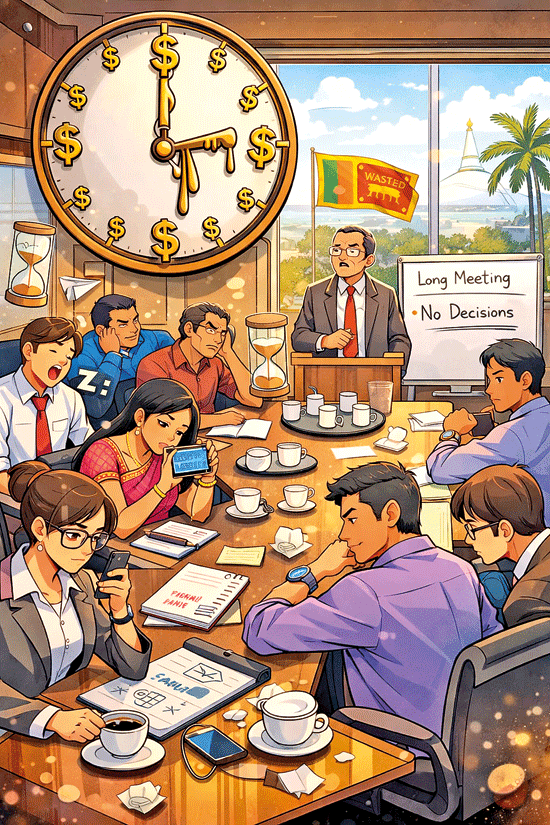
Meetings
Recently, I have participated in a discussion with many public and private sector representatives. The meeting lasted 145 minutes, and in the final 30 minutes, I noticed that many participants were not even looking at the head table, as they felt that enough was enough. In many forums, we have seen this, and the country and people need to consider the time ,money and opportunity cost of meetings.
What Research said
As per the article published by Whillans et al. (2020) indicated that the managers reported 83% of the meetings on their calendars were unproductive. And also some US-based professionals rated meetings as the “number one office productivity killer”. In the same Harvard-published article, Whillans et al. (2020) argued that excessive meetings disrupt employees’ ability to focus, constrain their autonomy, and generate time pressure. These factors collectively heighten stress levels and diminish both employee well-being and productivity. The authors emphasize that addressing meeting overload is crucial to maintaining a healthy, effective work environment. Meeting overload also undermines job satisfaction by limiting time for focused, meaningful work. The article highlights that the problem is not merely the number of meetings, but their poor design, unclear purpose, and lack of decision outcomes. The authors recommend redesigning meeting practices by adopting clearer agendas, reducing frequency, and greater respect for employees’ cognitive and temporal resources.
What we can do
To manage meeting overload, organisations should track a few key indicators. These indicators show how meetings affect daily work. Total meeting time is important. It shows how much of a workday is spent in meetings. For example, if staff spend most mornings in meetings, they have little time left for real work. Attendance is another indicator. Frequent absences mean the meeting may not be essential. Meeting room use highlights efficiency. If a room is booked for an hour but used for only 20 minutes, that is wasted time and space. Focus time is also important. Employees need uninterrupted periods to concentrate. A meeting-free afternoon helps people finish reports. Recurring meetings can reveal bad habits. A weekly meeting without clear outcomes adds little value. The cost of employee time is another factor. Every meeting uses paid work hours. This creates a hidden cost for the organisation. For example, a one-hour meeting with several staff members means many hours are spent without producing direct output. There are practical ways to reduce this. Meeting-free times can be set aside for deep work. For instance, keeping one morning free each week lets staff finish reports or analysis without interruptions. Recurring meetings should be reviewed and reduced. A weekly update meeting can be replaced by a short written update if no decisions are needed. Only essential people should be invited. For example, only decision-makers need to attend planning meetings. Others can get the summary later. Routine updates can be moved to email or online platforms. Project progress can be shared in a short message rather than a long meeting. Clear agendas and defined goals help keep meetings focused. A meeting with a listed purpose and time limit finishes faster and leads to decisions. Short follow-ups, such as brief action notes, ensure accountability without more meetings. Good management of meeting spaces also matters. Releasing unused rooms prevents wasted resources. These practices build a healthier meeting culture. Employees stay focused, use time better, and feel more satisfied at work.
Conclusion
We have witnessed how ineffective meetings can waste valuable time on many occasions. Sometimes, people do not fully appreciate the importance of time, especially in professional settings. During my tenure as Dean of Management at the Faculty Board of the Open University of Sri Lanka, I made addressing this issue a priority. I implemented a policy limiting Faculty Board meetings to 90 minutes. This change helped ensure that discussions remained focused and productive, making better use of everyone’s time. Leadership plays a crucial role in setting the tone for efficient meetings. It is important to work with all stakeholders to create a culture that values time and productivity.
In this nation, we need to think differently and should consider the need for improved, strategic management approaches. Developing and implementing short- to medium- to long-term strategies will benefit organisations across the country. Businesses that conduct purposeful, well-structured meetings gain a competitive advantage. Effective meetings foster better decision-making and enhance overall performance. This can be considered as one of the important Key Performance Indicators (KPI) for any country.
By Professor Nalin Abeysekera
(Professor in Management Studies, Open University of Sri Lanka. You can reach Professor Abeysekera on nalinabeysekera@gmail.com)
HitAd.lk is the best and biggest mobile phone market in Sri Lanka, and we guarantee you will find what you need here from our extensive listing of mobile phones for sale in Sri Lanka. Whether it’s a budget-priced smartphone for communication, or higher end features with advanced connectivity, there are many different options from which to choose from on our site!