


Unlocking the power of youth through education
View(s):
Orlando Edwards, Director, British Council Sri Lanka
We often say that young people are agents of change and our hope for the future. With youth under the age of 30 comprising half of the current global population, and at a time of radical technological transformation, this sentiment has perhaps never rung truer than it does now. If so, it is critical that these young people have a say in the education that prepares them to meet the challenges of the future.
This year, the International Day of Education is fittingly themed ‘the power of youth in co-creating education’. Inviting youth to be co-creators of their education matters because they will inherit a world that is changing as we speak, and their aspirations for this future must be reflected in what they learn so that they may contribute to achieving a more just, peaceful and equitable society.
There is growing recognition that young people are not only learners sitting in classrooms. This was reaffirmed through the ‘Youth Declaration on Transforming Education’ presented as young people’s input at UNESCO’s Transforming Education Summit in 2022. Young people are peers, partners, and educators, actively shaping learning spaces, influencing policy conversations, and contributing to the futures they will inherit.
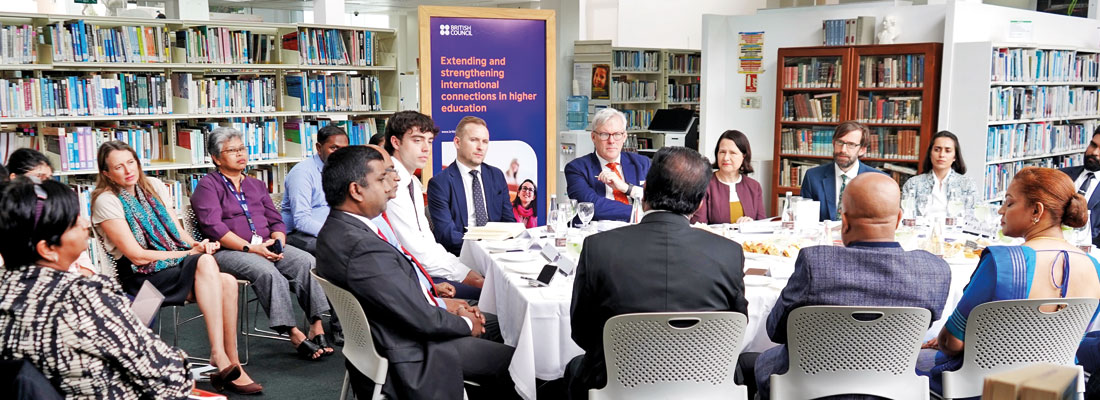
A UK Minister engages with Vice Chancellors on transnational education at the British Council Colombo library
In Sri Lanka, the British Council furthers youth participation through a portfolio of formal and non-formal education programmes reaching students across the island. This week the UK government released its latest International Education Strategy 2026 (https://www.gov.uk/government/publications/the-uks-international-education-strategy-2026 ), in which the role of British Council in collaborating with local partners to bridge the gap is highlighted. Among these priorities is a commitment to bringing internationally recognised UK qualifications closer to home. We support this goal by facilitating education partnerships between universities in Sri Lanka and the UK, creating new cross-border degree programmes known as transnational education (TNE). Enrolments of Sri Lankan students onto these TNE programmes doubled to over 60,000 by 2025 – providing them with an opportunity to obtain a UK degree here in Sri Lanka. We also delivered over 107,000 UK school exams and professional qualifications in Sri Lanka, thereby expanding equitable access to internationally recognised qualifications, strengthening Sri Lanka’s education system and global connectivity. Some of these Sri Lankan school exam test takers obtained top marks in the world!
English language education is the foundation of opportunity for youth, and the British Council’s has been working with the Ministry of Education, Higher Education and Vocational Education to deliver a number of focussed professional development programmes for teachers and students across the country support learning, confidence, and communication skills that extend well beyond exams. By strengthening classroom practice and enhancing participatory learning opportunities, these efforts contribute to long-term system improvement and more equitable access to quality language education. We improve teacher training for English language teachers island-wide: from 2022-25 we reached over 3,000 English teachers; and supported many 1000s more teachers through our 32 Regional English Support Centre (RESC) partners. Thousands of Sri Lankan teachers and teacher educators have accessed professional development resources freely accessible from the https://www.teachingenglish.org.uk website. Innovative new pilots such as NextGen Skills in the Central Province, are equipping school students in remote parts of the province with valuable IT, English and social skills. By centring local needs and focussing on nurturing peer group leaders for impact, this programme empowers both boys and girls to develop essential life and career skills while staying engaged in school.
For students who want to study abroad, the focus has gone beyond promoting access to UK education. By working closely with education agents, aligning with evolving UK visa processes and the UK’s Agent Quality Framework, to strengthening student preparedness and welfare, the British Council has helped reinforce trust, ethical practice, and transparency placing students, not numbers, at the heart of international mobility. Our community of close to 300 certified agents can be found easily on our agents and counsellors website (https://www.britishcouncil.org/education/agents-counsellors/database). These efforts support more informed decision-making and a more geographically inclusive approach, centring youth in the process.
As students return home or graduate from local TNE provision, we also help to build Alumni networks, who play a powerful role in this ecosystem. Since 2004, we estimate there are over 65,000 UK alumni, two thirds of which have graduated from local TNE programmes. This group includes Commonwealth, Women in STEM* and Chevening alumni across Sri Lanka, who are increasingly visible as mentors, role models, and peer educators. By sharing their journeys across diverse professional sectors, they demonstrate the real-world impact of international education and help the next generation imagine what is possible.
We glimpse how youth can truly be co-creators of their educational journey through our non-formal education programmes. This is where we engage wider youth communities on issues that matter today and will matter even more tomorrow: issues like climate change, sustainable development, peace and social cohesion, entrepreneurship and responsible citizenship. The energy and passion that these young participants bring to these programmes is infectious – and it only reinforces our belief in the promise and potential of the next generation.
As teachers are at the centre of this changings landscape, we also understand the importance of inclusivity and that is at the heart of everything we do. For example, The Being a teacher with disabilities: Perspectives, practices and opportunities research we published in 2024 provided valuable insights into the lived experience of English language and other subject teachers with disabilities in national education systems including Sri Lanka.
In marking this year’s International Day of Education, the message from our own experience is clear we can only move forward meaningfully if young people are engaged and invested in what they learn and how they learn. Education systems that exclude youth voices prepare learners more suited for the past. Education shaped in partnership with young people prepares societies for the future.
The writer Orlando Edwards is Country Director at British Council Sri Lanka.
Applications for the latest round of British Council Women in STEM scholarships are open now until the end of April 2026: British Council scholarships for women in STEM | British Council Sri Lanka
HitAd.lk is the best and biggest mobile phone market in Sri Lanka, and we guarantee you will find what you need here from our extensive listing of mobile phones for sale in Sri Lanka. Whether it’s a budget-priced smartphone for communication, or higher end features with advanced connectivity, there are many different options from which to choose from on our site!