

News
SLCOG in battle to halt preventable maternal deaths
View(s):- While lauding Lanka’s low Maternal Mortality Rate, Prof. Rukshan Fernandopulle
- highlights post-partum haemorrhage and self-harm for concerted action
By Kumudini Hettiarachchi
Inducted as the President of the Sri Lanka College of Obstetricians and Gynaecologists (SLCOG) on a Sunday in January, Prof. Rukshan Fernandopulle was ‘walking’ the talk the very next day.
He was not just attending but also contributing at the ‘Stakeholder Meeting on Eliminating Maternal Deaths due to Postpartum Haemorrhage’.
Explaining to the Sunday Times that the meeting was focusing on introducing a collaborative strategy for Sri Lanka, including revised guidelines on Post-partum Haemorrhage (PPH), he said it remained a significant, yet largely preventable, cause of maternal deaths. It is the leading cause of maternal deaths globally and “on and off” in Sri Lanka.
PPH, a life-threatening condition, is severe bleeding after giving birth to a baby. Early detection and treatment can save the mother’s life.
“PPH is preventable, and the World Health Organization (WHO) is in the forefront to ‘eliminate’ it,” reiterated Prof. Fernandopulle, who soon after being inducted as the 40th SLCOG President made clear that it was one of his priorities.
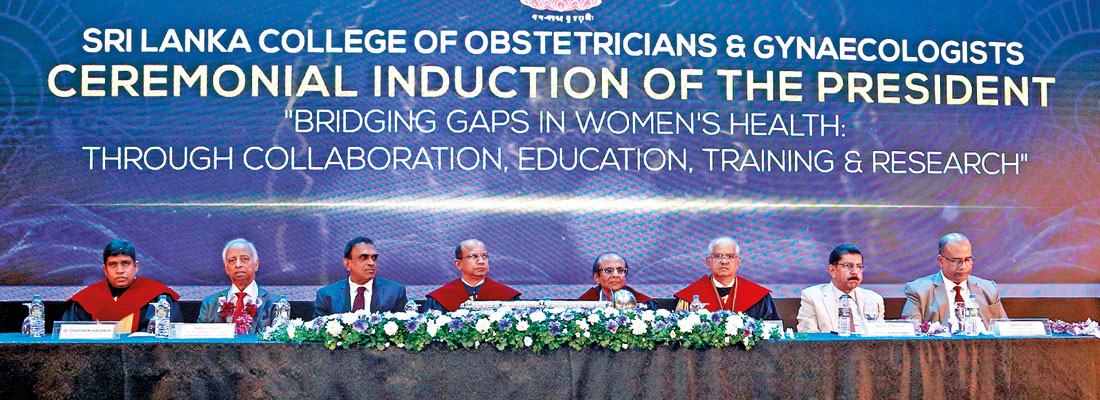
The head table (from the left): SLCOG Secretary Dr Chaminda Hunukumbure; Emeritus Prof. Sir Sabaratnam Arulkumaran; Science and Technology Minister Prof. Chrishantha Abeysena; newly inducted SLCOG President Prof. Rukshan Fernandopulle; SLCOG Patron Dr Jayantha Jayawardena; outgoing SLCOG President Dr Sanath Akmeemana; Health Ministry Secretary Dr Anil Jasinghe; and Supreme Court Judge Justice Yasantha Kodagoda
His battle is also wide-ranging.

Chief Guest Prof. Chrishantha Abeysena
“The SLCOG aims to prioritise PPH; cervical cancer prevention; quality improvement in obstetric care and safe optimisation of caesarean delivery rate; mitigating the impact of non-communicable diseases (NCDs) on maternal health & mental health issues related to pregnancy; subfertility services – Advanced Reproductive Technology (ART) access to the public; care of the ageing female population – healthy post-reproductive living; human resource development and reproductive health research,” underscored Prof. Fernandopulle.
With his theme for the year being ‘Bridging gaps in women’s health: Through collaboration, education, training & research’, he said that Sri Lanka’s Maternal Mortality Rate (MMR) was better than the globally projected figure. The country is on the pathway to achieving an MMR of 20 by 2030.
Lauding the low MMR as the “national pride of health care indices”, he said it is comparable to some high-income countries. Recently released data records the MMR as 24.9 per 100,000 live births. However, the decline in the MMR after 2000 has been slow, pointing towards the need for the maintenance of sustained measures for further appreciable reduction.
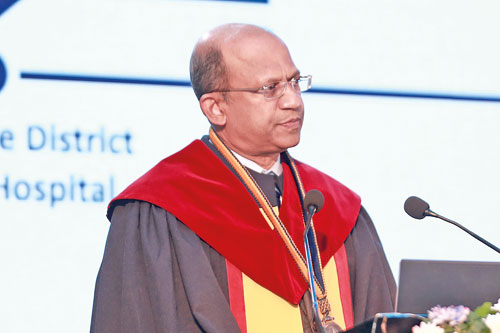
Prof. Rukshan Fernandopulle addressing the gathering
The main causes of MMR change yearly. In 2024 – the most common cause was heart disease; in 2023 – it was PPH; and in 2022 – it was respiratory diseases. Sustained efforts to address overall maternity care to further reduce the death rate are needed, said Prof. Fernandopulle, urging
the necessity for continuous staff training.
The SLCOG is conducting Emergency Obstetrics Training at the Doorstep (EOD) initiative and Safe Motherhood Programmes, he assured, raising a red flag over deaths due to self-harm and suicide. The figures for 2025 had surpassed those for 2024, which underscored the need to further strengthen screening for suicidal tendencies starting from the antenatal period. This is being implemented with the collaboration of the Family Health Bureau (FHB), the Sri Lanka College of Psychiatrists and the SLCOG.
He said, “Strengthening support, counselling services and access to family planning is essential to curtail the unacceptable rise in MMR due to suicides.”
Reiterating that the rise in the proportion of preventable maternal deaths is a concern, he said that the SLCOG’s prime objective is to collaborate with stakeholders to develop guidelines and care bundles, enhance training of staff and rectify deficiencies learnt from the Confidential Enquiry into Maternal Deaths (CEMD).
Some of the other issues raised by the SLCOG President were:
- Perinatal mortality – the stillbirth rate has reached a plateau from 2015 at an average 6.3 stillbirths per 1,000 births. Quality antenatal and intra-partum care improves stillbirth and early neonatal death rates. Preterm births and births following Artificial Reproductive Technology (ART), infections and lethal congenital anomalies contribute largely to perinatal deaths.
- The laws of the land do not permit termination of pregnancies complicated with lethal foetal anomalies. There is also no effective code of practice on ART services, and the unregulated transferring of many embryos results in poor perinatal outcomes. The SLCOG is in constant dialogue with relevant stakeholders to address these pressing issues. The causes leading to perinatal mortality contribute to a further increase in the neonatal mortality rate.
- NCDs among expectant mothers – a study shows that 70% had one or more NCDs. To improve pregnancy outcomes, pre-pregnancy care clinics and intra-partum care packages, which are in the pipeline, will be of benefit.
- n Low proportion of GDP allocated for health – this needs to be rectified to sustain and improve healthcare; otherwise, the system could collapse.
- n Unintended pregnancies contribute to maternal deaths – these become unwanted pregnancies leading to abortion and suicide. As such, the unmet need for family planning too contributes to maternal death.
- n Such unmet needs for family planning were noted in 22% of maternal deaths in 2024. Mothers with obstetric and medical issues are not on effective long-term family planning methods or are using prescribed methods incorrectly.
- Sri Lanka is growing old. Can we build a care system in time? The country runs the risk of becoming old before becoming affordable. The provision of care to the elderly with associated age-related co-morbidities has a major financial impact on low-income countries.
- Cervical cancer ranks as the 2nd most frequent cancer among women in Sri Lanka (crude incidence rate – 12.6 per 100,000). Around 70% are detected at an advanced stage of the disease, with current estimates indicating that every year (2023), 1,407 women are diagnosed with cervical cancer, while 780 die from the disease.
The national screening coverage was around 29.3% (2023), and we are falling short in this sphere as well as delayed detection of cervical carcinoma at more advanced stages bringing about a poor prognosis. The SLCOG and other stakeholders are working on human papillomavirus (HPV) screening and a Colposcopy detection strategy to strengthen the cervical cancer screening programme.
The best way to say that you found the home of your dreams is by finding it on Hitad.lk. We have listings for apartments for sale or rent in Sri Lanka, no matter what locale you're looking for! Whether you live in Colombo, Galle, Kandy, Matara, Jaffna and more - we've got them all!