

News
Focus on brain health and brain drain
View(s):- ASN President on integrated neurology for transformative outcomes
By Kumudini Hettiarachchi
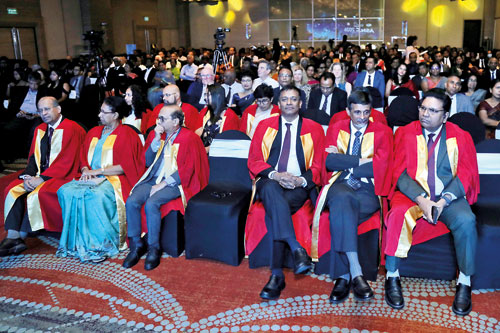
It was not only brain health but also humanity to the fore as the 19th Annual Congress of the Association of Sri Lankan Neurologists (ASN) was inaugurated in Colombo on Friday evening with eminent experts in attendance.
“We gather not only as professionals in the field of neurology, but as a united community committed to advancing brain health, strengthening collaboration and shaping the future of neurological care in Sri Lanka and beyond,” reiterated ASN’s President, Dr Ajantha Keshavaraj, relating a poignant tale.

At the head-table (from the left): ASN Joint Secretary Dr Rukshani Rupasinghe; Orator Dr Sanjaya Fernando; Chief Guest Prof. Neil Robertson, President of the Association of British Neurologists (ABN); ASN President Dr Ajantha Keshavaraj; Guest of Honour Prof. Jeyaraj Pandian, President of the World Stroke Organization; Prof. Ranjanie Gamage, ASN Founder President and first female Neurologist of Sri Lanka; and ASN Joint Secretary Dr T. Thivakaran Pix by M.A. Pushpa Kumara
It was the story of a 28-year-old expectant mother who came to her with a bad headache in the belief that it was severe migraine. An MRI of the brain, however, revealed a glioblastoma – an aggressive brain tumour which needed urgent neurosurgery, chemotherapy and radiotherapy. The multidisciplinary team recommended the termination of the pregnancy, but the patient wanted her baby to survive, and she was willing to undergo any treatment or suffering. She understood that her own survival was unlikely.
“That decision placed the medical team in an emotionally complex situation,” says Dr Keshavaraj, explaining how the patient underwent multiple craniectomies to remove pressure on the brain, chemotherapy, radiotherapy and repeated neuro-imaging. By seven months of pregnancy, she had slipped into a coma.
She says, “I was informed at one point that she was inoperable, severely malnourished and that the foetus had likely died. With a heavy heart, I received her back at the Neurology Ward of the Jaffna Teaching Hospital. We reassessed.”
She was severely malnourished and anaemic. But the ultrasound showed a live foetus, very small for gestational age – fragile, but alive.
The medical and nursing team looked after the mother. She remained in a vegetative state, but the baby showed slight improvement in growth. One morning, her breathing became irregular, her blood pressure dropped and oxygen saturation fell rapidly. An emergency caesarean was performed in the Neurology Ward itself, and a baby boy weighing 800 grams was delivered. He was in respiratory distress, and the neonatal team fought for him. Six months later, he was discharged to his father.
“Ten years later, a boy walked into my clinic with chocolates. He had just passed his Grade 5 Scholarship Examination. I got to know from him that it was his mother’s death anniversary. With tears in my eyes, I blessed him,” says Dr Keshavaraj, stressing that medicine is not only about protocols and survival curves; it is also about courage. About love…about respecting a patient’s choice, even when the odds are overwhelming. That child stands today as a living testament to a mother’s determination and a team’s commitment.
This is the meaning of Integrated Neurology for Transformative Outcomes, according to this neurologist.
The two-day congress ‘ASNAC 2026’ on this theme with its wide and varied coverage concludes today. While the pre-congress workshops were on February 26 and 27, the post-congress workshops are scheduled for March 2 and 3.
Before delving into the brain drain of neurologists, the “highest” among medical specialists in Sri Lanka, and the objectives of the congress, Dr Keshavaraj gave a brief glimpse of her journey into this arena.
“Choosing neurology was not accidental. It was driven by deep interest,” she said, elaborating how during her MBBS short case, she confidently diagnosed Bell’s Palsy, only to be gently shown skin lesions by Physician Dr S. Anantharajah, revealing Ramsay Hunt Syndrome.
While that moment reshaped her vigilance, it was an eye-opener in her clinical journey. As an intern medical officer in a busy medical casualty ward at the National Hospital of Sri Lanka (NHSL), she had come across a 14-year-old presenting with intractable headache, hypertension and skin rashes on both hands.
“An immediate brain CT confirmed PRES Syndrome (Posterior Reversible Encephalopathy Syndrome – a rare, usually reversible, neurological condition). Reaching this diagnosis within four hours earned Dr Sarath Gamini De Silva, my Consultant Physician’s appreciation and further strengthened my commitment to neurology,” she says.
Moving onto brain drain, Dr Keshavaraj said that over the last 19 years, ASN has grown to 81 Life Members, with 61 (78%) serving locally. Of the 91 Associate Members, only 38 remain in Sri Lanka, creating the highest rate of brain drain of neurologists.
“Compared to other specialities, neurologists face the highest rate of brain drain, with the contributory factors including inadequate infrastructure, heavy clinical workloads and perhaps significantly more attractive professional prospects abroad,” she said, extending her appreciation to all Life and Associate Members who continue to serve Sri Lanka.
With regard to the theme of ‘Integrated Neurology for Transformative Outcomes’, she explained that it reflects a holistic approach to neurology, fostering collaboration with local and global partners and embracing innovation to achieve better patient outcomes.
To achieve this theme, the ASN has identified two general objectives and three specific objectives. The general objectives are: to uphold the highest standards in neurological care; and to foster continuous learning and scientific innovation through education and research.
The specific objectives are: to lead the development of neurology in Sri Lanka by strengthening neurological services, to guide the Health Ministry on neurological matters through policy advice, and to build partnerships that promote holistic, patient-centred care through multidisciplinary collaboration. Dr Keshavaraj hoped that ASNAC 2026 will stand as a “remarkable” milestone in advancing neurological excellence.
| Drug-Resistant Epilepsy Management – an impossible dream now a clinical reality The evolution of paediatric epilepsy surgery in Sri Lanka marks a transformative era in managing Drug Resistant Epilepsy (DRE), which affects 15% of children with epilepsy and remains impervious to standard medications, said Consultant Paediatric Neurologist Dr Sanjaya Fernando. Dr Fernando, attached to the Lady Ridgeway Hospital (LRH) for Children and the National Epilepsy Centre (NEC) of Sri Lanka, was delivering the Dr J.B. Peiris Oration titled ‘The Art of the Possible: The Sri Lankan Odyssey in Paediatric Epilepsy Surgery’. Dr Peiris is considered a pioneer of neurology in Sri Lanka. He founded the Institute of Neurology at the NHSL in 1984. Here are excerpts of Dr Fernando’s oration: “When drugs fail, the resulting ‘seizure burden’ triggers cognitive decline, psychosocial instability and an elevated risk of sudden unexpected death (SUDEP). Because these seizures occur during critical neuro-developmental windows, the stakes are exceptionally high; persistent electrical interference can lead to irreversible intellectual impairment. Local research underscores this urgency, linking high epilepsy severity directly to increased school dropout rates, necessitating definitive surgical solutions to protect the developing brain. “A comprehensive clinical audit of the first 50 paediatric surgical cases at the NEC since 2020 demonstrates the success of this specialised intervention. The programme has achieved remarkable inclusivity, treating children from 16 of the 25 districts across Sri Lanka and proving that geographic barriers can be overcome through a centralised centre of excellence. “Outcomes are compelling: 88% of patients achieved favourable results, and 74% reached Engel Class Ia status – complete seizure freedom. This success also reduces the physiological toll of polytherapy, with the average daily medication count dropping from nearly three to fewer than two post-surgery. “A pivotal insight from the NEC is the importance of the ‘Surgical Treatment Gap’ – the time between the onset of drug resistance and surgery. Data reveal a stark reality: children who achieved total seizure freedom had a median gap of 16.5 months, while those with unfavourable outcomes waited an average of 55 months. This reinforces the maxim that ‘delay is destiny’. Every month lost to ineffective medication subjects the brain to cumulative trauma, arguing that surgery should be a standard of care early in disease progression rather than a final resort. “The second phase, ‘The Art of the Possible’, addresses the challenge of practising high-tech medicine in a resource-limited setting. While Western centres rely on expensive PET scans and invasive monitoring, the Sri Lankan team used local ingenuity to develop cost-effective alternatives. By pioneering Multimodal Imaging Integration (MMII), they created a ‘mathematical roadmap’ for surgeons. This approach utilises two primary pillars: EEG-MRI co-registration and Arterial Spin Labelling (ASL) perfusion MRI quantification, both built upon open-source software and collaborative technical expertise. “The EEG-MRI co-registration paradigm solves the ‘Inverse Problem’ of electrophysiology by fusing a child’s electrical activity with their 3D anatomical MRI. This allows clinicians to visualise exactly where the ‘electrical storm’ originates. Complementing this, the ASL perfusion technique offers a non-invasive way to measure cerebral blood flow. By identifying ‘hypoperfusion’ – regions where brain metabolism is abnormally low – surgeons can pinpoint epileptogenic zones that appear normal on standard MRIs. “These innovations make precision surgery accessible without prohibitive capital investment. The real-world impact of these innovations is seen in challenging ‘MRI-negative’ cases. Through MMII, the team identified a seizure focus in the right superior frontal gyrus of a 13-year-old boy, leading to successful resection and total seizure freedom. “The programme’s audacity was demonstrated by performing complex surgery on a 31-day-old neonate with hemimegalencephaly. Such cases represent the pinnacle of neurosurgical coordination, proving that the most vulnerable patients can be saved through high-level skill and innovative technological adaptation. “To remain patient-centric, the team introduced the Parent-Reported Experience and Satisfaction Questionnaire (PESS-Q). This metric captures the lived reality of families, showing a 77.3% satisfaction rate that mirrors clinical success. By valuing parental feedback, the NEC acknowledges that the goal of surgery is not just the cessation of electrical discharges, but the restoration of a normal childhood. When a child returns to school and a family is freed from constant anxiety, the true value of the ‘Art of the Possible’ is realised. “Therefore, the Sri Lankan odyssey in paediatric epilepsy surgery serves as a global blueprint for medical advancement in developing nations. It demonstrates that excellence results from the strategic application of ingenuity and clinical courage rather than unlimited resources. “By shortening the surgical treatment gap and embracing biomedical integration, the NEC has turned a once-impossible dream into a clinical reality. The journey continues with a mandate to ensure no child in Sri Lanka is left in the shadows of DRE.”
| |
The best way to say that you found the home of your dreams is by finding it on Hitad.lk. We have listings for apartments for sale or rent in Sri Lanka, no matter what locale you're looking for! Whether you live in Colombo, Galle, Kandy, Matara, Jaffna and more - we've got them all!