

News
Deficient marketing, regulation cited over lower tourist spend
View(s):By Wasantha Ramanayake
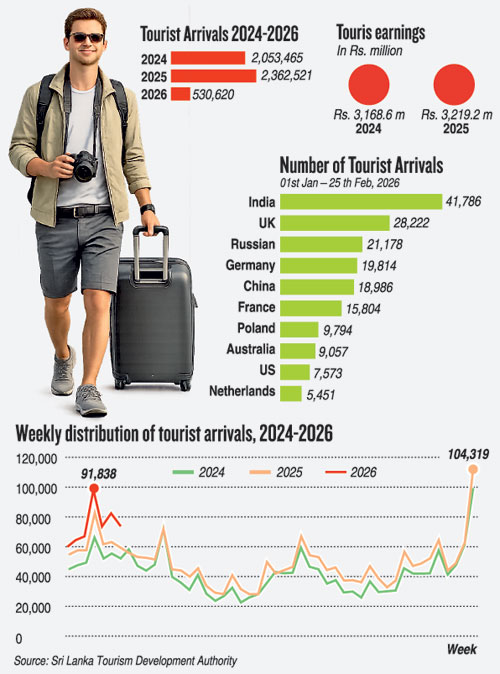
Sri Lanka’s tourism sector saw tourist arrivals rise in 2025, but average spending per tourist dropped, according to official data released by the Central Bank of Sri Lanka. This dilemma demands scrutiny of marketing strategies, strengthening regulatory mechanisms and introducing new products while ensuring sustainability, experts say.
Tourist arrivals increased to more than 2.3 million in 2025 from 2.05m in 2024, reflecting a year-on-year growth of 15.1%. However, total tourism earnings only increased marginally to US$3.219 billion in 2025, compared with US$3.168bn the previous year—an increase of just 1.6%.

Lower tourist spending stems from more low spending tourists and short stays
Spending per visitor dropped from US$171 to US$148 per day.
Contributory factors such as exchange rate volatility and the global economy, decreased tourist spending per day worsening the gap, said Professor Suranga de Silva of the Colombo University.
According to Deputy Tourism minister Prof. Ruwan Ranasinghe, the tourism industry should move from quantity to quality.
He said that the initial target of increasing tourist numbers, which was the government’s top priority, has been achieved.
However, the task of converting the numbers to quality and value is being addressed which requires amending the tourism law strengthening law enforcement, he told the International Tourist Guide Day celebrations in Colombo on 21 February.
Yet enforcing the tourism regulation falters in the face of the pressure from the industry. Some big players seek short term profits, the national Tourist Guide Lecturers claim. They said the Sri Lanka Tourism Development Authority (SLTDA) chairperson told the media that in terms of the undertaking given to the Supreme Court in a fundamental rights petition that SLTDA started cracking down on the illegal tourist guides and establishments.
Weeks later, they said the Police Tourist Division Director had told media that the tourist police no longer do random checks at tourist sites such as Sigiriya, due to pressure from the industry.
SLTDA sources said they are unaware that random checks had been stopped but promised to look into it.
Lower tourist spending stems from more low spending tourists and short stays coupled with economic pressures and competition from Thailand and Vietnam, says Professor Suranga de Silva. The Ditwah cyclone negatively impacted the tourism income despite the strong tourism rebound.
According to opposition legislator Dr. Harsha de Silva, domestic issues such as tourism leakages due to unauthorised foreign tourism business operations too, aggravated the situation, as reported in the media.
He said lapses in the regulatory mechanism allows foreigners on tourist visas to operate tourism businesses, such as travel agents, and transport and accommodation providers.
Russian-speaking national guide lecturers says if there is no marketing, the lucrative Russian market could be lost.
Russian tourists spend an average of US$200 only second to the daily average spending of British tourists. The average stay of the Russian tourists is 10 days versus five days for Indian tourists, they said.
In 2024, there had been 31,000 Russians and the numbers increased to 34,000 in 2025, but only 22,300 came in last January which is a 35% drop, a significant and alarming drop. Vietnam had recorded a three-fold increase of Russians to 125,000 in January, 2026, they said.
“We could have secured 25% of those tourists. Many Russian charter flights we had in Mattala last year now fly to Vietnam and Thailand. If we fail to promote the country in Russia we will not only lose them but also tourists from elsewhere, Kazakhstan, Azerbaijan, Belarus and Armenia.”
They said most Russian tourists are flown in by large destination management companies and their spending comes in to the country through the companies, with minimum leakages. They sought the services of large Russian tour operators such as Anex, Funsun, Bibilio Globus etc, who took a record number of Russian tourists to Thailand and Vietnam. These companies brought in a record number of tourists from Russia last year.
| Inaction tests regulator’s credibility On 22 July 2025, the Sri Lanka Tourism Development Authority (SLTDA) gave an undertaking before the Supreme Court of Sri Lanka (SC/FR/63/2023) to recruit and operationalise a special enforcement unit within three months to act against unregistered, unlicensed tour guides and operators. The commitment was clear: existing law would be enforced. Months later, despite public assurances — including statements reported in the Sunday Times by the current chairman— the unit has yet to be fully activated. Meanwhile, unauthorised operators continue to function openly, disadvantageous to licensed tour guides and compliant businesses during peak tourist season. The explanation offered — that consultations on a proposed new Tourism Act are ongoing — cannot justify inaction. Existing legislation remains binding until amended by Parliament; regulatory enforcement does not pause pending legislative reform. More concerning are recent indications that representations have been made suggesting that relaxed enforcement could stimulate short-term foreign exchange earnings. Economic growth is vital. But selective or deferred enforcement in pursuit of revenue risks undermining regulatory certainty and eroding confidence among lawful operators. A level playing field is not anti-business; it is pro-investment. Responsible businesses depend on predictable rules applied consistently and without influence. If commitments made before the Supreme Court are not honoured in practice, institutional credibility is inevitably called into question. The operationalisation of the enforcement unit is therefore more than an administrative step — it is a test of regulatory integrity. Enforcement must be independent, evidence-based, and insulated from lobbying or pressure. The lack of strict enforcement and adherence to minimum standards by the authorities allows unqualified individuals to operate, leading to misinformation, mismanagement of tourists expectations and ripping them off, and negative travel reviews. Whereas enforcement and the insistence on minimum standards among licensed service providers in tourism not only improves the quality of experiences and services but also boosts tourism revenue by attracting high-end spenders seeking exceptional offerings. The rule of law is not an obstacle to tourism growth; it is its foundation. — Akthar Mohamed, national
| |
The best way to say that you found the home of your dreams is by finding it on Hitad.lk. We have listings for apartments for sale or rent in Sri Lanka, no matter what locale you're looking for! Whether you live in Colombo, Galle, Kandy, Matara, Jaffna and more - we've got them all!