

News
Strainers in canals block plastic waste from polluting sea
View(s):By Sajeniya Sathanandan
The Ocean Strainer™ project, a national initiative to combat marine plastic pollution through upstream intervention, was launched on February 18 with the installation of the 100th unit at the Wellawatte Canal near Havelock City.
Beyond just catching waste, the initiative aims to change human behaviour. The goal is to make people understand that throwing waste into waterways is not fair—and to stop pollution at the source.
The initiative is led by the MAS Foundation, and individual strainers are often sponsored by private partners. The 100th symbolic unit was sponsored by a division of MAS itself.
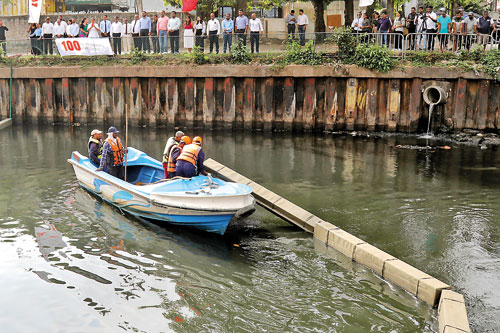
Catching plastic waste: A strainer being installed across the Wellawatte canal
A single strainer unit costs about Rs 1.2 million, which covers materials, monitoring, evaluation, and administrative costs.
The barrier is a simple technology designed to float on the surface. It is low enough to block floating debris like plastic and foam but allows the natural ecosystem flora and fauna to flow underneath.
Beyond just capturing waste, the system assists in the collection and proper segregation of materials, plastic, paper, and foam for proper disposal.
These units are now strategically placed across seven districts, including Colombo, Kalutara, Gampaha, Trincomalee, Puttalam, Matara, and Galle.
High concentrations of these units are found in areas like the Metro Colombo Wetland: 16 units; Bolgoda Lake-Weras Lake: 12 units; and the Kolonnawa Wetland: 9 units.
The project was first piloted in August 2020 at the Dehiwala Canal, where it collected over 67,000 kilos of waste in its first year.
The Sunday Times learns that collectively the 100 strainers prevent about 2.7 million kilograms of floating waste from reaching the ocean annually.
Also, across all the strainers on the island, closer to 7.1 million kilograms of waste have so far been prevented from going into the sea. At specific high-flow sites like the Wellawatte Canal, the system collects about 1.5 tractor loads of waste per day.
Research indicates that 9 million kilos of plastic waste enter the Indian Ocean via Sri Lankan waterways annually.
Analysis shows that 35-40 per cent of intercepted waste consists of plastic and polythene.
After segregation, recyclables are sent to partners, while non-recyclables are directed toward energy recovery.
This project uses the JICA standardised methodology to measure waste and the OSPAR Commission Marine Litter Monitoring Tool to analyse and classify.
Many canals flow through shanty areas where residents do not have the space or knowledge to segregate waste.
Peripheral or minor canals in areas like Kolonnawa are often stagnant due to waste because the SLLDC cannot access them with their equipment, a situation worsened by Cyclone Ditwah.
Also, university interns play a role in monitoring and evaluation. They assist the MAS Foundation by doing random household surveys, which help them to gain a better understanding of the specific questions and waste management issues faced by residents living in shanties along the canals. For instance, the data showed that these residents often lack the physical space to segregate waste.
The Sri Lanka Land Development Corporation is the main body responsible for maintaining the canals and daily cleaning. Their contribution to the project is providing access to the waterways, allowing the project team to use canals, rivers, and tributaries for the installation of strainers. While the project partners are responsible for building the strainers, this organisation facilitates the process by designating floating water body locations where these devices can be used, SLLDC Chairman Saman S. Senaweera said.
He also said strainers are designed to trap floating plastics and debris on the water’s surface rather than waste that has sunk to the bottom. By stopping the trash at these points, the system saves the downstream sections of the water system from further pollution. Once the waste is collected by boats, it is transported to a facility in Kerawalapitiya for disposal.
The Central Environmental Authority (CEA) provides approvals for installations and is involved in policy advocacy and lobbying.
The best way to say that you found the home of your dreams is by finding it on Hitad.lk. We have listings for apartments for sale or rent in Sri Lanka, no matter what locale you're looking for! Whether you live in Colombo, Galle, Kandy, Matara, Jaffna and more - we've got them all!