

News
D.R. Wijewardene: The man and the mission
View(s):Impressions of a 15-year association
Tomorrow marks the 140th birth anniversary of D.R. Wijewardene, the much respected press baron who founded the Associated Newspapers of Ceylon Limited and played a key role in Sri Lanka’s independence movement. To commemorate the occasion, we are reproducing the following article.
By E.E.C. Abayasekara
My first encounter with D.R. Wijewardene left a deep impression on me of the man himself, an impression which even the many subsequent much closer encounters in the work-loaded, pressure-packed fifteen years during which I worked for him did in no way diminish; the impression was of a man essentially simple and straightforward, and also possessed of an understanding nature.
The encounter was in 1934 when, being interviewed by him for a junior clerical post at Lake House, I had questions to ask of him myself, which, with the directness and brashness of a 19-year-old, I did.
Will I have opportunities for advancement?” – “Yes.” “How far can I go?” – “Well, that will depend on you; you can rise to be manager.
“And what is the manager’s salary?” “Rs. 750.”
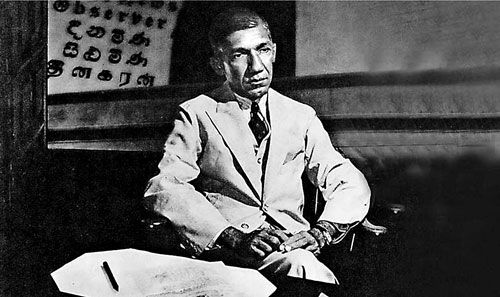
D.R. Wijewardene: A life defined by simplicity and straightforwardness
Direct replies, but their significance lay in the manner in which they were given: quite simply and straightforwardly, as man to man, not savouring of an employer-employee relationship.
Within days of my taking my seat at an office desk at Lake House, it was brought home to me convincingly that the almost quiet man who had spoken to me so simply was the powerhouse, in many senses, of the powerful institution he had founded and over which he presided.
That same simplicity and straightforwardness were, I was later to find, basic to the man and were characteristics he also looked for and valued in others.
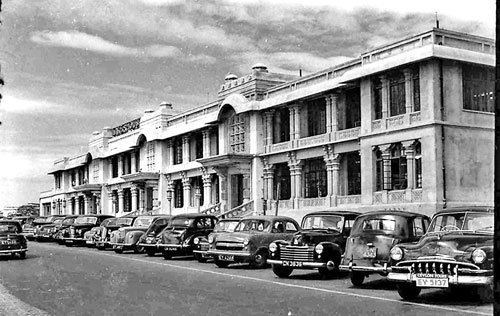
Lake House: Landmark institution built by D.R. Wijewardene to promote independent journalism in Sri Lanka. Pic courtesy lakhouse.lk
Writing of him in 1960, his biographer, H.A.J. Hulugalle, reputed for his balance, fairness and good judgement, said: “It is probably correct to say that no Ceylonese during the present century exercised a more pervasive influence than he did.”
How then, it may be asked, were there so few in the country who were aware when he died, of who D.R. Wijewardene was and what he had done; not only of his outstanding contribution towards the attainment of political independence but also, through his newspapers, of the spreading of education, the stimulation of political and social consciousness, and a greater awareness of our national cultural heritage?
The answer is, I think, to be found in what must seem a deliberate self-effacing policy he adopted, the studied avoidance of personal publicity; not only because he happened to be a naturally shy man, but mostly because, I am sure, he was persuaded that, where great causes were concerned – independence, press freedom, the public interest – persons should always be subordinate, publicity-wise, to the causes they espoused.
As a leading newspaper proprietor by any standards in the then newspaper world, he was very much in the centre of things in newspaper councils of his day, and thus in demand to propose or respond to toasts and the like at such gatherings abroad, something he was most averse to accepting, unless it was necessary to.
In a letter to Herbert Hulugalle in 1937, he refers to one such occasion. He wrote: “I am strongly hesitant, but they are insistent; I haven’t given my final word… If I agree in a weak moment, it will simply be for the greater glory of Lake House; Reuter might send a cable about the dinner, and if my name is there, make a judicious splash for the sake of the newspapers. No photograph.”
True, circumstances, styles and conventions in these matters have changed with the years, but the principle behind Wijewardene’s approach to propaganda for causes and personalities is clear enough and points to certain basic moral values which can be lost sight of.
In the complex task he applied himself to of organising and coordinating the forces in the country which had their sights on self-government, and later, in building up from scratch and, undoubtedly, against great odds, an extraordinarily large newspaper organisation, Wijewardene must have inevitably been confronted with as large a body of problems and crises as anyone.
It is a matter of history that he surmounted these. That some of those who came in touch with him towards the latter years of his life, when new complexities had developed and age was catching up on him, saw at times only an impatience and querulousness in his approach to situations would be natural, but this was by no means his normal reaction.
In fact, times of stress and difficulty, I observed, seemed to stimulate some inner resource in him, and I have seen him almost looking forward to grappling with difficulties he was anticipating.
In the 1915 riots, he had, as an officer in the volunteer service, and at one time as a suspect of the military authorities, cause enough for anxiety and concern.
In letters he had written at the time to his fiancée, couched in simple, unaffected terms, his biographer found evidence of “a simple and sincere character even in the midst of civil turmoil and personal emotion”.
Whilst his perfectionist tendencies were by no means matched by as expansive a patience in day-to-day matters, he never seemed in times of real crisis to lose his cool.
Whenever he had occasion to have a strong letter prepared, and one which he suspected might have been influenced more by emotion than reason, he had a practice of laying it by to be looked at afresh after 24 hours in a more settled perspective.
One occasion I still remember because it struck me as extraordinary at the time was when Wijewardene was to be summoned before the Select Committee of the State Council on a charge of breach of privilege, and it was known that an attempt was to be made to humiliate him.
He was normally not given to genial smiles when it came to getting on with the work. But that morning I found that the usual look of concentration had given way to a smile, with a hint of mischief in it. Rolling up his sleeve – an unconscious mannerism of his when he was impatient to get his teeth into something in earnest – he remarked, “This is going to be fun. I am waiting to give it to them.”
However, we were denied this bit of fun, as the inquiry fizzled out. Seeing that the issue which led to the charge had something to do with his ongoing battle for freedom of the press, a cause always close to his heart, I could understand he was spoiling for a fight, and threats could in no way daunt him.
The impression that Wijewardene was a heartless man who set work and efficiency above all else seems to have gained ground, apparently through stories passed around by word of mouth. Certainly he did set high standards of work, application to work and efficiency, and he was by no means tolerant of negligence and carelessness, nor was he inclined to suffer fools gladly.
It has to be said, though, that such attitudes are not uncommon to perfectionists, and he was in fact a supreme example of that breed.
On the other hand, he was, by and large, a fair employer and, when the business prospered, a generous one, especially perhaps to those who worked well for his organisation.
Provident Fund and employee share schemes were initiated by him many years in advance of most businesses.
It is also to be borne in mind that, being the man he was, Wijewardene was not the one to publicise his acts of kindness and consideration, whether done in the office or outside.
A young man who was noticeably underweight found one day that the “Boss”, as the Managing Director was called among the staff, had arranged for him to have a glass of milk daily in the afternoons, this being brought in the “Boss’s” car when he came in about 3 p.m.
I know because I happened to be that young man. When he came to know that I had planned to go upcountry on my annual holiday, he quietly slipped me a generous cheque, mentioning it could be used for warm clothes, which he knew I would need.
Always the gentleman, he did so without the least hint of patronage, so one sensed it did come from the heart.
I am sure there were others who would have experienced similar gestures of kindness, not necessarily in money.
In Wijewardene’s philosophy, work and play did not mix; each had its role and place. Thus, if he gave short shrift to those he was satisfied had been guilty of lapses or negligence, he also gave every encouragement to those who displayed an intelligent interest in their work or showed any initiative.
It was extraordinary how amidst all his responsibilities and work—from giving his mind to questions of public interest to all the multifarious activities involved in running a newspaper organisation—he still found the time to enquire into the progress of and to help even junior staffers in different departments in various ways, suggesting ideas for short articles, lending magazines, and drawing them out in conversation.
How he managed to do all this from memory, for he had no system of keeping notes, always amazed me. Equally surprising was how he managed to ferret out information about problems some of the staff he was particularly concerned about were up against in order to give thought to what might be done for them.
(Extracted from an article published in the Daily News on February 22, 1986. The writer served as the secretary to the board of directors at the Associated Newspapers Ceylon Limited-Lake House)
The best way to say that you found the home of your dreams is by finding it on Hitad.lk. We have listings for apartments for sale or rent in Sri Lanka, no matter what locale you're looking for! Whether you live in Colombo, Galle, Kandy, Matara, Jaffna and more - we've got them all!