

News
Spotlight on the surrogate mother
View(s):- Justice Yasantha Kodagoda on need to regulate Assisted Reproductive Health
By Kumudini Hettiarachchi
The dire predicament of the surrogate mother and the urgent need for a strong regulatory framework covering Assisted Reproductive Health, was the clarion call from a Supreme Court Judge to an eminent gathering of Obstetricians and Gynaecologists last Sunday in Colombo.
“As a stepping stone towards a recommendation being made to the Government for the promulgation of a comprehensive legal regulatory framework relating to the delivery of reproductive health services including surrogacy, I suggest that the Sri Lanka College of Obstetricians and Gynaecologists (SLCOG) might consider initiating an inclusive dialogue both within the college and outside with other stakeholders,” urged Justice Yasantha Kodagoda.
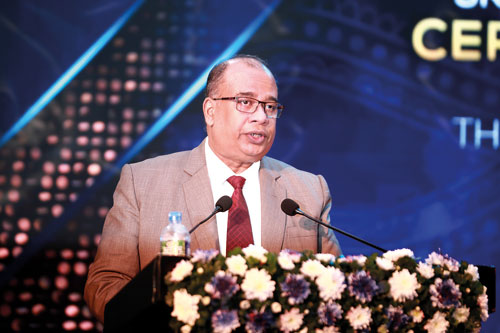
Justice Yasantha Kodagoda
Surrogacy is an arrangement where a woman carries and delivers a child for another couple or individual.
Addressing the induction ceremony of Prof. Rukshan Fernandopulle as the 40th President of the SLCOG, Justice Kodagoda who was a Special Guest said that such a dialogue can be initially aimed at developing an ethical framework to regulate the provisions of reproductive health services. Currently in Sri Lanka, there is no specialized regulatory framework which governs the delivery of reproductive health services including fertility treatment.
He said: “While from one perspective the absence of such regulation and associated controls have supported the development of the super-specialisation of fertility treatment through freedom to experiment and apply technology and engage in innovation, we have also witnessed the downside of such total freedom to do as you choose.
“There is room to believe that where there is no regulation either through enforceable professional ethics or a voluntary code of conduct, and when the law of the land is silent, there is room for unfairness, abuse, exploitation, inequity, injustice and inappropriate commercialization. In fact, some investigators would argue that the prevailing situation enables such social lesions to loom at large.”
Focusing specifically on surrogate pregnancies from among the range of fertility treatment available in the country, he took up a recent doctoral thesis of Danushika Abeyrathne of the Faculty of Law, University of Colombo, on ‘A rights-based examination of the status of surrogate mothers’. Justice Kodagoda had examined her PhD thesis.
Keeping in mind the evidence that had been collected by that researcher, he said the core finding highlighted the vulnerabilities of surrogate mothers. These vulnerabilities, particularly emanated from the legal lacuna regulating ‘agreements’ entered into between the parties to surrogate fertility arrangements.
The researcher had documented multiple instances where surrogate mothers had been left abandoned with the pregnancy or the newborn. That predicament of the surrogate mother had either been because the donor mother and father or one of them, had changed their mind mid-way during the pregnancy or due to their having realized that the foetus was affected by a genetic abnormality or merely because they disliked the newborn’s appearance.
“In such situations, several surrogate mothers who almost always had come from impoverished backgrounds and had engaged in the undertaking of surrogacy in the darkness of abuse or exploitation or due to other reasons which had already led to their being marginalized and stricken by poverty, had been left stranded in a worse situation than they were before the undertaking of surrogacy,” said Justice Kodagoda.
He went onto say that in almost all surrogate arrangements examined by the researcher, parties had entered into written agreements which “purportedly” provided for the protection of the rights of the surrogate mother, rights of the donors and to the entitlements of those who commissioned the surrogate arrangement. Such agreements had been drafted by lawyers and executed in their presence.
“At the commencement of the surrogacy arrangement and during the initial phase of the pregnancy, the surrogate mother had been well-looked after and financial commitments of those who had commissioned the surrogacy had been fulfilled. However, in some instances, when the relationship between the parties had run foul due to a reason that I have already referred, the agreement had been breached. In such instances, surrogate mothers had found themselves vulnerable and helpless and were traumatized,” he said.
Underscoring that for the victimized surrogate mother, legal enforcement of the breached contract had become almost impossible, he said that the situation had got complicated because there were doubts among legal professionals.
He explained that these doubts were on whether such an ‘agreement’ was valid and enforceable in the eyes of the law and whether courts had the jurisdiction to enforce a breached surrogacy agreement. This is because such contracts are not regulated by law and contain some amount of either false information or ambiguous clauses. To compound matters, these agreements have been entered into in utmost secrecy.
Due to these reasons as well as challenges in accessing justice delivery services, the researcher had not come across a single case in which a stranded surrogate mother had been successful in suing the donors for breach of agreement and obtaining compensation.
“I have also not come across such a case. Therefore, the solution most surrogate mothers had found was to suffer in silence with a heavy burden on their shoulders. To compound matters further, in some such instances, the surrogate mother had even found it difficult to give the newborn child for adoption,” said Justice Kodagoda.
Pointing out that the livelihood, dignity, social standing and rights of such women must be protected, he said: “We must bear in mind that surrogate mothers are not mere vessels in which a foetus grows and childbirth takes place. A surrogate mother cannot be treated as a subject matter of a commercial agreement. Surrogate mothers are human beings who should not be abused or left vulnerable for further abuse. They are human beings who need protection. A surrogate mother is a person who has the right to dignity and the entitlement to enjoy fundamental rights vested in all citizens.”
Justice Kodagoda argued that fertility treatment is not merely a medical matter augmented by advanced technology and specialized skills. It is a specialised medical process of wider societal concern and an area of medical science that warrants appropriate regulation.
Moving onto other situations arising from the wide range of fertility treatment methods which also warrant careful attention, he said the pertinent questions are: Whether sperm, ova and embryos may be purchased or sold; how unused embryos should be dealt with; and what legal obligations should govern sperm and ovum banks.
“We must also consider whether there should be legal limits on the number of fertilisations using the sperms of a single individual and what rights a child, born through donor sperm and/or ova, has to ascertain his/her genetic identity. We need to also agree on who should be entitled to provide reproductive health services and under what conditions such services may be delivered. We must also find answers to the issue of commercialisation of the delivery of reproductive health technologies,” he said.
Pointing out that these are only “some” of the many issues that require serious deliberation, Justice Kodagoda suggested that reproductive health services must be regulated, ideally by law.
“We in the legal profession are bent on prescribing laws as a solution to whatever that ails society and as a remedy for harmful, weak or inappropriate human conduct such as conduct which is contrary to national and public interest and conduct motivated only by financial gain. We like to be governed by rules, as opposed to either the dictates or the whims and fancies of the powerful or the influential. We often say that when laws are absent or silent, injustice speaks loudest and the poor and weak suffer the most,” he added.
Earlier, he acknowledged that Obstetricians and Gynaecologists who have specialized in reproductive health including fertility treatment have supported the aspirations of couples to have children and experience the miracle of childbirth.
Among those present at the induction were Science and Technology Minister Prof. Chrishantha Abeysena; Health Ministry Secretary Dr. Anil Jasinghe; internationally-acclaimed Emeritus Professor Sir Sabaratnam Arulkumaran; SLCOG Patron Dr. Jayantha Jayawardena and outgoing SLCOG President Dr. Sanath Akmeemana.
The best way to say that you found the home of your dreams is by finding it on Hitad.lk. We have listings for apartments for sale or rent in Sri Lanka, no matter what locale you're looking for! Whether you live in Colombo, Galle, Kandy, Matara, Jaffna and more - we've got them all!