


The outcome of the Sri Lankan Education System: Quality or Quantity?
View(s):Sri Lanka is currently engaged in discussions on long-overdue educational reforms, which is indeed a positive and much-needed development. Education reform must focus not only on curricula and examinations, but also on the well-being of students—both physically and mentally.

At the same time, we are a nation navigating an economic crisis, with countless hardships faced by ordinary people. Yet, as I observe the situation, many of these visible challenges are merely “symptoms” of a deeper, systemic issue. Among those root causes lies our education system, which has for years emphasized rote learning and academic competition at the expense of creativity, critical thinking, and student welfare.” As we know, with the blessings of “free education” by Dr. Kannanagara,
Sri Lanka has advanced in education in the past. You can explain this with a better literacy rate as one indicator. Unfortunately, the education system has not changed for years, aligning with the requirements of society. I have seen certain experts discuss different best practices in education in countries such as Sweden in many forums in Sri Lanka, but no real impact on the system itself. We have witnessed many negative outcomes (in terms of deteriorating the quality of people in society, ranking of education in Sri Lanka) by questioning the “quality of education in Sri Lanka.” In this article, I am going to discuss one facet of this “real problem” and which is related to the “size of the school bag,” which I consider part and parcel of this problem.
In Sri Lanka, it is not uncommon to see a child weighing around 25 kilograms carrying a schoolbag that weighs nearly 10 kilograms. This image alone speaks volumes about the crisis in our education system. For students in grades six to ten, managing nearly ten subjects a day has become the norm—raising serious questions about whether our education policymakers have truly acted in the best interest of the next generation. (This is a broader issue that deserves a detailed discussion in a separate article.).
In India, the Ministry of Education (formerly the Ministry of Human Resource Development) introduced a School Bag Policy that prescribes clear weight limits for students at different grade levels. According to these recommendations, school bags for students in Classes 1 and 2 should not exceed 1.5 kilograms, those in Classes 3 to 5 should weigh between 2 to 3 kilograms, and for Classes 6 and 7, the limit is 4 kilograms. Similarly, students in Classes 8 and 9 should not carry more than 4.5 kilograms, while the bag of a Class 10 student should not exceed 5 kilograms.These guidelines have been adopted and implemented by several Indian states,reflecting growing national concern over the health risks posed by heavy school bags.
A similar move has been seen in Peshawar, Pakistan, where the Elementary and Secondary Education Department has ruled that a student’s school bag should not exceed 15 percent of the child’s body weight. The initiative aims to prevent long-term physical strain among school-aged children.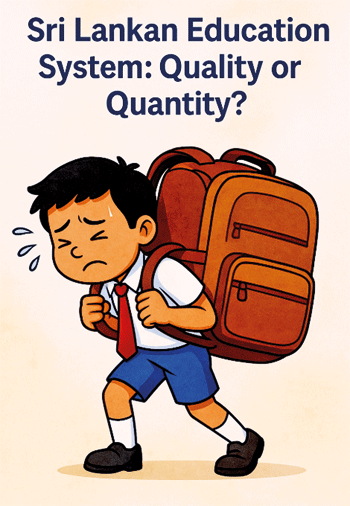
In contrast, Sri Lankan students often carry much heavier loads. Observations show that a grade seven student typically carries a school bag weighing more than twice the recommended limit, placing them at high risk of developing postural deformities, back pain, and other ergonomic complications. International research underscores the seriousness of this issue. A study in Al-Ahsa, Saudi Arabia, found that around 73 percent of students carried bags weighing more than 15 percent of their body weight, while 42 percent reported suffering from back pain. Similar findings across many countries suggest that excessive school bag weight is not merely a matter of inconvenience but a genuine public health concern.
Given these patterns, there is a pressing need for Sri Lanka to undertake a systematic national study to assess the gravity of the problem and introduce evidence-based weight limits for school bags. Establishing such guidelines would be a vital step in safeguarding children’s health and promoting a more student-friendly education environment.
There is a grave need for a revisit of the education system in Sri Lanka in terms of many aspects. But in this article, I would like to emphasize “the quantity vs. quality” of the education system of the country. Weightage of the bag is something related to ‘quantity’, which we need to revisit while improving the ‘quality.’ As I mentioned earlier, this is one of the symptoms of the “real problem” we are facing in the country, and authorities should take this seriously as a matter of priority.
Professor Nalin Abeysekera
(The writer is a Professor in Management Studies, Open University of Sri Lanka and you can reach Professor Abeysekera at
nabey@ou.ac.lk)
HitAd.lk is the best and biggest mobile phone market in Sri Lanka, and we guarantee you will find what you need here from our extensive listing of mobile phones for sale in Sri Lanka. Whether it’s a budget-priced smartphone for communication, or higher end features with advanced connectivity, there are many different options from which to choose from on our site!