


The Future of Healthcare in Sri Lanka: AI, Humanity, and the Next Generation of Professionals
View(s):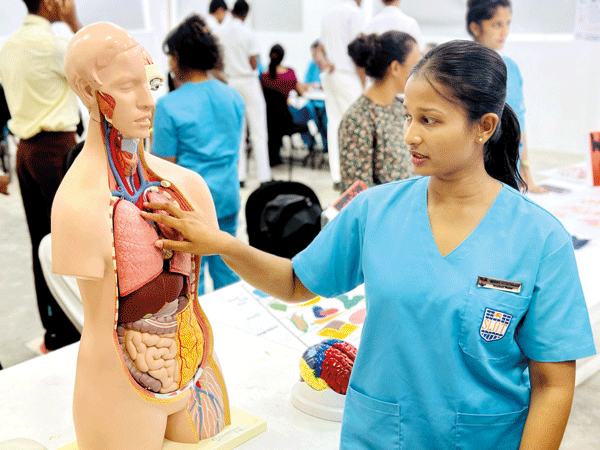
A few years ago, many educators in Sri Lanka were still debating whether online learning itself was practical. Today, our students are already using Artificial Intelligence (AI) tools to summarise research articles, practise communication skills, prepare clinical documentation, and even simulate patient interactions. Whether we fully accept it or not, the future of healthcare has already entered our classrooms.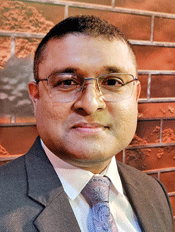
As a counselling psychologist and academic, I believe Sri Lanka cannot continue training healthcare professionals for a healthcare system that is not updated. The traditional model, where students mainly memorise information and reproduce it during examinations, is becoming outdated very quickly. Future healthcare professionals will need something more. Hospitals and the healthcare system will not be exceptions to the influence of AI. Therefore, healthcare workers must learn how to think critically, communicate effectively, adapt continuously, and use technology responsibly without losing their humanity.
This is especially important for professionals such as doctors, nurses and psychologists. Patients largely value the emotional connection they have with healthcare professionals. A patient may forget the medication they received, but they often remember the nurse who comforted them during a difficult night or the counsellor who listened without judgement during a painful moment in life. Although AI may be able to mimic aspects of human interaction, it is unlikely to fully replace genuine human connection.
At the same time, we should not ignore the enormous opportunities technology brings. Sri Lanka continues to face shortages in healthcare workers, particularly in mental health services. Long waiting times, overcrowded hospitals, and increasing psychological distress among young people are becoming common realities. Properly used AI systems may help reduce some of this burden. Telemedicine, digital mental health screening tools, and AI-assisted healthcare systems can improve access to care.
However, there is also a danger in becoming overly dependent on technology. As a psychologist, one concern I have is whether future healthcare systems may become efficient but emotionally disconnected. A healthcare system can become technologically advanced while at the same time becoming less humane. That is something we must avoid.
I sometimes observe this tension even among students. Many young people today are highly capable technologically, but some struggle with face-to-face communication, emotional regulation, and resilience under pressure. Yet these are exactly the qualities healthcare professionals need most. A nurse dealing with an anxious family member, or a psychologist working with a suicidal client, cannot rely only on technical knowledge or digital systems. This means healthcare education itself must evolve.
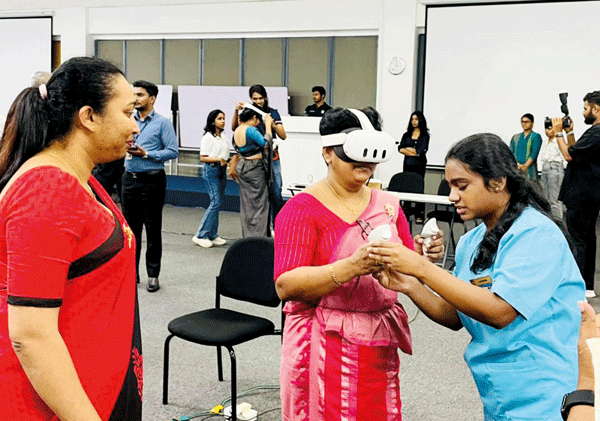
At SLIIT and its health education arm, Althia SLIIT-Hemas Health Uni, we have already started moving in this direction. In nursing education, we aim to use simulation-based learning to expose students to realistic clinical situations before they enter hospital settings. In psychology and other disciplines, we are introducing more technology-supported learning, discussions surrounding AI and digital healthcare, and opportunities for students from areas such as psychology and IT to collaborate and work together.
However, technology alone is not enough. Students must still develop the ability to think critically, communicate calmly under pressure, and connect with people in a genuinely human way. A psychology student learning about AI-assisted screening must still be able to sit with a distressed client without immediately reaching for a checklist. A nursing student who is comfortable with digital monitoring systems must still know how to comfort a frightened patient at 3 am.
But this transformation should not remain limited to a few institutions. It is something the entire healthcare education sector in Sri Lanka must collectively embrace. If Sri Lanka invests wisely in education, innovation, and ethical healthcare development, we have the potential to become a regional leader in modern healthcare training.
The future is already here, and honestly I do not think we can afford to ignore it and continue training healthcare professionals in the same way we did a few decades ago. As educators, this is the time for us to come together and rethink how we train the next generation. They will need to understand technology and AI, but they must also remain deeply human, able to listen, empathise, adapt, and continue learning and improving with humility over time.
Dr Nilanga Abeysinghe, Head of Academics, Althia – SLIIT Hemas Health Uni
HitAd.lk is the best and biggest mobile phone market in Sri Lanka, and we guarantee you will find what you need here from our extensive listing of mobile phones for sale in Sri Lanka. Whether it’s a budget-priced smartphone for communication, or higher end features with advanced connectivity, there are many different options from which to choose from on our site!