

News
Goods importers and households weighed down by price pressures
View(s):By Sajeniya Sathanandan
Sri Lanka’s economy is being tested by external pressures with a rising US dollar and escalating international conflicts driving up the cost of fuel imports, domestic cooking gas, and electricity. Traders and consumers are trapped in a dilemma of unpredictable price changes.
Traders claim that importers are absorbing much of the cost pressures and retailers are operating with small profit margins.
Professionals in the Pettah trade sector told the Sunday Times that to prevent a drop in demand, importers have been operating on very thin margins, despite the strengthening US dollar.
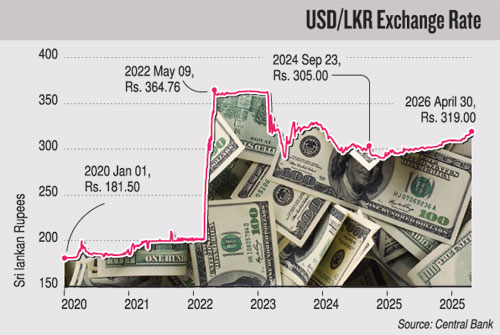
The US dollar has been fluctuating between Rs. 318 and Rs 320, which is seen as a big factor affecting prices.

Traders claim they are selling nearly 70% to 90% of stock at a loss. This includes items like garlic, where they lose Rs 60 to Rs 70 per kilogram.
Many new traders have entered the import business, leading to an oversupply of goods. Importers are forced to sell current stock at low prices and generate cash flow to clear subsequent shipments.
For items like Keeri Samba rice, the cost to the importer is about Rs. 248.50, but the gazetted retail price is Rs. 255. After adding transport costs of around Rs. 5, there is no profit margin, leading traders to refuse purchases and forcing importers to lower prices further.
They said despite these losses over the last two to three years, traders have not reduced their workforce, as many have been with them for 10 to 15 years. They have to pay for transport, employees, and taxes. Businesses are often funded by a 50:50 mix of personal funds and bank loans.
The government has recently allowed the import of rice, but permission was granted too late (only 4–5 days before the New Year). Shipments have arrived around 12-13 April, coinciding with a 10-day holiday where no drivers or workers were available. This resulted in nearly 100,000 tonnes of rice being sold at a loss because it was stuck in storage while supply exceeded demand.
Traders are adversely affected by the US dollar exchange rate, which has been fluctuating for the past three years. Sources claimed that the government has not provided any favourable responses.
Traders claimed that the government earns significantly more than traders on certain items. For instance, the government collects Rs 65 per kilogram in duty for rice, while traders are losing Rs 2 to Rs 3 per kilo. Specific duties for certain items, including Rs 50 per kilo for sugar and 25 cents per kilo for both whole and broken varieties of dhal.
Large mills like Prima receive duty concessions for grain, allowing them to produce flour cheaper than traders who must pay high duties for imports. This has led many traders to stop importing wheat flour because they cannot compete with this monopoly, the Sunday Times learned.
Importing certain items, like green gram, coriander, and peanuts, is only allowed for specific individuals through the Agriculture Department.
Many goods are imported on 30-to-60-day credit terms. If the US dollar was at Rs. 303 when the goods were ordered but rose to Rs. 320 by the time payment is due, the importer must pay the difference.
Main items like sugar, rice, wheat flour, dhal, and oil are perishable and have to be sold quickly.
In Sri Lanka, importers must pay Customs duties and bank bills before samples are taken for testing (SLS/SGS). It often takes 10 to 15 days to clear cargo through Customs. Since banks only provide 30-day credit facilities, importers are left with only 15 days to sell the goods and repay the bank, which is often impossible.
Sources claimed that if a shipment is rejected by Customs, the importer loses the money remitted abroad, and getting a refund on paid Customs duties can take years.
About 1,000 containers are reportedly held by Customs due to minor issues like a two-day delay in the on-board date, with no flexibility to release them for industrial use or animal feed.
Large importers offer credit to retailers, which smaller importers, who need immediate cash to survive, cannot afford to do, further squeezing small businesses out of the market.
Prices of laptops and other electronic devices have increased, but prices could drop in the next two to three months. While the dollar effect has not been felt yet, it is expected to impact the market.
The business operates on a cash-only basis and does not offer credit. However, the business itself must manage credit and interest rates.
In other sectors, prices have increased.
Courier services’ prices increased by Rs 100 in April for all deliveries, including those within Colombo and those outside of Colombo.
Affordable laundry services are operating under tight profit margins due to rising operating costs, including electricity and water. Global conflicts and supply chain bottlenecks have significantly increased the cost of essential supplies. To serve their core customer base, these service providers have kept their prices stable while not passing on costs to consumers.
Local salons and seamstresses have not decided to increase their prices yet but are considering it. Personal funds and loans can’t be stretched too far.
Some are barely surviving as they need to support employees’ families as well as their own.
Pharmaceutical businesses predict higher prices.
“The pharmacy business is not in trouble at the moment because they imported goods in January and stocked them for six months. As they are using old stock, they do not have the right to increase prices due to the external factors. After June, if the situation has not settled, prices might increase.’’
The price of a kilo of wheat flour has been increased by Rs. 10. The Ceylon Bakery Owners Association head, N. K. Jayawardena, said bakery product prices have not been increased, following the earlier Rs 10 increase.
Any more price increases could deter consumers from bakery products.
Price pressures are being felt in homes.
A homemaker said: “As a 30-year-old teacher at a school in Colombo, the rising cost of living has made it incredibly difficult to support my 3-year-old son on my current low salary. With fuel, electricity, and cooking gas prices continuing to surge, my fixed income simply does not stretch far enough, leaving me in a constant state of anxiety. The financial pressure has also taken a toll on my marriage, leading to unnecessary conflicts with my husband as we struggle to make ends meet. To ensure my child is fed and cared for, I have had to resort to taking out loans and selling my personal gold.’’
| Regulator invites suggestions The Public Utilities Commission of Sri Lanka (PUCSL) has published a consultation paper based on estimates and is inviting all stakeholders to provide feedback and suggestions until May 8. The regulator is taking steps to ensure that excess costs related to coal purchases are not included in the tariffs. It has been recommended that the industrial sector be exempt and that tariffs for sub-categories in the general purpose, government institutions, and tourist hotel sectors, where monthly consumption is below 180 units, be unchanged. A recommendation has also been made to not raise tariffs for 95% of consumers, including domestic and religious categories, supported by the government subsidy. PUCSL has been informed by the Treasury to provide a Rs 15 billion subsidy for consumers starting May 10. A deficit of Rs. 38bn for the National System Operator for the second and third quarters of 2026 has been estimated by the PUCSL. Due to the coal situation, this deficit calculation excludes additional costs for electricity generation. Due to rising fuel prices in the global markets, the NSO has submitted a revised cost estimate for electricity generation on April 27. | |
The best way to say that you found the home of your dreams is by finding it on Hitad.lk. We have listings for apartments for sale or rent in Sri Lanka, no matter what locale you're looking for! Whether you live in Colombo, Galle, Kandy, Matara, Jaffna and more - we've got them all!