

News
CEB no more: New power structure endures operational birthing pains
View(s):By Niranjala Ariyawansha
Following the declaration of the date on which the transfer of assets and liabilities of the Ceylon Electricity Board (CEB), Sri Lanka’s largest and most critical long-standing utility, to six new companies from March 9, there has been operational disarray due to serious flaws and inadequate planning, the Sunday Times learns.
According to sources, the reason was the government’s sudden gazette notice of the “appointed date’’ without setting up the minimum level of operational requirements of successor companies.
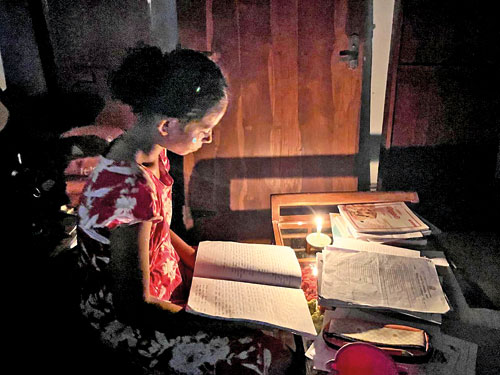
This girl, studying by candle light, was one among tens of thousands affected by the strike. Pic by Hiran Priyankara
One official said, “We are not aware of what the government’s urgency is. If the minister is satisfied, the Act says after completing a few conditions, such as the preparation of a long-term generation expansion plan and energy policy, the ‘appointed date’ can be gazetted. However, without fulfilling operational requirements, the newly formed companies are inoperative. If they had taken at least a month to issue the gazette, such problems would not have arisen.’’
Also, these problems have occurred because the Power Sector Reform Secretariat (PSRS) had not done its job properly.
Under these circumstances, without signing a collective agreement confirming the rights of employees and the management, and with the issuance of the gazette notice, all employees began a two-day strike on March 9, and as a result, power outages were reported in many parts of the island.
The six successor companies set up with 100% ownership by the government are National System Operator (Private) Limited (NSO), Lanka Electricity Generation (Private) Limited (LEG), National Transmission Network Service Provider (Private) Limited (NTNSP), Electricity Distribution Lanka (Private) Limited (EDL), CEB Employees Fund (Private) Limited (CEBEF), and Energy Ventures Lanka (Private) Limited (EVL).
A number of serious and decisive problems that have arisen due to the ‘appointed date’ being issued through the March 9 gazette notice are as follows:
Fresh account opening is still pending for new companies;
There are delays in issuing appointment letters to assign CEB employees to new companies;
On the day the appointed date was declared, the service of nearly 2,500 employees who chose the Voluntary Retirement Scheme (VRS) was terminated. However, there are no plans on continuing operations without those employees;
There are no plans on how to pay compensation of about Rs 2 billion to employees who opted for voluntary retirement;
The IMF has expressed unwillingness to provide the amount through an electricity tariff revision. The funds should come from the Treasury, and in the end, it will be a burden on the public;
The CEB has to settle an Rs. 80bn deficit by the end of March. However, neither the CEB nor the new companies have any plans to settle it;
The CEB Employees Fund was established for the employees’ provident fund, pension fund and related matters, but the necessary regulations of the pension fund have not yet been made. Also, this company has not held any board meetings so far.
Against this backdrop, sources said that there is no assurance of employee pensions in April. The sources also said there is no certainty about the provision of pensions in the future either.
The collective agreement between employees and companies has not been signed. The handbook has not been finalised either.
EGL, NTNSP, and EDL have not signed agreements with the National System Operator (NSO) for power purchase sales, transmission service sales, and power service sales. As none of these agreements has been finalised yet, the boards of the four companies have temporarily prepared a cash flow agreement. It has been submitted to the Public Utilities Commission of Sri Lanka (PUCSL) for approval, and PUCSL is discussing it.
“A cash flow agreement was temporarily prepared because it takes some time to finalise the previously mentioned agreements. However, the gazette was declared before obtaining approval,’’ a source said, adding that many things could have been finalised if the government had waited about a month to issue the gazette.
Sources emphasised that, when reforming an institution like the CEB, there needs to be operational continuation, because this process has to happen while supplying electricity and doing everything related to it. This is something that should be transitioned smoothly and slowly. But according to the Act, as soon as the ‘appointed date’ is set, the CEB is abolished. The Electricity Act has not accommodated at least a year’s overlapping period between CEB and the new companies coming into existence. This vital blunder exists in both Act No. 36 of 2024, adopted by the previous government, and Act No. 14 of 2025, passed by this government.
All the trade unions, including the CEB Engineers’ Union, had taken steps to inform the President in writing about the serious problems that arose in the restructuring process with a tug-of-war between the subject minister and the former director general of PSRS.
Nevertheless, the President informed them during a discussion with trade union representatives last Thursday that he had not received any of those letters, the Sunday Times learns.
The President has emphasised to unions that the government would take steps to protect employee rights during the transition.
Still, the CEB, a massive state monopoly established under the Parliamentary Act No. 17 of 1969 on November 1, 1969, has now been unbundled into six companies, and the process is fraught with shortcomings and challenges.
| Unions unplug unsuspecting homes, shops Tens of thousands of electricity consumers suffered this week after a strike by Ceylon Electricity Board (CEB) trade unions over the restructuring left more than 15,000 faults or repairs unattended. Consumers in several areas said that this time one of the key features was that they were unable to file complaints as some of the depots were locked, while the usual numbers they called went unanswered. As a result, several grocery shops, poultry shops and fish stalls had disposed of spoilt stocks. “We had to throw almost all the food in the fridge as the power failure lasted more than 36 hours,” Anuradhika Seneviratne, a resident of Katana, said. She said that despite attempts to file a complaint about the failure, calls went unanswered. Another resident in the same area said he had called over at one of the CEB depots and was told that they could not give a date or time when electricity could be restored. He said it appeared that some workers sabotaged the power supply. A resident from Pasyala, Champika Thushara, said there was no power for more than 24 hours and no water either. A grocery shop owner from Awissawella, Anura Fernando, said several items in the deep freezer had to be thrown out as the power failure was restored more than 30 hours later. Mr Fernando said that apart from the losses to his shop and, personally, his family too, the excessive heat was unbearable. “The government declared electricity distribution an essential service, but it seemed that there was no use of it as necessary action was not taken,’’ he said. Soon after the trade unions ended their strike on Wednesday, power supply was restored in most areas. | |
The best way to say that you found the home of your dreams is by finding it on Hitad.lk. We have listings for apartments for sale or rent in Sri Lanka, no matter what locale you're looking for! Whether you live in Colombo, Galle, Kandy, Matara, Jaffna and more - we've got them all!