

News
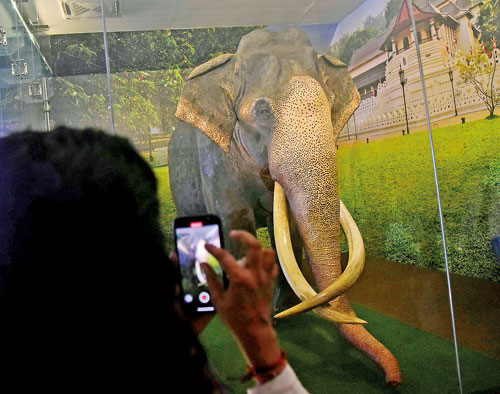
Admired tusker transformed into specimen of historical value
View(s):By Nidarshani Wickramasinghe
The owner of tusker Nedungamuwe Wijaya Raja, Ayurvedic physician Harsha Dharmawijaya and its mahout ‘Kalu Mama’ are delighted that the tusker who died four years back has been preserved and is being displayed at the National Museum of Natural History.
The team that recreated the Indian tusker for display also takes some pride in their work.
“Veda Mahattaya (Mr Dharmavijaya) and his family held our hands and said it was a meritorious deed to restore the tusker as it was alive. There is nothing more we can say. He said the only thing missing is the breath. That alone is enough for us. Our challenge was to bring Nedungamuwa Wijaya Raja back to life. We are humbly happy that we have succeeded in this national challenge,” an officer involved in the conservation project said.
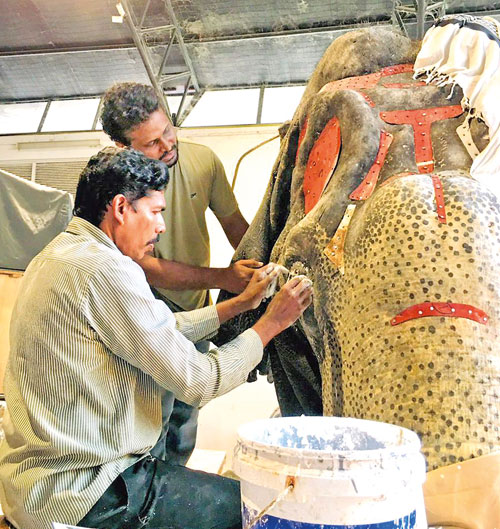
The internal structure of the elephant was built using iron and then covered with plaster of Paris, using materials such as coconut fibre sackcloth, fibre ropes, and adhesives Pix by Akila Jayawardena
Conserving the Nedungamuwa Wijaya Raja cost about Rs 26 million, funded mainly by the Treasury along with Rs 2 million contributed by the Temple of the Sacred Tooth Relic. The project took about four years to complete.
According to Deputy Director (Zoology) K P Lankani Somarathne, who oversaw the project, the preserved tusker can now be maintained for up to another 100 years using taxidermy techniques.
Speaking to the Sunday Times, she explained the beginning of the conservation process.
“On the morning of March 7, 2022, we received the message that the tusker had died. Immediately, the Ministry of Buddha Sasana instructed us to carry out the preservation. This is the second time in recent history that a tusker has been preserved. The previous one was the elephant Raja of the Temple of the Tooth.”
Two divisions of the Department of National Museums worked on the project: the taxidermy division and the exhibition design division. Their work was interdependent.
Ms Somarathne explained the initial stages of the preservation.
“First we had to remove the skin. Dr Dharmawijaya arranged a coconut estate in Nedungamuwa for us. The work was carried out by the taxidermy division team, including taxidermist Chamalka Kothalawala, specimen collector Ravindra Wickramanayake, and Susantha Balasooriya. The first two have now retired. Staff members Amila Senanayake, Thilini Tharaka, and Radheesha Lakshan also assisted.”
The skin, about two centimetres thick, had to be carefully separated while delicately removing parts such as the ears, eyelids, trunk sections, and tail. This process alone took three days.
“We became very emotional during that time,” she said. “After all, we were cutting the body of a ceremonial tusker. It was a deeply sensitive moment.”
After applying proper preservation chemicals to prevent deterioration, the head with tusks was brought to the Colombo museum. They were buried within the museum premises for three and a half months to clean the skeletal structure under special police security due to the value of the tusks.
The tusks weigh over 200 kilograms in total, with one measuring eight feet and the other seven feet in length.
“The internal structure of the elephant was built using iron by Ravindra Wickramanayake and then covered with plaster of Paris, using materials such as coconut fibre sackcloth, fibre ropes, and adhesives. Afterward, the remaining sculptural work was handed over to the exhibition design division,” Ms Somarathne said.
The next challenge was restoring the lifelike appearance of ‘Nedun’.
A team including L. R. Wijepala, L. P. Mahinda, Lasith Siriwardhene, and Darshana Kumara worked on this stage.
Model artist L. P. Mahinda explained to the Sunday Times, “This was a big challenge because we were recreating a national treasure recognised even by children, Nedungamuwa Raja. It had many unique features: a distinct spotted pattern, a large trunk, markings on the ears, and unique skin textures. Our responsibility was to recreate those characteristics accurately.’’
Although now retired, L. R. Wijepala was serving at the time and had previously been involved in the creation of the preserved model of the elephant Raja at the Temple of the Sacred Tooth Relic.
“It was with that experience that we undertook this work. He naturally possessed this creative ability. Likewise, Lasith and Darshana had carefully studied animals.’’
If the muscles, tissues, ribs, and the spinal column of the legs are not positioned correctly in their proper places, the skin cannot be fitted properly. The biggest challenge was stretching the skin. The skin must fit precisely around the nails. If the basic body structure is not properly shaped beforehand, stretching the skin alone will not work; it will simply sag.
“When we took over the model of the elephant to recreate it, we found that after scaling it, there was a slight reduction in height. Therefore, we cut underneath the belly section of the structure and raised it by about 11 inches using chain blocks. As a result, the current model now stands very close to the elephant’s actual height,” Mr Mahinda said.
The artists studied thousands of photographs and watched videos repeatedly to capture the elephant’s exact posture. The weight of the tusks caused the head to tilt slightly downward in old age; the team recreated that same posture.
Some of the skin patterns had faded during the preservation process, so they were carefully restored through detailed study. Artificial eyes were specially crafted from plastic and painted to match the original colour.
“The biggest challenge was stretching the skin over the structure,” Mr Mahinda said. “It cannot be done twice. Sometimes we worked until two or three in the morning to complete the process.”
When the Sunday Times asked about their feelings after seeing the final result, he said, “We feel we have performed a national service. Our challenge was to bring Nedungamuwa Raja back to life, and we are happy that we achieved it. We did our best with the experience, patience, and dedication.”
According to Deputy Director Ms Somarathne, the preserved specimen is regularly inspected.
“We prepare condition reports, check for cracks or damage, and monitor everything daily. These materials are subject to biodegradation, but if conservation is properly continued, the elephant can remain preserved for another 100 years,” she said.
Visitors can view the restored Nedungamuwa Wijaya Raja at the National Museum of Natural History from 9:00 a.m. to 5:00 p.m., except on Mondays.
Museum Curator Priyani Fonseka said that more people are eager to see the elephant exhibit.
“Now many people are specifically visiting to see ‘Nedun’. This museum (Natural History Museum) offers a great deal of educational knowledge, and we encourage visitors to explore it.”
| Indian giant a regular feature at Kandy fest Nedungamuwa Wijaya Raja was born in 1953 in India. His first owner was Jayachamarajendra Wadiyar, who was the Maharaja of Mysore in India. As a token of gratitude, the Maharaja gifted two calves to Ven. Neelammahara Thero, who had cured a chronic illness of one of the Maharaja’s family members. One of those elephants later became Navam Raja of the Gangaramaya Temple, while the other became Nedungamuwa Wijaya Raja. In 1978, at the age of 25 years, Wijaya Raja was entrusted to Ayurvedic physician Dharmawijaya of Nedungamuwa. After his passing, the elephant came under the care of his son, Ayurvedic physician Harsha Dharmawijaya. | |
The best way to say that you found the home of your dreams is by finding it on Hitad.lk. We have listings for apartments for sale or rent in Sri Lanka, no matter what locale you're looking for! Whether you live in Colombo, Galle, Kandy, Matara, Jaffna and more - we've got them all!