

News
All eyes on Southern Coast as debris and spills from IRIS Dena trigger pollution scare
View(s):By Tharushi Weerasinghe
Debris and pollutants from the IRIS Dena, the Iranian vessel torpedoed by a US Submarine 19 nautical miles away from Sri Lanka’s southern coast, washed up on beaches along the southern belt last week.
Orange slicks lapped at the beaches of Hikkaduwa and Dodanduwa and oil barrels washed ashore Meanwhile an influx of scientists and coastguard officers were investigating the potential impacts and further pollution that could result from the incident.
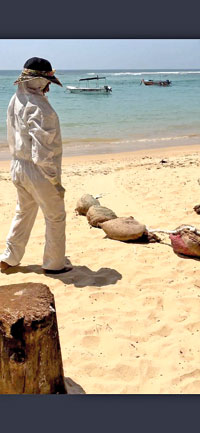
Environment officers use absorbent gunnies to clear out any pollutants in the water
“We suspect it is lubricant oil, very close to the beach, almost at the beach, extending up to two to five nautical miles towards the sea,” Sri Lanka Coast Guard spokesman Commodore Prasad Jayasinghe said. Working across the Hikkaduwa and Nonagama stretches, his teams deployed booms to contain the patches and then used absorbent pads to lift the oil from the surface. The response saw 50 to 60 personnel from the naval command, 30 to 40 from the coastguard, and additional civilian partners through the Clean Sri Lanka initiative and the respective municipal councils involved in the operations. Weligama and Hikkaduwa municipal councils handled the disposal. Commodore Jayasinghe noted that while his teams are on standby, rough seas were complicating containment: “When the sea gets rough, it gets scattered.” He added that diesel tends to evaporate in sunlight, whereas lubricating oil is more persistent because it sticks to the water surface and remains .
But the Marine Environment Protection Authority (MEPA) speculates that the substance is “a lubricant but not oil.” “We cleaned up over the weekend until Tuesday and lubricant was on the water, not oil,” MEPA Chairman Samantha Gunasekara, said. Four barrels washed into the Hikkaduwa and Dodanduwa areas, with the fourth being damaged. MEPA dispatched divers alongside teams from the Department of Wildlife Conservation, the Coast Conservation Department, and the Coast Guard to assess the seabed. “There was no visible damage to the sea beds,” Mr Gunasekara said. However, he stressed that samples had been drawn and sent to the Ceylon Petroleum Corporation for analysis, with results pending. He acknowledged that no formal studies of the explosion’s broader impact have yet been conducted. While surveillance has continued, with nothing new observed since Wednesday, he cautioned that the situation remains fluid. “Things can come again, so we are watching.”
The contamination was visible enough to shut down diving operations in Hikkaduwa for at least a day. “We saw stretches of an orange liquid across the ocean surface,” said a dive instructor from Hikkaduwa. “It lasted for about a day, so we couldn’t take anyone out on Sunday, but once it was cleaned up, our guests were okay.” The area is frequented by turtles because of the shallow waters.
The National Aquatic Resources Research and Development Agency (NARA) has been closely monitoring developments. “A NARA regional officer visited the site and observed oil patches and saw clean-ups using absorbent pads,” NARA’s Environmental Science Division’s Principal Scientist Dr. Sharmali Wijesekera, said. A research team was subsequently dispatched to conduct a dive survey, representing both the environmental studies and marine biological resources divisions. They documented corals in Hikkaduwa through videos and photographs. While no oil patches were immediately visible to the team on the corals, Dr. Wijesekera observed that biodiversity impacts take time. “We have to study deeply to make sure there is no damage.” She noted that no dead fish had been reported by fishermen, and that coastal vegetation appeared unaffected. Naval experts have suggested the explosion may have occurred at a depth of about two kilometres, which means it may not have reached the surface with full force. However, Dr. Wijesekera stressed vigilance: “Impacts usually take time.” Studies are expected to be completed by Monday.

Pollutants observed by divers along the coast. Samples have been extracted for testing
The question of what may have happened farther out at sea, in the deeper waters where the IRIS Dena sank, raises its own concerns. “These are all areas used by whales and dolphins in general, and there is definitely an overlap between where the ship sank and areas where we have observed these mammals before,” Dr. Asha de Vos, marine biologist and blue whale researcher said. She notes that as the wreck is approximately 19 nautical miles off the Galle coast, well within watersthather team has documented as active cetacean habitat. “It happened in an area where they were present,” she said. Dr. de Vos noted that until more information on the actual attack was available, it would be difficult to gauge the impact of the explosion.

Absorbent materials used by the Coastguard being laid out to dry along the rocks at Hikkaduwa Beach.
However, she noted that underwater explosions produced intense, impulsive sounds that can cause hearing impairments — temporary or permanent — depending on their intensity, and in severe cases can lead to mortality. Whether that occurred here remains unknown. She was equally cautious about the long-term picture: “Any potential oil leaks are worrying, so we will have to wait till more information comes out.” On the presence of a sunken vessel itself, she noted that wrecks are not inherently damaging, “sinking vessels in the area are not an issue,” but that the moment of sinking and its aftereffects are where the real concern lies. Her conclusion was unambiguous: “Overall, this is not a positive thing.”

| Iranian sailors’ remains flown home; Lanka’s humanitarian response earns praiseThe remains of 84 Iranian sailors, killed in a US submarine attack in Sri Lanka’s exclusive economic zone last week, have been repatriated to Iran on a special flight from Mattala Airport on Friday (13). The dead were among 130 personnel aboard the warship IRIS Dena when the vessel was sunk 19 nautical miles away from Sri Lanka’s southern shores. The vessel was in the region after taking part in a naval event in India. Responding to its distress call, the Sri Lanka Navy launched a rescue and search operation. They rescued 32 sailors and recovered 84 bodies. The repatriation was jointly handled by the Foreign Ministry, the Iranian Embassy, and the Health Ministry through the Karapitiya Hospital’s management. A police escort facilitated the transfer of the remains in four containers from the Karapitiya hospital’s morgue, where they were being stored in special refrigerators, to the airport. According to Navy spokesman Buddhika Sampath, 206 Iranians are in the Navy’s care at the Welisara Navy Camp. “They are in our care, so at the moment there have been no arrangements made for them to leave the camp, and we ensure that whatever they need is provided to them.” Health and Media Minister Nalinda Jayatissa noted earlier this week that the costs incurred for the storage of the remains, medical costs for injured sailors, and the costs of accommodating the personnel at the camp were all being borne by the Sri Lankan government on a “humanitarian basis”. The second Iranian vessel, the IRIS Busherh, which was supposed to be transported to Trincomalee, is still outside the Colombo Port, sources said, noting that it was stalled there due to engine trouble. Following the Sri Lankan government’s response to the diplomatic and humanitarian crisis that ensued, the United Nations Resident Coordinator in Sri Lanka, Marc-André Franche, welcomed the government’s gestures. In an X post he said, “We welcome the Sri Lankan Government’s focus on humanitarian assistance grounded in the United Nations and international conventions, respecting its commitment to multilateralism, maintaining neutrality, and underscoring its dedication to peace.” US President Donald Trump commented on the attack this week and noted that he questioned officials over the decision to destroy the IRIS Dena instead of capturing it. He noted that his officials had responded that “it was a lot more fun” to sink the vessel. | |
The best way to say that you found the home of your dreams is by finding it on Hitad.lk. We have listings for apartments for sale or rent in Sri Lanka, no matter what locale you're looking for! Whether you live in Colombo, Galle, Kandy, Matara, Jaffna and more - we've got them all!