


Research is meaningful only if it benefits society, Malaya Uni team asserts
View(s):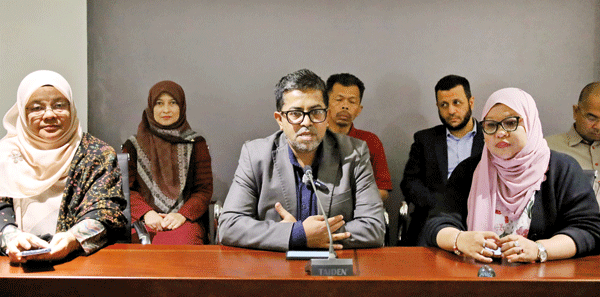
The Malaya Universiti deligation
Universiti Malaya’s vision, according to its Educational Foundations and Humanities Department Head Dr Azni Yati Kamaruddin, is shaped as much by global realities as by academic rigour. Speaking to the Sunday Times during a Malaysian delegation’s recent visit to Rajarata University, she said the university’s focus is on producing graduates who are not only academically competent but also globally grounded.
“We don’t just produce students that engage actively in academic advice. We want them to be part of the world, part of the global, as the world is moving towards digital and AI,” she said. Students, she added, are expected to return to their home countries with “deep thinking”, informed by community engagement and international exposure.
Moving beyond ceremonial agreements, Dr Kamaruddin stressed that institutional partnerships must deliver outcomes that extend beyond declarations. “We want to make what we declared on paper… practical, to create practice in a real situation that could benefit both universities,” she said. Among the priorities she outlined were joint and comparative research and its educational and social impact, postgraduate placements, and curriculum mapping.
For Malaya University senior lecturer and delegation coordinator Dr Mohammad Ismath Ramzy, the central challenge in long-term collaboration lies not in producing research but in translating it into societal benefit. “In the research phase, we are very good, and the research findings are very good. But how we are going to implement what we have found from the research is a real challenge,” he said, emphasising that research must ultimately serve national development.
“Research is not for research; it’s for development,” he noted, adding that this principle requires stronger emphasis, particularly within the humanities and social sciences. Drawing from Malaysian practice, Dr Ramzy said research outcomes are expected to feed directly into policy formulation, curriculum development, and institutional reform.
Collaboration, according to Prof. Zaharah Hussin of the Faculty of Education, Universiti Malaya, is deliberately structured to ensure depth rather than fleeting exposure. She explained that both inbound and outbound student exchanges require a minimum seven-day academic stay, which she described as “short-term but still significant”. Lecturer mobility, meanwhile, is supported through formal sabbatical arrangements of up to nine months.
“This engagement is quite long,” she said, noting that collaboration also includes benchmarking visits, joint supervision, and the appointment of Sri Lankan academics as external examiners for Universiti Malaya doctoral theses. Such roles, she added, involve sustained academic responsibility and quality assurance rather than symbolic participation.
Beyond mobility, Prof. Hussin highlighted joint publications, shared research grants, and examiner and keynote appointments across the region as mechanisms that anchor partnerships over time. “It’s a long process, but it’s meaningful for both parties,” she said, describing the collaboration as “a win-win situation” grounded in mutual academic contribution rather than short-term visibility.
Dr Ramzy noted the cultural, historical, and social affinities between Sri Lanka and Malaysia form a strong foundation for long-term cooperation. “Malaysia and Sri Lanka have more similarities. The culture, the environment, and even human relations are almost similar,” he said, noting that over 4,000 Sri Lankan students join Malaysian universities each year largely due to this compatibility.
He stressed the need for stronger engagement with national bodies such as the University Grants Commission to institutionalise academic mobility and training. He also highlighted Malaysia’s ability to deliver globally recognised education at a comparatively lower cost. “Sometimes the quality is better than European or Western universities, at one-third of the expense,” he said.
For Dr Kamaruddin, the most immediate outcome of the visit to Rajarata University was capacity building, particularly for students and early-career academics. Referring to earlier discussions between the two faculties, she said the delegation returned with a clear intention to contribute expertise, especially in research training.
“We want them, especially the students, to gain experience,” she said, noting that many lack the means to study abroad. Over two days, the team conducted focused training sessions covering specialised topics aligned with their areas of expertise. The objective, she explained, was practical application. “We want to see the students have the knowledge of the training that they can use… especially in doing their job in the universities,” she said, underscoring the importance of tangible academic outcomes rather than symbolic engagement.
Dr Kamaruddin urged young people not to view language or geography as barriers to learning or success. “Language does not determine how intelligent you are,” she said, encouraging students to seek knowledge and experience both locally and internationally and to return with a sense of responsibility to their country. Representation, she stressed, matters. “The way you portray yourself, your parents, your culture, and your country is the most important thing,” she said, noting that young academics and professionals become “the frontliner for your country” through how they conduct themselves abroad.
Prof. Hussin cautioned against superficial learning. Young people, she said, should “have deep knowledge, not only on the surface… not only rely on AI” and continue to value real-world experience alongside digital access.
The delegation’s visit to Rajarata University marked another step in long-standing academic cooperation between the two countries. The visit was coordinated by Dr Mohammad Ismath Ramzy, a Sri Lankan academic attached to Universiti Malaya, together with Rev. Vinita of Rajarata University. Discussions focused on strengthening joint research, staff development, and academic exchange programmes.
Universiti Malaya, ranked 58th globally in the QS World University Rankings 2026, is Malaysia’s oldest research university and has maintained sustained engagement with Sri Lankan higher education institutions for several decades. It has collaborated with universities including Colombo, Jayewardenepura, Peradeniya, Moratuwa, South Eastern University, and Buddhist and Pali University, producing over 120 Sri Lankan PhD and Master’s graduates across disciplines such as medicine, engineering, education, IT, arts, and religious studies.
The visit formed part of a broader framework of cooperation led by Dr Ramzy, who has facilitated 182 collaborative programmes with Sri Lankan universities since 2014. At present, five Sri Lankan academics serve at Universiti Malaya, while over 17 Sri Lankan students are pursuing postgraduate studies there.
- Dilushi Wijesinghe
HitAd.lk is the best and biggest mobile phone market in Sri Lanka, and we guarantee you will find what you need here from our extensive listing of mobile phones for sale in Sri Lanka. Whether it’s a budget-priced smartphone for communication, or higher end features with advanced connectivity, there are many different options from which to choose from on our site!