

News
Ditwah’s fury took people by surprise, were warnings adequate?
View(s):By Tharushi Weerasinghe
Sri Lanka’s emergency response to Cyclone Ditwah unfolded under immense pressure this week, with national and district authorities activating early warnings, evacuations and search-and-rescue operations as the system intensified.
Yet many affected residents told the Sunday Times that they only realised the severity of the cyclone by Thursday night, raising concerns about how effectively warning systems functioned on the ground.
Residents in areas with power interruptions, like Kandy, were also completely cut off early on since no warnings had been given to residents to charge their devices or prepare alternative communication methods.
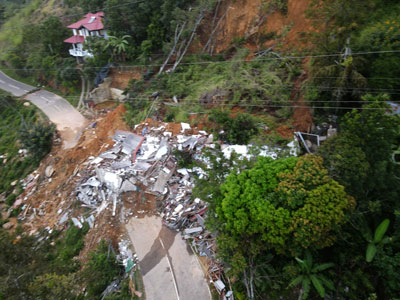
Landslide in Badulla. Pic by Prasad Rukmal
Access to essential supplies, confusion over the location of designated “safety centres,” and unclear instructions on evacuation procedures were among the most commonly cited difficulties.
Public notices repeatedly urged people in high-risk areas to move to safer locations, but several residents said they did not know where these locations were. Under Sri Lanka’s disaster response structure, early-warning drills and risk communication are expected to be relayed to households through Grama Niladharis under the district secretariats. TheSunday Times could not confirm whether these mechanisms reached high-risk communities in time.
Even in areas where evacuations were ordered, some residents refused to leave, believing the situation “would not be that bad.”
Deputy Director at the Disaster Management Centre (DMC), Janaka Handunpathiraja, said national mechanisms had been formally activated in line with the National Disaster Management Act of 2005.
Under the Act, “the President appointed a special council… and everything operates within that, even the Army.” He said the National Emergency Operation Plan of 2017 is automatically triggered during declared crises, guiding coordination between the tri-forces, district administrations and first responders.

He claimed that preparations began well ahead of the cyclone’s land-affected phase. “Since the 22nd, we have been informing the public,” he said, adding that exam authorities were alerted early, worst-case scenarios assessed and search-and-rescue deployments made in advance.
He pointed to three days of unprecedented rainfall — including 490 mm recorded in Kandy over 72 hours — and said landslide advisories and weather briefings were issued throughout. Daily press conferences, public notices and district-level alerts were used to warn communities to stock up ahead of the anticipated impact from November 26-28.
Evacuation communications, he said, were initiated only when the relevant scientific agencies issued red alerts. “Red alerts indicate evacuation,” he explained, noting that alerts were disseminated to stakeholders via fax and email and to the public through SMS, physical visits and local announcements. While evacuation centres in high-risk areas were identified in advance and local committees tasked with informing residents, he said, some people’s reluctance to leave hampered operations. “Kind requests and forced evacuation are different — in Sri Lanka, no forced evacuations yet.” Road closures during the cyclone, he added, were managed by police and local authorities once risks were confirmed.

While questions on whether or not warnings were sent out in time remain, reports of residents and commuters disobeying advisories were also a growing concern. Crowded buses continued to function on declared at-risk roads and ended up stranded and needing air support for evacuation as flood waters closed in. Some residents along the Kelani River basin also reportedly refused to leave their homes for fear of break-ins and robberies. “We cannot legally conduct forced evacuations, but our authorities on the ground were incredibly supportive in making sure people were moved to safety.”
As of 9 a.m. on Saturday, the DMC reported that 488 safety centres had been opened across the island to accommodate more than 43,000 affected persons. The Sunday Times sought clarity from national agencies regarding gaps between initial risk detection, the timing of early warnings and the formal activation of emergency protocols; however, authorities could not confirm at the time of press due to the ongoing response.
While early-warning processes were activated, gaps in Tamil-language communication at the national level raised separate concerns about equitable access to life-saving information.
Mr. Handunpathiraja acknowledged that “a lack of translators at the Disaster Management Centre hampered cyclone-related communications in Tamil at the national level,” though district offices had attempted to bridge these gaps through WhatsApp, SMS, phone calls and localised Facebook posts. Numerous landslide and flood warnings were issued nationally as the system escalated, but few were released in Tamil.
Information Integrity & Policy Researcher Dr. Sanjana Hattotuwa, who independently monitored official updates, observed that only a dozen of the 68 Facebook updates published between Tuesday (25) and Saturday (29) contained any Tamil content, all of which were limited to flooding. “There was a significant disparity in both the frequency and the granularity of life-saving, critical information provided in Sinhala vs. Tamil,” he noted as Sinhala posts covered landslides, road closures and A/L examination logistics not reflected in equivalent Tamil updates.
Dr. Hattotuwa said Tamil-speaking communities “lost out on” detailed landslide warnings issued by the NBRO, real-time road closure alerts and examination-related logistical updates, including air-delivery of exam papers to Jaffna. He also noted missing river-basin warnings, limited maritime advisories and the absence of granular wind forecasts in Tamil.
As heavy rainfall and hazardous conditions continue across several districts, emergency teams remain deployed islandwide. Even as response operations scale up, authorities now face parallel scrutiny over both the functioning of early-warning systems and the persistent language gaps that shaped public access to crucial information during Cyclone Ditwah.
The best way to say that you found the home of your dreams is by finding it on Hitad.lk. We have listings for apartments for sale or rent in Sri Lanka, no matter what locale you're looking for! Whether you live in Colombo, Galle, Kandy, Matara, Jaffna and more - we've got them all!