

News
Price shock hits consumers before electricity bills’ crushing blow
View(s):By Kasun Warakapitiya
Wednesday’s electricity tariff hikes—over 25% for households consuming more than 180 units—have shocked the public on multiple fronts.
Not only consumers but traders, industrialists, hoteliers, and others depending on diverse livelihoods appear worried.
Though people dread receiving this month’s electricity bill, they are already feeling the impact of the tariff hike, as traders and service providers raise prices, citing higher electricity costs.
With the current heatwave, most households said they are compelled to use fans and air conditioners, but they hesitate when they imagine the burden of this month’s bill.
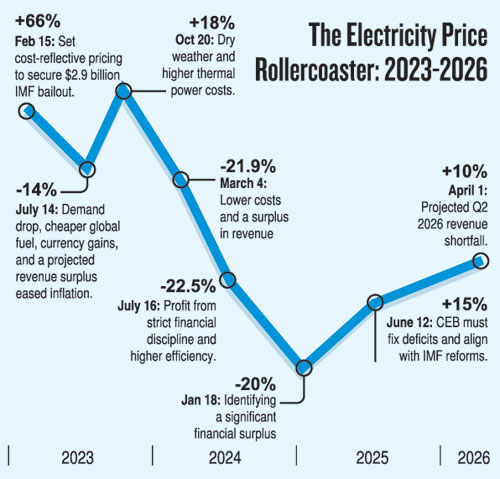
Ajith Hettiarchchi, a resident of Nahena in Wattala, said that while the tariff increase will be felt directly in this month’s electricity bill, prices of goods and services have already risen following last month’s double fuel hikes.
“These days people cannot manage without fans, as the heatwave is unbearable even at night. So all I can say is that we have to pay more for electricity this month,” he added.
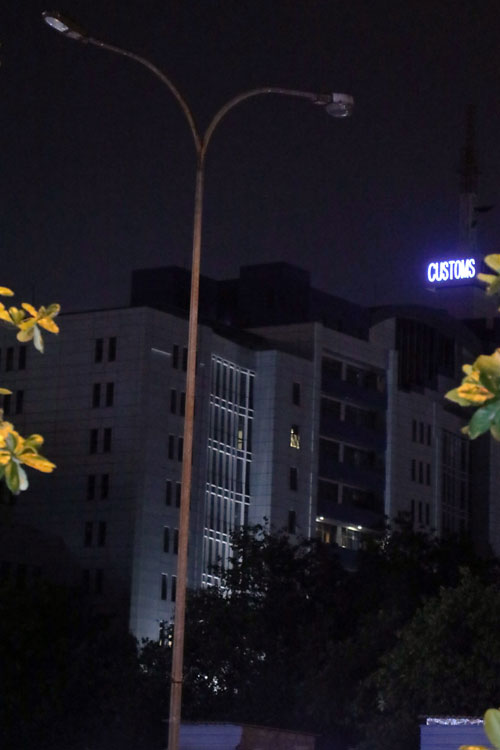
Street lights off in Colombo city. Pix by M.A. Pushpa Kumara
Sandamali Ratnayake (27), a tuition teacher who recently moved into a rented house in Kiribathgoda, said her daily expenses have risen sharply. She noted that her February electricity bill was only Rs. 1,300, but in March it had doubled to Rs. 2,600.
She said she believes the increase is largely due to overusing the fan during the heatwave. She complained the rise in utility bills was unbearable, as she had to pay as much as Rs. 25,000 for the house rent.
“I just hope the landlords don’t raise the rent; if they do, managing expenses will be impossible,” she said.
Traders, meanwhile, said they are more concerned about power cuts than the cost surge from the tariff increase, since they would be forced to operate generators to keep their businesses running.
Dasith Walgamage (36), a supermarket manager, said he would have to cut discount margins to cope with the 25 per cent rise in electricity tariffs.
He explained that the air conditioners and refrigerators at the supermarket must run all day to keep perishable
items such as vegetables, fruits, meat, and fish fresh.
“My major concern is power cuts. If the government imposes them to conserve energy, we would be badly affected, as we would be forced to use generators to keep refrigerators running. Another problem is that it is virtually impossible to obtain fuel for generators from fuel stations, since the government has not introduced any mechanism for it,” he said.
Bakery owners, too, said the electricity tariff hike has hit their industry, driving up production costs.
Bakery Owners Association president N.K. Jayawardena noted that since they recently raised product prices after the fuel price hikes, they would not push for another increase immediately. He explained that despite losses, they would maintain current prices, and a decision on the price hike would be taken after the National New Year holiday week.
A well-known hotelier, requesting anonymity, said the electricity hike has seriously impacted service costs at high-occupancy hotels. However, he added, this pales in comparison to the expenses they would face if compulsory power cuts are imposed, forcing them to run generators.
| Some state offices disregard directive
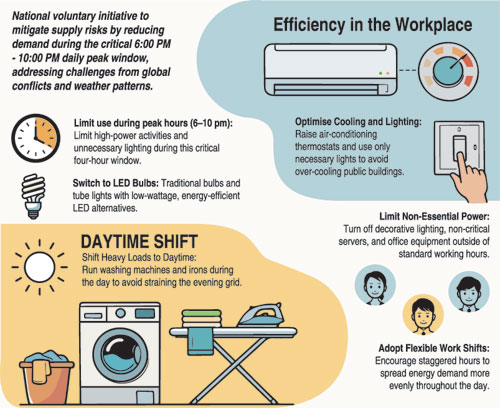
Display boards of government departments and institutes as well as some roadside billboards remained illuminated despite the government directive to switch off. It was observed that the Electricity Board main office’s display board and the billboards of Sri Lanka Customs and other institutions remained switched on. Street lights on Colombo’s main city areas also continue to be on in most areas. The circular on the use of fuel and power and energy sparingly was issued by the Commissioner General of Essential Services. Six guidelines were issued on using electricity sparingly. All state institutes should switch off air-conditioners, while all local government institutes should switch off street lamps from 6:00 pm to 10:00 pm. The private sector, too, was requested to follow. Apart from that, a directive asks to switch off lights fitted to illuminate billboards and roadside digital screens. And organisers of gatherings of over 100 people, such as musical shows, are told to not use electricity from the grid. An official of the Department of Emigration and Immigration told the Sunday Times that ACs and any extra lights are turned off, but it has made life difficult inside for them and people who visit the premises. Customs spokesman Chandana Punchihewa said ACs are switched off and fans are used. He said officers assigned to ports and airports cannot be shifted and the numbers needed are deployed. He said head office work staff comply with the no AC directive. The director of the Department of National Zoological Gardens, Dr Chandana Rajapaksa, said ACs are switched off at 3:00pm and fans are switched on. Officials are sent for field work at the zoo and given a chance to stay away from offices. “We have not cut off electricity to animal enclosures and the water sprinklers. Tank filters at the aquarium area remain operational. As the zoo has greenery, our offices can weather the heat,’’ he said. The Department of Wildlife also aims to reduce the use of electricity and fuel. Director General Ranjan Marasinghe said field officers have been told to limit the use of vehicles. He said the state sector holiday on Wednesday also helps to reduce the use of electricity in the main office, but he said staff shortages mean office staff cannot be asked to work from home. | |
|
Switch off to reduce diesel use By Kasun Warakapitiya Ceylon Petroleum Corporation Chairman Janaka Rajakaruna has called on Sri Lankans to conserve electricity so that the use of diesel to generate power can be reduced. He explained that although solar energy is used for daytime electricity generation, diesel is used at night in power plants. Mr Rajakaruna said 1,100 metric tonnes of diesel was approved because hydropower generation had dropped due to prevailing dry conditions. “This is why the government issued circulars to reduce consumption of electricity in peak hours so diesel consumption could be reduced. Apart from that, the government is also discussing adopting work from home for state institutes to conserve diesel,’’ he said. He assured fuel availability and added that a tanker carrying 32,000 MT of diesel and 8000 MT of jet fuel has arrived. The QR code and odd-and-even number systems will continue, although queues have reduced. “However, I would consider removing the systems in the future if needed,” the chairman said. Mr Rajakaruna called for reducing the use of fuel also because prices are fluctuating in global markets. He expects the rupee to weaken further versus the US dollar, and the fuel price will have to be revised up if needed, but not immediately.
|
The best way to say that you found the home of your dreams is by finding it on Hitad.lk. We have listings for apartments for sale or rent in Sri Lanka, no matter what locale you're looking for! Whether you live in Colombo, Galle, Kandy, Matara, Jaffna and more - we've got them all!