

News
Imports of alternatives to fill Keeri Samba shortage
View(s):- As underground market thrives, farmers blame lack of government cultivation plan
By Nidarshani Wickramasinghe
A shortage of Keeri Samba and complaints of prices exceeding Rs 350 a kilogram have emerged ahead of the biggest cultural festival this month.
As a solution to the shortage of Samba and Keeri Samba, the Food Policy and Security Committee has focused on importing alternative rice varieties. Since Keeri Samba is cultivated only in Sri Lanka, it is not possible to import it.
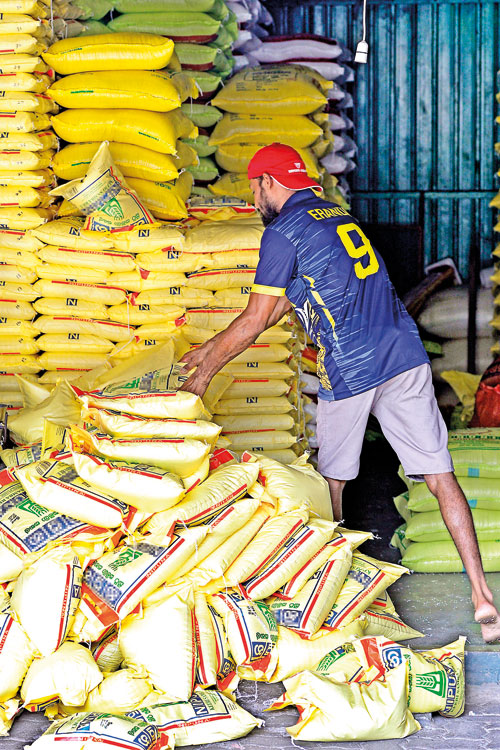
Pic by Eshan Fernando
Cabinet approval was recently granted to import a maximum of 1,040 metric tonnes of rice varieties classified under HS Code 1006.30.29, including Ponni Samba and Keeri/Ponni varieties, known as GR 11.
Imports are allowed from April 1 to the end of the month, and stocks must be cleared from Sri Lanka Customs on or before May 31. The import licence requirement has been waived.
Through this decision, the government expects to stabilise prices and ensure a continuous supply of rice.
However, consumers complain that Keeri Samba is being sold at high prices in the black market secretly to customers known to traders.
“I needed to buy Keeri Samba for a personal need at home. In the end, I had to buy it from a known trader who sells consumer goods. I had to spend nearly Rs. 4,000 to buy 10 kilograms of Keeri Samba,” a consumer said.
In Pannipitiya, a consumer said there was evidence to suggest that the milling of Keeri Samba was continuing.
“Broken Keeri Samba is openly available for sale. Rice gets broken only when it is milled. So, proper Keeri Samba rice should also be openly available in the market. Where is it then? This is completely a racket. It’s an injustice to
consumers.”
All farmer representatives said the main reason for the Keeris Samba shortage is the lack of a proper method or basic plan by the government for cultivation.
G.G. Rathnasiri, chairman of the Seruwila Mahaweligama Farmers’ Organization and chairman of the Seruwila Agrarian Services Committee, said that during the last ‘Maha’ season, farmers cultivated a large amount of Keeri Samba and that there is absolutely no possibility of a shortage.
He suggested that if any wholesale store is inspected, Keeri Samba stocks will be found.
“On several occasions, we told Deputy Agriculture Minister Namal Karunaratne to do soil tests and recommend suitable paddy varieties. Then farmers in each region could cultivate the most suitable variety. That way, the needed quantity of rice could be planned and cultivated. The ministers paid no attention. If they had, paddy prices would have stabilised, and there would be no need for imports,’’ he said.
“During the ‘Maha’ season, private sector millers bought wet Keeri Samba paddy from us at Rs 155 a kilogram. When they process and sell it as rice, the price could reach Rs. 400 a kilogram. About 25,000 acres are cultivated in the ‘Alla’ Govi Janapadhaya, and this time, two-thirds of it was Keeri Samba.’’
One sack contains 68 kilograms of paddy. The private sector bought a sack from us at Rs 10,600. The Paddy Marketing Board purchases Nadu, while the private millers pay higher prices for Keeri Samba and collect it, he said.
Punchirala Rathnayake, chairman of the Anuradhapura District Joint Farmers’ Organisation, said, “There is no proper government plan. There is no fixed price. In this Maha season, about 500,000 acres were cultivated in the Anuradhapura district, mostly Nadu. The government should provide fertiliser, fuel, and seeds under a proper system. There is a shortage of Keeri Samba due to the lack of a proper government plan,” he said.
“It is said that 11% of the country’s total rice requirement is Keeri Samba, and due to the lack of a basic plan from the government, artificial shortages have arisen,’’ said P.K.D. Wijerathne, treasurer of the Polonnaruwa District Agrarian Services Federation.
“If lands were properly selected and targets achieved, artificial shortages would not arise. Generally, not even 5% of the Parakrama Samudraya irrigation area is used for Keeri Samba cultivation. The Mahaweli B Zone accounts for only about 5%. Keeri Samba yields are low and require much effort. It is a delicate crop that needs special attention. The government must understand this and create a proper plan,” he said.
Former Agriculture Minister Mahinda Amaraweera said the monopolistic rice mafia in Sri Lanka has now become even stronger, and it would be extremely difficult for any government to confront it.
“I see that the current government lacks proper understanding of paddy cultivation. There is no practical discussion with officials. There is absolutely no reason for a rice shortage. During my time, we even planned to export rice. We had a surplus.’’
The Sunday Times attempted several times to contact Agriculture, Livestock, Land and Irrigation Minister K.D. Lal Kantha and the Consumer Affairs Authority by telephone, but there was no response.
Dr Thushara Wickramarachchi, director general of the Department of Agriculture, told the Sunday Times that he rejects the allegations that the government had no plans regarding the cultivation of Keeri Samba.
“There is a shortage of Keeri Samba; that is true. The reason is that Keeri Samba is widely used for fried rice, so demand is high. In
Sri Lanka, Basmati is not commonly used for fried rice. Also, with rising living standards, people prefer Keeri Samba,’’ he said.
Rice from the previous season’s paddy harvest is coming onto the market now. Newly harvested rice is not immediately released to the market because the quality is lower right after harvesting, he said.
“The minimum paddy price was increased to Rs. 140 to encourage farmers to cultivate more. Traders or mill owners stock up to gain higher profits. The government sets minimum prices to protect farmers. We do not force farmers to cultivate specific varieties. Over 95% of cultivation is done using about 10 varieties,’’ he said.
“Keeri Samba takes about four months to grow. With a longer process, yields decrease. So, some farmers are reluctant to cultivate it. We cannot force them to grow more Keeri Samba.
Following the government decision to import alternatives to Keeri Samba, a private rice miller was seen unloading stocks at the Narahenpita Economic Centre yesterday, as captured in this photograph to the right.
The best way to say that you found the home of your dreams is by finding it on Hitad.lk. We have listings for apartments for sale or rent in Sri Lanka, no matter what locale you're looking for! Whether you live in Colombo, Galle, Kandy, Matara, Jaffna and more - we've got them all!