

News
Mayday, mayday: How US-Iran conflict unfolded in Sri Lanka’s economic zone
View(s):By Tharushi Weerasinghe
The sinking of the IRIS Dena by a US submarine just 19 nautical miles from Sri Lanka’s shore in its Exclusive Economic Zone has forced Colombo to navigate one of the most complex diplomatic and legal crises in its recent history, with pressure mounting from Washington not to repatriate Iranian survivors and a third Iranian vessel now docked in India.
The vessels and its mission
The three Iranian naval vessels at the centre of the crisis, IRIS Dena, IRIS Bushehr, and IRIS Lavan, had all been operating in the region following participation in a naval exercise in India. The IRIS Dena had departed Indian waters about a week before it was attacked, and was in transit through the Indian Ocean when the strike occurred.
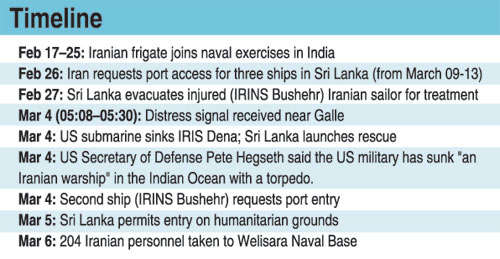
On February 26, Iran formally requested permission from Sri Lanka’s Ministry of Foreign Affairs for three naval vessels to enter Sri Lankan ports between March 9 and 13, described as a visit to enhance bilateral cooperation. Sri Lankan authorities, however, took note that the vessels were already positioned close to, but outside, the country’s national maritime zone. As President Anura Kumara Dissanayake later explained, a cooperation visit of this nature requires extensive formal procedures, and the government was still studying those procedures when events overtook the process.

Sri Lanka Navy and Air Force launched a major rescue operation to save survivors and recover bodies from IRIs Dena
On February 27, Sri Lanka received a separate request: a sailor aboard the IRIS Bushehr, one of the vessels then near Sri Lankan waters, had been injured. The Sri Lanka Navy and Air Force responded on humanitarian grounds, bringing the injured sailor and an accompanying officer ashore and directing them to receive medical treatment.
The attack: March 4
In the early hours of March 4, Sri Lanka’s Navy received a distress signal. Navy Spokesperson Commander Buddhika Sampath told the Sunday Times that the signal was received between 5. 05 a.m. and 5.10 a.m. A rescue mission was deployed from Galle harbour by 6 a.m. “The rescue vessels reached the survivors within a matter of minutes,” he said, adding that the first naval officers on scene found only life rafts and oil spills. “We did not observe the ship or any wreckage,” he said.
The IRIS Dena had been struck approximately 19 nautical miles from the Port of Galle — outside Sri Lanka’s 12-nautical-mile territorial sea, but within its Exclusive Economic Zone. The Sri Lanka Navy and Air Force launched a major rescue operation, recovering 32 survivors and 84 bodies, all of whom were brought ashore. The survivors are currently receiving treatment at Karapitiya Teaching Hospital.

In its initial press briefing, the Sri Lanka Navy said it had no information on the nature of the attack or who carried it out. That changed only when United States Defence Secretary Pete Hegseth later publicly claimed responsibility, confirming that an American submarine had torpedoed and sunk the Iranian frigate. Deputy Minister of Defence Major General Aruna Jayasekara confirmed to the Sunday Times on Friday that there had been “absolutely no communication” from the US government, by way of advance notice, explanation, or information-sharing, regarding the military operation. “We only knew what happened through the US Defence Secretary Pete Hegseth’s briefing that was broadcast later, claiming responsibility for the attack,” he said.
The sinking is notable in historical terms: it is the first time since the end of the Second World War that a United States submarine has sunk an enemy vessel. Both the United Kingdom and Pakistan have sunk vessels using torpedoes in the intervening decades, but this marks a significant threshold for American naval engagement.

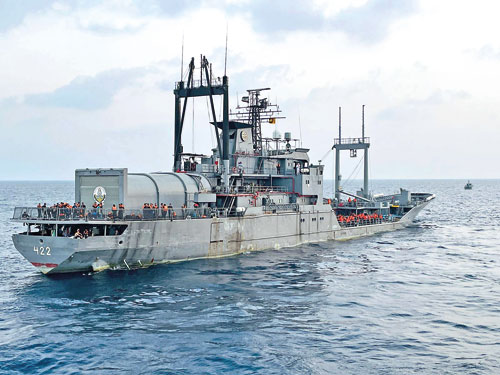
After negotiations between the vessel’s captain and Sri Lanka Navy officers, and with agreement from all parties, Sri Lanka announced that it would evacuate the IRIS Bushehr’s 208 crew members
The IRIS Bushehr: A second crisis
Even as the rescue operation for survivors of the IRIS Dena was underway, a second Iranian vessel, the IRIS Bushehr, informed Sri Lanka’s Ministry of Foreign Affairs on March 4 that it was requesting permission to enter a Sri Lankan port on the 4th and 5th of March, after reporting engine damage. Sri Lanka’s Foreign Minister entered into discussions with his Iranian counterpart, while the Iranian Embassy maintained continuous contact with the Ministry of Foreign Affairs.
The situation presented Sri Lanka with a genuine legal and diplomatic dilemma. As President Dissanayake outlined in a special media briefing on March 5, the government was required to carefully examine its obligations under the United Nations Convention on the Law of the Sea (UNCLOS) and the Hague Convention of 1907, which govern how a neutral state may deal with a belligerent’s naval vessel. “This is not an ordinary situation,” the President said. “A neutral state, a vessel belonging to one party to a conflict, and a request to enter our ports must be considered strictly in accordance with international conventions and international obligations.”
After negotiations between the vessel’s captain and Sri Lanka Navy officers, and with agreement from all parties, Sri Lanka announced that it would evacuate the IRIS Bushehr’s 208 crew members, comprising 53 officers, 84 cadet officers, 48 senior sailors and 23 sailors, bringing them ashore at Colombo Port. The vessel itself would not remain at Colombo, which serves as Sri Lanka’s principal commercial harbour; instead, it was to be taken to the Port of Trincomalee under Sri Lankan naval escort, with a skeleton crew and Sri Lankan naval personnel on board.
The Deputy Minister of Defence confirmed that responsibility for handling those aboard both vessels, the survivors from the IRIS Dena and the crew of the IRIS Bushehr, has since been transferred to the Sri Lanka Police under the Public Security Ministry.
The third vessel: IRIS Lavan docks in India
A third vessel from the same Iranian naval deployment has meanwhile sought shelter elsewhere. Indian media reports, citing government sources, indicate that Iran approached India on February 28 seeking urgent permission for the IRIS Lavan to dock at Kochi after the vessel developed technical issues while in the region following the International Fleet Review. India approved on March 1, and the IRIS Lavan docked at Kochi on March 4, the same day the IRIS Dena was sunk. Its 183 crew members are currently being accommodated at naval facilities in the city.
With the IRIS Dena destroyed, the IRIS Bushehr in Sri Lankan custody and the IRIS Lavan docked in Kochi, all three Iranian naval vessels from the same regional deployment are now accounted for across South Asian waters.
Washington pressures Colombo
Sri Lanka’s handling of the crisis is now drawing direct pressure from the United States. According to an internal US State Department cable dated March 6, reported by Reuters, the US Embassy in Colombo has conveyed to Sri Lankan authorities that neither the survivors from the IRIS Dena nor the crew of the IRIS Bushehr should be repatriated to Iran. The cable also indicated that Sri Lanka should minimise any attempts by Iran to use the detained sailors for propaganda purposes.
Sri Lanka’s government has not publicly commented on the US request. The Deputy Minister of Defence insisted when questioned that Sri Lanka has not started any defence discussions and is continuing to follow its policy of neutrality.
The Sunday Times also reached out to the US Embassy in Sri Lanka for confirmation and was directed to the United States Department of State Media Inquiries System, which is yet to respond.
Parliamentary dispute over
pre-attack contact
The events have also sparked controversy in Parliament. MP Mujibur Rahuman this week claimed that the IRIS Dena had arrived at the edge of Sri Lanka’s maritime territory and requested permission to enter before the US attack, and that the government failed to respond. “The government of Sri Lanka did not respond, and while the vessel waited, they were attacked,” he stated. Rahuman also alleged that Iran’s Ambassador to Sri Lanka, Dr. Alireza Delkhosh, had confirmed that the Sri Lanka Navy Commander had personally requested the vessels to visit Sri Lanka, which was the original impetus for the deployment. The Sunday Times reached out to the Iranian Ambassador for clarification, but did not receive a response.
The Ministry of Defence has flatly rejected these claims. Deputy Minister Jayasekara stated that there was “absolutely no communication” from the IRIS Dena before the distress call received on the morning of March 4.
Questions of international law
Admiral Priyantha Perera Retired, the 25th Commander of the Sri Lanka Navy, told the Sunday Times that the legal picture, while complex, points in a relatively clear direction under existing international instruments, even as it raises uncomfortable questions about the erosion of the international rules-based order.
“In an international conflict, whether it is a declared war or not, when we know there is a war, there are parties, and there are rules,” Admiral Perera said. “Under the laws of war and engagement, including the Geneva Conventions, the Hague Convention of 1907, and the San Remo Manual, an engaging belligerent has legitimate targets. These include enemy government vessels, coast guard vessels, navy ships, and the like, generally on the high seas. As long as the target is on the high seas, the United States can lawfully attack it.”
The IRIS Dena had departed Indian waters before the attack. At the point it was struck, it was beyond the 12-nautical-mile territorial sea limit and therefore legally on the high seas — irrespective of being within Sri Lanka’s EEZ. “International law regards the EEZ as high seas for navigation and safety,” Admiral Perera noted. “The United States was not required to inform the Sri Lankan government.”
He explained that neutral states, such as Sri Lanka and India, have specific obligations when belligerent vessels seek access to their ports. “When an actively engaged state enters a neutral port, a 24-hour rule applies — the vessel can request assistance such as replenishment and repairs, but must leave. Repairs to elevate fighting capacity are illegal. Repairs may require more time, but that requires a separate understanding,” he said.
In the case of the IRIS Bushehr, Trincomalee was identified as the most appropriate option. “The ship went there without the Iranian crew, which is better for safety. Once in our waters, the vessel is under our control, and no one can attack it, given that the intention was clear for the reason of the diverted passage,” he said. If the ship fails to leave within 24 hours or a reasonable time thereof, the ship should not be allowed to leave until the end of the ongoing conflict.
On the question of innocent passage, whether the Iranian vessels could have transited Sri Lanka’s territorial sea for safety, Admiral Perera was clear that innocent passage exists only for traversing the Teritorial Sea on a designated passage unimpeded and expeditiously as to proceed to or from port facilities and Internal Waters of that Coastal State. This reflects well that no belligerent vessel could seek refuge under the concept of innocent passage to avoid pursuit and attack. “For naval vessels, there are conditions under innocent passage: no surveillance, no weapons activated, and submarines must surface, among others. You can not divert into a territorial sea for safety. That is not how innocent passage works,” he said.
On conditions that apply for the rescued Iranian naval personnel of Dena and the crew of Bushehr, if that ship is held in our port it cannot be repatriated until the end of the war.
Another senior naval commander,who wished to remain anonymous, pointed to a deeper and more troubling dimension of the crisis. The theory of neutrality, he explained, operates formally only in the context of a declared war, and the United States has not declared war against Iran. “We are not a party to this conflict. America has not formally declared war against Iran. Under the American Constitution, it is Congress that declares war, not the President. The Congress did not approve this action. In that sense, it is an illegal war,” he said.
He was direct about what that means in practice. “America has, in its own national defence strategy, signalled that it no longer wishes to be bound by the international rules-based order; it will do what benefits itself. Multilateralism is no longer a priority. This is an enormous problem for countries like Sri Lanka, because it survives and is protected by those rules. The attack does not come under a formal war action; the United States considers every Iranian target a legitimate target. There is no one to hold them to account. They did not even inform Congress, let alone their allies, their partners, or Sri Lanka.”
In a pointed observation, he noted that Washington did not inform India either, a significant omission, given the close military partnership between the two countries, including through the Quadrilateral Security Dialogue (the Quad, comprising the US, India, Australia and Japan). “In the Indian Ocean, India should have been America’s main partner. That gives rise to a serious question: this happened in India’s backyard. We talked about maritime surveillance and domain awareness, and we could not even detect a submarine coming and attacking a ship,” he said.
He added that this geopolitical realignment has consequences extending beyond the immediate incident. China, Europe and India have all signalled that the rules-based international order remains important to them. “America has said it is to their disadvantage, so they changed. That is now a major issue for every country that depends on international law for its security and sovereignty, and Sri Lanka is one of them.”
Colombo’s stance: Neutrality and humanity
President Dissanayake, addressing the nation at a special briefing at the Presidential Secretariat on March 5, was emphatic that Sri Lanka would not allow itself to be drawn into the conflict on either side. “We shall not, under any circumstances, permit our land territory, maritime zones, or airspace to be utilised in a biased manner by any nation engaged in a conflict, nor in any manner that inflicts harm upon another nation,” he said. “No matter what external outcries or pressures may exist, we do not panic or act recklessly.”
The President called on all parties to the conflict to demonstrate a commitment to peace. “What the world urgently needs today is peace. People are dying, and there is a risk of a severe global economic crisis,” he said. “As a state, we are ready to extend our support to every step taken towards that end.”
As of Friday, the sailors and officers from both vessels remain in Sri Lanka. The IRIS Bushehr was slated to be moved to Trincomalee but was still in the Colombo Port for ‘repairs’ as of Saturday afternoon, according to internal sources. The question of what happens next, to the crew, the ship, and Sri Lanka’s carefully maintained neutrality, remains unresolved, with Washington pressing hard for Colombo not to return the Iranians home.
The best way to say that you found the home of your dreams is by finding it on Hitad.lk. We have listings for apartments for sale or rent in Sri Lanka, no matter what locale you're looking for! Whether you live in Colombo, Galle, Kandy, Matara, Jaffna and more - we've got them all!