

News
Calls to break barriers facing women and girls in Science
View(s):By Malaka Rodrigo
On her retirement day, emeritus professor Savitri Gunatilleke recalled how, coming from a conservative family background, she had to overcome several barriers as a woman to become one of Sri Lanka’s pioneers in rainforest ecology. After graduating in 1969 from the University of Ceylon (now University of Peradeniya), she travelled to Aberdeen in Scotland for postgraduate studies.
One of the first challenges she encountered was her dress code. Fieldwork required practical clothing, yet she had grown up wearing only traditional Sri Lankan attire that was not suited for working in forests. Having never worn jeans before, she had to adapt to an entirely new way of dressing and working in the field.
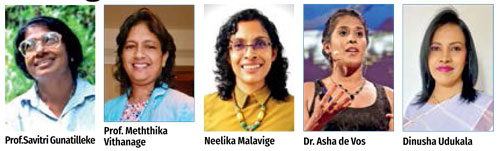
After returning to Sri Lanka, Prof. Gunatilleke chose to conduct her research in the Sinharaja Forest Reserve, despite never having previously entered a forest. Yet she overcame these obstacles and went on to become one of the pioneers of ecological field research in Sinharaja.
Such were the barriers faced by Sri Lankan women scientists decades ago. While times have changed now, the determination of Prof. Gunatilleke and others like her paved the way for future generations.
Among the globally recognised Sri Lankan women scientists today is marine biologist Dr.Asha de Vos, who braved the ocean waves to study the world’s largest animal; the Blue Whale.
“The challenges I have faced on my journey have been numerous; from people thinking that my job is a man’s job to questioning how I dress and judging me for not following traditional expectations,” Dr. de Vos said. Such remarks, she noted, are merely distractions. “I keep moving forward so powerfully that those comments fall by the wayside.”
Stories like those of Prof. Gunatilleke and Dr. de Vos reflect the determination of Sri Lankan women scientists who have pursued field-based environmental research despite many social and professional barriers. Yet such challenges are not unique to Sri Lanka.
Recognising this global issue, the United Nations declared the International Day of Women and Girls in Science in 2015, observed annually on February 11, to highlight the critical role women and girls play in science and technology and to promote gender equality in STEM (Science, Technology, Engineering, Mathematics) fields.
“As societies grapple with widening inequalities, a four-pillar approach bringing together artificial intelligence, social science, STEM, and finance has the potential to drive inclusive and sustainable progress, especially in resource-constrained nations like Sri Lanka,” said Prof.Meththika Vithanage, who has been ranked among the world’s top 2% most cited scientists on several occasions.
“Being a woman scientist in Sri Lanka has been profoundly rewarding, yet quietly exhausting,” Prof. Vithanage told the Sunday Times. “I came into science because of curiosity instilled by my parents , not because I wanted to prove anything about gender. But it required relentless dedication amid civil war disruptions, sleepless nights analysing data, and working in a system where resources were limited and expectations were high to reach where I am today,” Prof.Vithanage said.
Sri Lanka’s scientific infrastructure still faces challenges, she noted as there are barriers of limited research funding, bureaucratic hurdles, lack of advanced equipment, and even power outages that can derail experiments. Women often face additional scrutiny, with cultural norms expecting them to prioritise family roles, making long laboratory hours or remote fieldwork difficult, she added.
Neelika Malavige, professor of Immunology and Molecular Medicine, points out that Sri Lanka often appears successful in encouraging women into science at the undergraduate level. Women frequently outnumber men in universities and other higher educational institutions. “However, what is less visible is what happens after graduation,” she explained. Many women do not continue along the same professional trajectory as their male counterparts, particularly in research leadership, technology development, or senior academic and industry roles.
Data reflects this pattern. The 2022 National R&D survey conducted by the National Science Foundation of Sri Lanka recorded 3,208 male researchers and 3,061 female researchers by educational qualification—numbers that appear relatively balanced. Yet a study by the Institute of Policy Studies of Sri Lanka, analysing data from the National Intellectual Property Office of Sri Lanka, found that between 2018 and 2022 only about 8% of patent applications were filed by Sri Lankan women.
Several factors contribute to this gap. Family responsibilities—including childcare and household duties—still fall disproportionately on women. Without institutional support such as affordable childcare facilities and flexible working arrangements, many talented women struggle to sustain long-term careers in science and technology. As a result, the country may not fully benefit from the investment it makes in educating women in STEM fields, Prof. Malavige said.
The immediate past president of the Sri Lanka Academy of Young Scientists, Dinusha Udukala, also highlighted the limited female representation in leadership roles in scientific institutions. “For example, Sri Lanka has produced only a few women vice-chancellors in universities,” she noted.
Another critical stage is early-career research, particularly after completing a PhD. “Many women scientists maintain strong momentum until the doctoral level, but after that family commitments such as raising children, often interrupt their careers,” Dr. Udukala explained. Although some scientists eventually return to research, this break can cause them to miss important opportunities during crucial years of career development.
The best way to say that you found the home of your dreams is by finding it on Hitad.lk. We have listings for apartments for sale or rent in Sri Lanka, no matter what locale you're looking for! Whether you live in Colombo, Galle, Kandy, Matara, Jaffna and more - we've got them all!