

News
Land grabs, clearings, and solar projects cause more elephant intrusions
View(s):By Kasun Warakapitiya
As the human-elephant conflict continues, without a clear solution, the Department of Wildlife Conservation (DWC) says it has reached the point that it cannot be resolved only by it.
Land grabs, illegally fencing off land for cultivation and development projects as well as power generation, have become issues that need intervention from other stakeholder ministries, departments, and local governments.

Supun Lahiru Prakash
Officials who declined to be named said people do not know the underlying causes and instead blame the department for the deaths of elephants or destruction of farmland.
They said the human-elephant conflict had spiralled out of control.
Pointing out that the elephant home ranges remain outside of protected areas, they said the areas may be forested land which belongs to other state entities or private land. When that land is fenced off and used for human activity, the elephants move towards villages and farmland, aggravating the issue.
Environmentalists, too, pointed out that as land is limited, both man and beast should compromise. People should follow the managed elephant reserve concept.
The chairman of the Centre for Environmental Justice, Hemantha Withanage, said people should harmoniously use land to resolve the human-elephant conflict.
He said chasing elephants into protected areas is not productive, as the human-elephant conflict has gone beyond the point where it could be resolved by the DWC alone.
Mr Withanage said many companies, large-scale cultivators, and solar power operators are clearing off 50 to 150 acres of land, though the lands are not necessarily protected; elephants roam the areas.
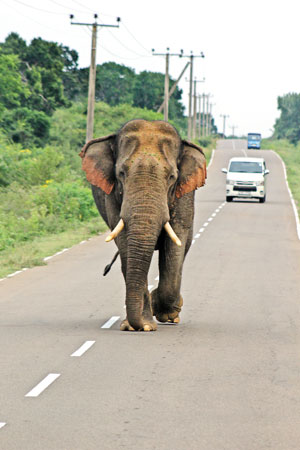
Environmnetalists and conservationists fear that the human-elephant conflict has spiralled out of control
“This land issue is something that has to be resolved by the state entities which own them. Apart from that, district secretaries and divisional secretaries should look into the matter and be strict in releasing land for development,” he said.
He explained that the environmental impact assessment should be done before releasing land for development, and even the use of electric fencing should be done after assessing its implications.
Mr Withanage also pointed out that the agriculture sector should promote new ways of obtaining a high yield from small spaces, and farmers should be guided to grow crops that do not attract elephants.
“If we manage the cultivation and sustainably use land, we might be able to keep the human-elephant conflict from aggravating,” he said.
Environmental conservationist and researcher Supun Lahiru Prakash said government actions so far to address human-elephant conflict lack adequate understanding of both the gravity of the issue and the ecological and behavioural dynamics of elephants.
“The core of the present mitigation strategy appears to remain unchanged: driving elephants into protected areas, confining them within electric fences, and increasing manpower to guard those fences. This approach has demonstrably failed for more than six decades. The recent budget speech of the President, along with subsequent policy actions, reflects no deviation from this outdated framework,” he said.
He said that following the change in government, local political pressure reportedly led to the resumption of elephant drives, despite their scientifically documented ineffectiveness. These operations were reintroduced in areas such as Anuradhapura, Polonnaruwa, Puttalam, and Hambantota, repeating past mistakes. A similar attempt was also ongoing in the Mahiyanganaya area. The consequences were immediate: in 2025, fatalities rose again, with 160 human deaths and 455 elephant deaths.
According to him, Sri Lanka’s approach to elephant management and conflict mitigation was formulated in 1959, when the recommendation was first made to confine elephants to selected protected areas. After more than 60 years of effort by the DWC to achieve this goal, 70% of elephant habitat still lies in landscapes shared with people. It is therefore self-evident that continuing this approach is unrealistic. Environmentalists and experts have consistently conveyed these concerns to the government. Nevertheless, subsequent policy decisions show that these warnings have once again been ignored. 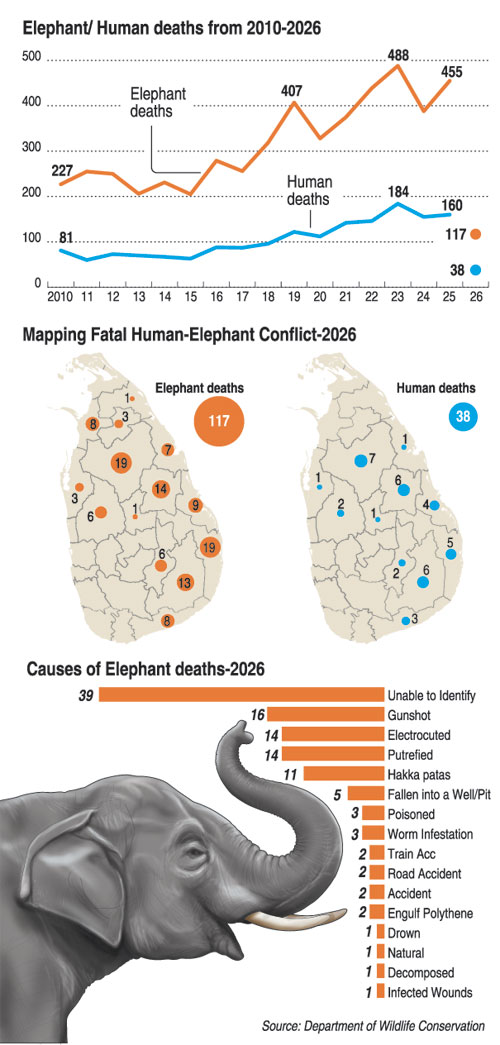
After nine consecutive years of rising fatalities due to human-elephant conflict, there was a drop in 2024.
According to DWC statistics, 388 elephant deaths and 155 human fatalities were recorded island-wide. This improvement resulted from the partial implementation of the National Action Plan for the Mitigation of Human-Elephant Conflict (2020), despite the previous government’s failure to establish a presidential task force to oversee and coordinate its execution, Mr Prakash explained.
Apart from that, the DWC’s decision to discontinue large- and medium-scale elephant drives likely played a significant role in contributing to this positive shift.
Mr Prakash said that the government has effectively sidelined this scientifically grounded and comprehensive National Action Plan. Instead, on July 7 last year, a circular titled “Establishment of District-Level Committees for Elephant-Human Conflict Management” was issued under the signature of the Presidential Secretary. Such fragmented and poorly coordinated administrative measures are unlikely to resolve a crisis of this scale and complexity.
DWC Director General Ranjan Marasinghe said that according to the Fauna and Flora Protection Ordinance preamble, the objective is to preserve biodiversity. But prevailing developments mean greater effort is needed to mitigate the human-elephant conflict.
He said the elephants thrive in savanna-type ecosystems, and so the elephants are attracted to cleared-out areas. Humans and elephants both compete for the same resource.
“The land development requires intervention of stakeholders, relevant ministries and administrative officials, as these lands belong to different entities. The DWC itself is unable to solve the land matter and needs the support of the state, private entities, and people,’’ he said.
He said the DWC has to look into the overall numbers of elephants and their health and maintain carrying capacities to conserve them.
| Lime tree barrier could hold back raiders Growing a hedge of lime trees around vegetable plots is being tried out by the Elephant-Human Coexistence Foundation as a pilot project that could deter elephant raids. This began last week at Maningamuwa village in Anuradhapura District. The bio fence is seen as a non-violent and environmentally sustainable approach. At the launch, 1,200 lime plants were handed to four farmers. These bio fences are meant to reduce the human–elephant conflict while also improving livelihoods and increasing household incomes through conservation-friendly agriculture. A cofounder of the foundation, Panchali Panapitiya, told the Sunday Times the project would help deter elephants and also empower people economically when they gather a lime harvest. The programme was implemented with the support of the District Secretary, the respective Divisional Secretariats, and the Department of Wildlife Conservation.
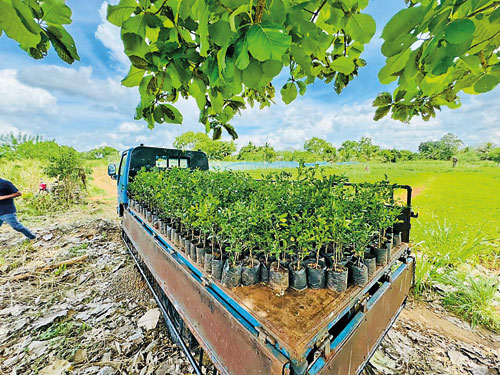 The launch of a pilot project: Lime plants to create a protective bio fence | |
 Thanuja Samarawickrema
 U.G. Aananda Samarawickrema Father and daughter killed on way to farm A father and daughter living in the Monaragahaulpatha area in Matale had been killed by an elephant on Friday, police said. They said the tragedy occurred when the father was taking his daughter on his motorbike to drop her off at a farm where she was employed. They died on admission to Wilgamuwa Provincial Hospital. The victims were identified as Thanuja Samarawickrema, 25, and her father U.G. Aananda Samarawickrema, 57. Pix and text by Indika Aruna Kumara
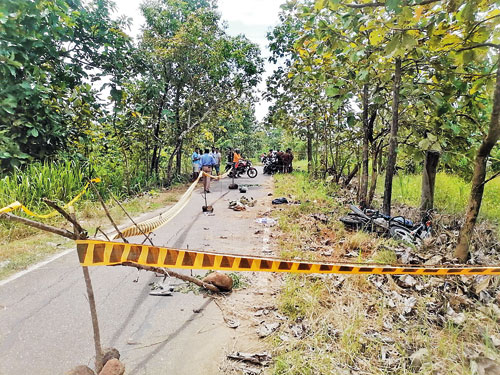 Scene of the tragedy |
The best way to say that you found the home of your dreams is by finding it on Hitad.lk. We have listings for apartments for sale or rent in Sri Lanka, no matter what locale you're looking for! Whether you live in Colombo, Galle, Kandy, Matara, Jaffna and more - we've got them all!