

News
Road rebuilding continues; dozens more contracts to be awarded
View(s):By Ishu Bandara
Only three important impassable road sections remain to be rebuilt out of the 316 roads damaged by Cyclone Ditwah, while the most difficult and costly part of the recovery is slope protection, as stabilising slopes requires specialised advice and designs from the National Building Research Organisation (NBRO), which takes time to coordinate,” said Road Development Authority (RDA) Director General H.H.N.A. Hettiarachchi.
“The biggest problem we are facing during construction is slope damage. For some areas, we can make decisions and continue the construction. But for most, such as Kadugannawa and Reverston, we need advice from the NBRO. I have now appointed a special team to collaborate with the NBRO and prepare the designs to speed up the process,” Mr Hettiarachchi said.
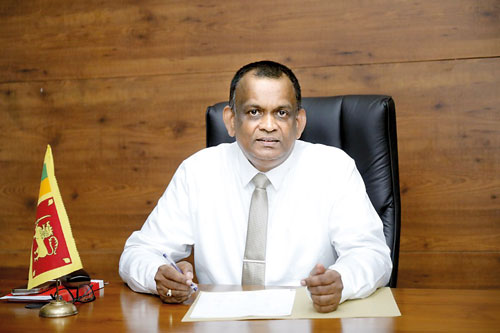
RDA Director General H.H.N.A. Hettiarachchi
According to the RDA, of the 316 roads damaged during the cyclone, only three impassable road sections remain to be rebuilt.
Among them, the Moragahakanda-Wellewela Road is under construction, with a tentative completion date of March 17, 2026. Until then, vehicles can use the bypass road.
Construction on the B 612 Ramboda-Pusulpitiya Road is on hold, pending the NBRO report, while the B 640 Nainamadama-Eranvila Road section also remains impassable, and no completion date has been determined.
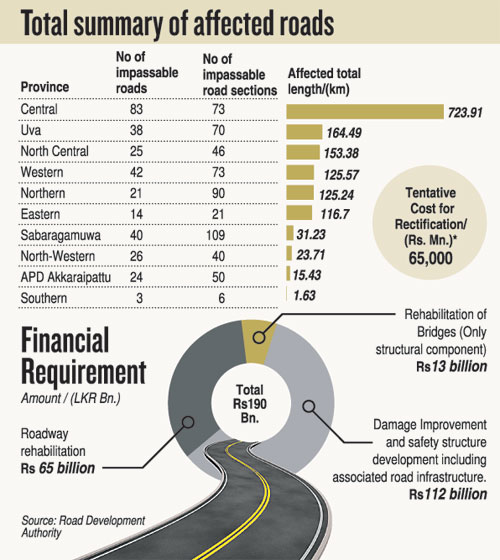
The Sunday Times learns that the total estimated cost for repairs is Rs. 190 billion. Of this, road rehabilitation accounts for Rs. 65bn, bridge reconstruction for Rs. 13bn, while the largest share, Rs. 112bn, is allocated for slope protection.
Mr Hettiarachchi told the Sunday Times that almost 41 bridges were initially identified as damaged. Of these, eight had already been reported as damaged before Cyclone Ditwah but were fully destroyed afterwards. International assistance is now being provided, with India supporting the reconstruction of 16 bridges and China assisting with 17. “Funding arrangements for the remaining bridges are expected to be confirmed by other agencies,” Mr Hettiarachchi said. “India has already supplied 10 Bailey bridges, and another consignment is expected next week. The full reconstruction of permanent bridges is estimated to take about one and a half years.”
As reported in the Sunday Times, although nearly 400 road sections were damaged, the RDA has bundled them into about 160 larger tender packages to make them more practical for contractors to bid for, as some damaged stretches are very small, only about 5 to 10 metres in length.
The RDA Director General said tender advertisements were placed in newspapers calling for bids for road reconstruction under about 160 tender packages, using emergency procurement procedures to expedite the process, enabling tenders to be finalised and work to begin within three weeks.
“We advertised tenders for 12 packages on Thursday, February 12, and another 12 on Friday, February 13, bringing the total number of advertised packages to 24 so far. Our target is to call for 25 to 30 new tenders each week,” Mr Hettiarachchi said.
Mr Hettiarachchi said that for slope protection works, designs are being prepared in collaboration with the NBRO, and bids for these specific projects are expected to begin within one to two weeks.
For now, procurement and supervision are being handled by local engineers, with funding provided through local allocations.
Discussions with international funding agencies are ongoing. Talks with the World Bank and the Saudi Fund are scheduled for next week, while the Japan International Cooperation Agency (JICA) has begun initial studies for possible assistance.
He noted that while fast-track road repairs are expected to be completed in three to six months, the more complex bridge reconstruction and slope protection projects will take significantly longer.
In the meantime, according to a report by the United Nations Development Programme (UNDP), cyclone flooding has submerged over 16,000 km of roads in Sri Lanka, including more than 480 bridges, threatening access to essential services for communities across the country.
The Gampaha and Colombo districts were among the hardest hit. In Gampaha, Katana, Gampaha town, and Ja Ela each recorded over 300 km of exposed roads, while Wattala also experienced high levels of flooding. In Colombo District, Kaduwela emerged as a high-exposure zone.
The railway network has also been affected, with over 278 km of lines and 35 railroad bridges exposed to flooding. In Colombo and Thimbirigasyaya, more than 10 km of tracks were damaged, while Ja-Ela in Gampaha remains a critical point for both road and rail transport. Mannar Town and Nanaddan in Mannar District also recorded over 10 km of exposure each, raising concerns about movement and service access.
The best way to say that you found the home of your dreams is by finding it on Hitad.lk. We have listings for apartments for sale or rent in Sri Lanka, no matter what locale you're looking for! Whether you live in Colombo, Galle, Kandy, Matara, Jaffna and more - we've got them all!