

News
Mechanised beach seine method and related issues get closer scrutiny
View(s):By Sajeniya Sathanandan
Groups of beach seine fishers have ended their Satyagraha following undertakings of further studies to find a balanced solution to the use of tractor-mounted winches for ma-del (beach seine) fishing.
Talks involving relevant parties are to begin on Monday, according to the President’s Media Division.
A meeting was held on Friday at the Presidential Secretariat with President Anura Kumara Dissanayake and the fisher groups.
The President had mentioned that solutions will be provided on a balanced approach by considering the general fishing community and environmental organisations, scientific research and reports from state institutions and the Ministry of Fisheries, and prohibiting banned fishing techniques and adhering to international conventions for marine resource safety.
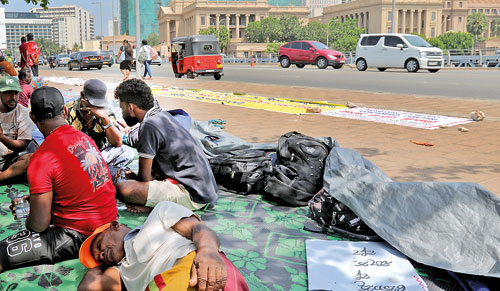
The protest by fishermen in front of the Presidential Secretariat. Pix by M.A. Pushpa Kumara
Also, a separate meeting with the Ministry of Finance will be arranged to address leasing and payment issues.
Pandiyan John Menko, a fisherman, said the president has stated during the meeting that a solution would not be found immediately, but a committee comprising five from each side will be set up and will investigate the issues for one to two months.
Following the protest by fishermen, officials of the Fisheries Ministry and relevant agencies addressed the media on February 9 about the legal aspects of the regulations and the environmental impact.

Fisher group representatives meeting President Anura Kumara Dissanayake
During the press conference, Fisheries and Aquatic Resources Director General Susantha Kahawatta said temporary permission was once given to 183 people for research but was officially revoked in 2016 because the practice was considered unsustainable.
The use of tractors destroys the natural profile of the beach, harms coastal vegetation, and damages sensitive ecosystems like coral reefs and seagrass beds, Coast Conservation and Coastal Resource Management Director General Terney Pradeep Kumara said.
Central Environmental Authority (CEA) Director General Kapila Mahesh Rajapaksa said the high-power winches destroy shallow-water habitats and the organisms essential for the marine food chain.

Ma-del campaigner Danuka Peiris
Marine Environment Protection Authority (MEPA) Chairman Samantha Gunasekara said heavy tractors leave deep trenches up to two feet deep along the shoreline. He also raised concerns about the significant pollution, such as nylon ropes and plastic waste, which are left behind by these operations.
The Assistant Director (Marine) of the Department of Wildlife Conservation, Rekha Sanjeevani Rajasinghe, said the tractor movement on beaches destroys sea turtle nesting sites and eggs. The speed of mechanised pulling prevents turtles and other marine life from escaping the nets.
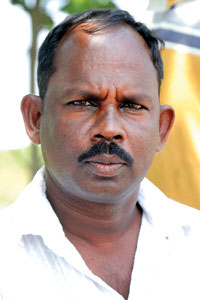
Pandiyan John Menko
The Satyagraha near the Presidential Secretariat was launched by a group of fishers demanding the repeal of the ban on tractor-mounted winches for ma-del (seine net) fishing. The protest began on February 5 and ended on Friday.
The campaign involved seine fishers from several coastal areas, including Mullaitivu, Kokilai, Jaffna, Batticaloa, Puttalam, Kaluthara, Trincomalee, Negombo, and Mannar.
Ma-del campaigner Danuka Peiris, who said he had 20 years of experience, said the protesters would not leave and were prepared to protest until death unless the government could scientifically prove that the winch system caused damage to the environment. He explained that ma-del is an ancestral practice dating back over 150 years which was formalised in 1984 through a gazette, and it mandated the use of human labour for pulling nets and boats for surrounding the fish.
By 2010, the industry faced a significant decline because it relied on manual labour. Younger generations (children of fishers) moved into other professions.
To survive, the industry adopted this method. They initially tried pulling nets directly with tractors in low gear, but this was banned by the government of Mahinda Rajapaksa due to concerns over beach erosion.
The “tak tak” sound is the specific noise made by the tractor engine while it is operating in low gear to pull the fishing nets, which attracts the fish. A winch is mounted onto a stationary tractor. The process typically involves two tractors positioned on either side of the beach. Both tractors use winches to pull the two ends of the net simultaneously from the sea.
The fishers argue that the winch is actually better for the seabed than manual pulling. They explained that when humans pull the net, it is dragged entirely along the sea floor. In contrast, the winch keeps the net four inches above the sea floor.
Mr Peiris said that this specific winch technology is not unique to Sri Lanka; it is also used in Portugal and India (Kerala). This system was developed by the fishermen themselves and was used for 13 to 14 years with the initial guidance and testing by government officials before the recent ban.
He also claimed that the National Aquatic Resources Research and Development Agency (NARA) did tests at three locations in Sri Lanka and found that the winch method is environmentally friendly.
However, NARA officials have not provided a clear response regarding the above statement.
In July 2024, winch operators got a letter stating they must cease the mechanised winch operations by 1 January, he said.
Roughly 500 Ma-Del units across the country are affected. Each unit employs between 35 and 50 workers, impacting thousands of families. These workers come from various regions, including Badulla, Bandarawela, Kandy, and Batticaloa.
He said it is a negative for employers and workers. Businesses are affected, and so are families.
Fishermen criticised the ministry’s technical and development officers for failing to introduce new technologies, forcing fishermen to innovate on their own, and now those innovations are banned.
Fisheries, Aquatic and Ocean Resources Minister Ramalingam Chandrasekar told the Sunday Times that the government has not banned the method entirely. The restriction is on the use of tractors and winches to pull the nets. Traditionally, these nets were pulled within a range of about 1.5 miles (roughly 2.5 kilometres) from shore, a distance that does not require mechanical assistance.
However, fishermen have begun extending their nets as far as 10 to 15 kilometres out and then using tractors and winches to pull them back in. Pulling nets from such great distances acts similarly to bottom trawling, scraping the seabed and destroying the marine environment. The process harms fish larvae and breeding grounds.
Mr Chandrasekar firmly said that the sea will eventually become a “desert”, leaving no resources for the future as millions of juvenile fish that should have remained are hauled in.
“The tractor-pulling method benefits a small group of people; it harms the majority of small-scale fishermen who rely on healthy coastal ecosystems for their daily livelihood,’’ Mr Chandrasekar said. The government met with these fishermen six months ago and told them that the use of tractors and winches would be prohibited after 31 December.
Still, the fishers filed a lawsuit against the government. The minister said that because there is a court hearing on the 27th, the government cannot talk to protesters.
The ban affects the incomes of the fishers, but there is also the issue of sustainability.
Kiriwatige Chamara told the Sunday Times he had borrowed from his employer to feed his family while he took part in the Satyagraha. He is the breadwinner. “Before the ban, all these years I worked not minding the weather even though I am a heart patient.’’
NARA Chairman Sanath Hettiarachchi said, “Back in the day tractor-mounted winches were introduced to assist in pulling the nets without the initial knowledge of authorities. Also, some ministers may have allowed the use of tractors and winches despite previous restrictions’ ’.
They see the use of tractors and winches currently being banned as a window of opportunity for comparative research.
The Sunday Times learned during the campaign period that the price of fish had fluctuated at Peliyagoda Fish Market, including Maduwa at Rs 1,400, Paraw at Rs 1,800, Hendella at Rs 2,000, Suddha at Rs 1,500, Kelawella at Rs 1,500, Balaya at Rs 1,100, Atawalla at Rs 1,300, Hurulla at Rs 1,200, Gal Malu at Rs 1,500, Thambuwa at Rs 1,600, and Thalapath at Rs 2,300. Also, the source mentioned fish shortages, market demand and imports could be other factors for price volatility.
The best way to say that you found the home of your dreams is by finding it on Hitad.lk. We have listings for apartments for sale or rent in Sri Lanka, no matter what locale you're looking for! Whether you live in Colombo, Galle, Kandy, Matara, Jaffna and more - we've got them all!