

News
“Any erosion of judicial independence harms not only the judiciary, but society itself”
View(s):- Justice Gihan Kulatunga’s address at the ceremonial sitting to welcome him to the Supreme Court
By Ranjith Padmasiri
Judicial independence is not an abstract ideal, nor is it a privilege conferred upon judges. It is, at its core, a constitutional guarantee owed to the people who come before our courts seeking justice,
The observation was made by Justice Gihan Kulatunga at the ceremonial sitting to welcome him to the Supreme Court this week.
Excerpts from Justice Kulatunga’s speech follows:
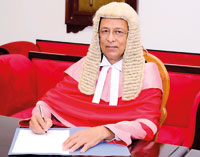
Justice Gihan Kulatunga
“Judges do not exercise power in their own right; they hold office in trust for the public. That trust is sustained only when justice is administered impartially, efficiently, and with integrity. Any erosion of judicial independence ultimately harms not only the judiciary, but society itself.
“As I see, when one reflects upon judicial accountability, it is not the mere accountability simpliciter but how judicial accountability can be balanced with judicial independence.
“These are complementary values, in the sense that the independence afforded and enjoyed by the judiciary is on the premise that those of us judges who are vested with judicial power will conduct and behave in an ethical manner both in our judicial as well as our personal lives.
“This necessarily will follow that maintaining the integrity and propriety are necessary attributes that accompany the assumption of this exalted office, which will enable the maintaining of the independence of the judiciary, which is essential to maintain public confidence.
“We, as judges, cannot have a distinction between our official and personal lives. Impartiality demands more than the absence of bias; it requires discipline of mind, habit, and outlook. It requires all judges to hear courteously, answer wisely, consider soberly, and decide impartially.
“As for hearing courteously, during the last Court Vacation, I had occasion to reflect upon Lord Denning’s book, ‘The Due Process of Law’, particularly his observations on what he called “the judge who talked too much” about a judicial officer more eager to be heard than to listen.
“Recalling the decision in Jones v. National Coal Board, Lord Denning acknowledged that the trial judge had intervened with the best of intentions. He sought clarity. Yet good intentions, however sincere, when too frequent or too forceful, risk the appearance of a step beyond the proper bounds of the judicial role. Lord Denning held that a judge is “not a mere umpire to answer the question ‘How’s that?’” nor is he an advocate in disguise. He must resist the temptation to descend into the arena, as if and when a judge puts on the robe of an advocate, he sheds the mantle of impartiality; that change does not become him well.
“Lord Denning, ordering a re-trial, quoted Lord Bacon’s words, “Patience and gravity of hearing is an essential part of justice; and an over-speaking judge is no well-tuned cymbal.” I wish that I had read this much earlier in my judicial career. In retrospect, a dialogue between the bench and the bar is not undesirable.
“Attorney General Parinda Ranasinghe, Jr in his address said Justice Kulathunga, will bring in a vast amalgam of knowledge, experience competency and a high degree of skill to this age old institution of the Supreme Court.
““It will no doubt augment and deepen the overall excellence of the dispensation of justice in our country and enhance the much-needed credibility.”, he said.
(Please visit for full speeches)
The best way to say that you found the home of your dreams is by finding it on Hitad.lk. We have listings for apartments for sale or rent in Sri Lanka, no matter what locale you're looking for! Whether you live in Colombo, Galle, Kandy, Matara, Jaffna and more - we've got them all!