

News
Failed tests and confidential documents: Heat over South African coal
View(s):By Namini Wijedasa
Internal documents from the Lakvijaya coal power plant show that samples from three consecutive shipments of South African coal, bought through India’s Trident Chemphar Ltd, failed quality tests.
The official data proves that each coal shipment registered Gross Calorific Values (GCV)—which represents the heat released upon combustion—well below levels required to generate optimum electricity from the plant’s three units.
While the specification of the procurement agency Lanka Coal Company (Pvt) Ltd (LCC) was for GCVs of between 5,900 (reject value) and 6,150, Lakvijaya test reports show that the first shipment registered a calorific value of 5,348; the second one was 5,420; and the third was even lower, at 4,805.
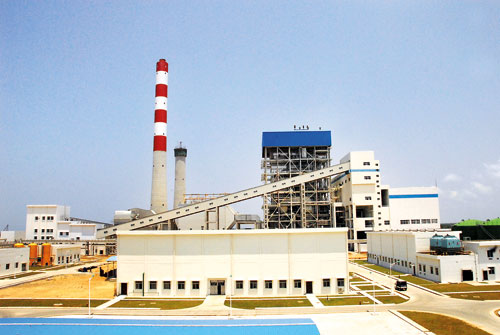
Lakvijaya coal power plant
Similarly, a coal consignment is liable for rejection if its ash content is above 16 percent (the standard acceptable value is 11 percent). But these reports indicate that ash content in the first consignment was 21.29 percent by weight; the second was 22.42 percent; while the third was 22.21 percent.
The LCC’s latest coal tender became controversial after a report was leaked last month from the Lakvijaya plant indicating that the first shipment received under the agreement had failed quality tests, jeopardising both electricity generation and the coal power plant.
Who wanted the report withdrawn?
The calorific value of coal depends on ash and moisture content. Lakvijaya generates electricity by burning pulverised coal to produce high-pressure steam that drives turbines. The lower the GCV and the higher the ash content, the lesser the heat that is generated.
The damning internal report was submitted this week to the Sectoral Oversight Committee (SOC) on Infrastructure and Strategic Development. During its proceedings on Thursday, Chairman SM Marikkar revealed that 24 hours after it was presented, the Energy Ministry—he did not name anyone—requested the SOC Secretary to “disregard” the Lakvijaya report.
A separate document was thereafter presented to the SOC containing results from an accredited Indian laboratory called Cotecna, indicating that, while the first shipment had failed quality tests, the second and third shipments had passed. This directly clashes with the internal report of the Lakvijaya coal power plant.
This glaring contradiction was repeatedly questioned by SOC members, including Opposition Leader Sajith Premadasa, and Samagi Jana Balawegaya MPs Mr. Marikkar and Ajith P. Perera. The most vocal member of the National People’s Power was Asitha Niroshana Egoda Vithana. The Sunday Times watched the proceedings and also obtained copies of the relevant documents.
Not fake news, just
confidential
When asked whether the Lakvijaya reports contained falsified data, Power Plant Manager P. W. Bamunusinghe—who was also present—said that a list of questions was sent to the plant after which “internally, we provided answers to it”.
Mr Bamunusinghe contended that it was a confidential document sent to the office of the Ceylon Electricity Board’s (CEB) General Manager for discussion purposes and that “as a mistake, it was sent to Parliament”.
Asked directly whether the information was false, he replied: “According to our experience, it is correct”.
SOC Chairman Mr. Marikkar then notified Energy Ministry Secretary K.T.M. Udayanga Hemapala that the internal, real-time report of the Lakvijaya power plant has been deemed accurate and that, even though the SOC had been asked to disregard it, “we will not ignore it”.
“According to this report, three shipments have failed,” he observed. “The third shipment is worse than the first. Based on this information, the Committee is directing you to conduct an independent inquiry as to why there is a contradiction between these two.” Prof. Hemapala was instructed to “do it immediately”, before the relevant coal samples run out; also to test samples at another international lab that was not Cotecna.
How do these losses arise?
There are other indications in the documents submitted to the SOC that the coal shipments from South Africa were problematic. For instance, a letter sent to the SOC by Additional Secretary (Power and Power Sector Reforms) of the Energy ministry K.L.R.C. Wijayasinghe includes a table of “estimated direct losses” incurred by the CEB, if any, in the generation of power using low-quality coal under the respective shipment.
Puzzlingly, despite the Cotecna results clearing shipments two, three and four as being of acceptable quality, the Energy Ministry has estimated direct losses due to electricity generation from the first shipment to be Rs. 595.1mn (although the recoverable penalty is said to be Rs 644.5mn); the second to be Rs. 288.5mn (recoverable penalty is just Rs. 135.1mn; the third is a massive Rs. 1.04bn rupees (recoverable penalty is only Rs. 150.3mn); and the fourth is Rs. 865mn (recoverable penalty is Rs. 107.1mn).
The SOC observed that these estimated losses make it clear that the Lakvijaya internal report is accurate and that the numbers prove that the third shipment—with its estimated loss being the highest—was worse than the first.
The regulator, Public Securities Commission of Sri Lanka, was separately asked to submit to the SOC data they possess about electricity generation from Lakvijaya on days the low-quality coal was fed into the plant; and to calculate whether the reported estimated losses are accurate.
More coal for the same
electricity
Mr. Premadasa pointed to another piece of documentary evidence: an “abnormal” quantity of coal (from five shipments of this South African coal) has to be burnt to generate the required amount of electricity per kilowatt hour. For instance, the optimum average coal rate in terms of kilograms per kWh is 0.36. However, with the low-quality coal, 0.401kg/kWh is needed in the first shipment; 0.387kg/kWh in the second one; 0.429kg/kWh in the third one; 0.413kg/kWh in the fourth one; and 0.434kg/kWh in the fifth shipment.
“Never mind the load port report, this report, that report,” he remarked. “There is a serious problem in these shipments. When it comes to burning the coal, you can’t hide the quality. It is recorded in the charts. It is very clear in the statistics you provided that it is not in one or two shipments, there is substandard coal in several shipments because you have to burn more coal than necessary to generate electricity.”
If the power plant cannot generate sufficient electricity, the cost of using alternate sources of power—such as diesel—is passed onto the consumer, he warned.
What happened to the Auditor General’s recommendations?
Several concerns were raised regarding the manner in which the tender was carried out. For instance, the number of days allowed for bidding was reduced from the usual 42 days to 21 (then extended by another week). And certain crucial specifications were lowered, which critics say allow fly-by-night companies to participate in tenders.
For instance, it was originally mandatory for applicants to have “experience in supplying at least 01 million MT of coal having GCV of 5,900 Kcal/kg or higher in last 36 months”. This was reduced to companies with experience of supplying more than 500,000 MT of any coal type in the last 36 months and just 100,000 tons of coal above 5,900 GCV.
LCC representatives said these conditions loosened in June 2023, during the economic crisis, to enable more suppliers to participate and to ensure speedier procurement.
Mr. Perera pointed out, however, that the Auditor General had subsequently inquired and submitted recommendations via the Parliamentary Committee on Public Finance that the tender process be normalised since the extraordinary situation that existed during the economic crisis no longer prevailed.
The officials present admitted that this was not done. It was questioned whether they had “avoided” notifying the Minister and Cabinet of the Auditor General’s recommendations, preferring to continue with a procurement process that was now irrelevant. The Ministry Secretary was directed to immediately take action in this regard.
Officials also revealed that the Attorney General’s advice had been sought with regard to several aspects of the procurement and its outcomes.
Hugely delayed shipments
Meanwhile, LCC officials revealed that, under the term tender agreement, there should be a total of 14 shipments by the end of February. At present, however, only seven have arrived—with the sixth and seventh now being unloaded. They said they have sent emails to the supplier, urging them to get the shipments back on track according to the agreed schedule. No further action has been taken.
For the first failed shipment—which was proven to be of low quality by both the Lakvijaya report and the Cotecna tests—LCC has claimed a penalty of US$ 2.2mn, which covers the losses sustained. No other penalties have been sought. There has been no termination warning.
Prof. Hemapala revealed that Cabinet approval has been granted to import 300,000 MT of coal through emergency procurement, if such a situation arises. This was also dissected by the SOC, which pointed out that emergency purchases typically cost more than if spot tenders had been systematically included in the master procurement plan.
He also admitted, upon questioning, that there were two other options: to contact the second lowest bidder, with the option of negotiating down its price; or to terminate the contract and go for a new tender.
The best way to say that you found the home of your dreams is by finding it on Hitad.lk. We have listings for apartments for sale or rent in Sri Lanka, no matter what locale you're looking for! Whether you live in Colombo, Galle, Kandy, Matara, Jaffna and more - we've got them all!