

News
Serious concerns over social media posts on fatty liver disease
View(s):- Important Sri Lankan study finds widespread quality deficiencies and gaps in authoritative health communication
By Kumudini Hettiarachchi
Serious concerns have come to the fore after a team of Sri Lankan researchers examined social media and health information regarding fatty liver disease, originating from Sri Lanka.
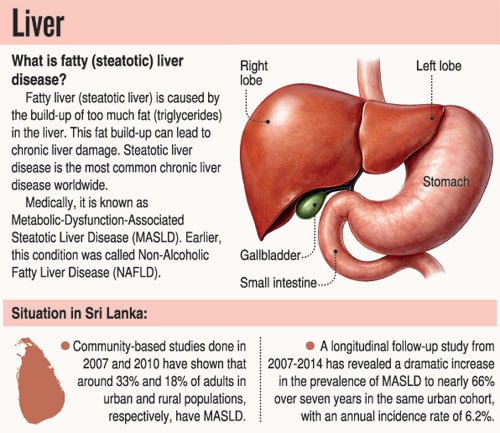
In the first broad analysis of posts relating to Metabolic-dysfunction Associated Steatotic Liver Disease (MASLD) in Sri Lanka on social media (SoMe), the team found that most content “originated” from non-healthcare sources. MASLD was earlier known as Non-Alcoholic Fatty Liver Disease (NAFLD).

Prof. Madunil Niriella
Other disturbing findings include a digital health information landscape characterised by widespread quality deficiencies and gaps in authoritative health communication.
“The findings have underscored the urgent need for coordinated public health interventions that address both content quality and the fundamental mismatch between information reliability and user engagement in SoMe environments,” the team underscores.
The team advocates for regulatory oversight mechanisms – on guidelines for health information quality assessment and verification systems – potentially coordinated through the Health Ministry and the Health Education Bureau.
SoMe is defined as “internet-based channels that allow users to opportunistically interact and selectively self-present, either in real-time or asynchronously, with broad and narrow audiences who derive value from user-generated content and the perception of interaction with others”.
In the study titled ‘Evaluating the quality of social media content on MASLD: An experience from a lower middle-income country’, the team had looked at posts in Sinhala, English and Tamil on Facebook, YouTube, TikTok, Instagram and X (Twitter) in Sri Lanka, covering two decades (20 years) from January 1, 2005, to December 31, 2024.
Their findings on this important issue have been published in ‘PLOS One’ on March 13, 2026.
PLOS One is the world’s largest multidisciplinary, open-access academic journal, publishing peer-reviewed research across science, medicine, engineering and related social sciences/humanities. Based in California, United States of America, it is published by PLOS, a non-profit corporation.
The study team comprised Madunil Anuk Niriella, Indeewari Prathibha Wijesingha, Krishanni Prabagar, Arjuna Priyadarshin De Silva & Hithanadura Janaka de Silva of the Faculty of Medicine, University of Kelaniya, Ragama; Dhanushi Abeynayake of the Embilipitiya District General Hospital; Hiruni Jayasena of the Faculty of Medicine, Sir John Kotalawala Defence University; Piyal Rangana Herath of the Polonnaruwa Teaching Hospital; Anuratha Kajendran of the Jaffna Teaching Hospital; Vithiya Rishikesavan of the Kalutara Teaching Hospital; Karthiha Balendran of the Faculty of Medicine, University of Jaffna; and Tiloka de Silva of the Faculty of Business, University of Moratuwa.
“Our primary objective was to evaluate the accuracy, completeness and quality of the content of SoMe posts related to fatty liver disease or MASLD originating from Sri Lanka,” says the team.
Reiterating that MASLD represents a significant public health concern, the lead author of the study, Prof. Niriella, says that SoMe increasingly influences health perceptions in lower-middle-income countries. One-third (1/3rd) of Sri Lanka’s population uses SoMe for health information.
“Assessing MASLD content for accuracy, completeness and quality on SoMe is, therefore, important,” he says, underscoring that their study findings highlight the need for improved quality control and health literacy initiatives on SoMe platforms.
This cross-sectional study of 289 posts covered YouTube – 158 (54.7%); Facebook – 101 (34.9%); TikTok – 14 (4.8%); X (Twitter) – 11 (3.8%); and Instagram – 5 (1.7%). The languages of the posts were: Sinhala – 214 (74.0%); Tamil – 54 (18.7%); and English – 21 (7.3%).
The team had categorised the posts as ‘Fresh’ if they scored 60% or higher on all three factors of accuracy, completeness and quality or ‘Rotten’, if otherwise. The freshness analysis had revealed alarming quality deficiencies: 237 posts (82%) were classified as ‘rotten’, and only 52 (18%) as ‘fresh’.
The team had also categorised the posts by ‘source profile’ and ‘content type’.
The source profile included:
- ‘Health Institutions’, a third-party organisation like a government, university, hospital, research group, etc.
- ‘Healthcare Professionals’, a person practising clinical care, research or education.
- ‘Alternative Healthcare Professionals’, a person practising indigenous or alternative medicine.
- ‘Non-Healthcare Persons’, a person with fatty liver disease or any other individual who is not a healthcare professional.
- ‘Undisclosed Identity’, from a page/channel, but does not provide information about the author/creator.
The way people use SoMe differed by age group, the study team states, noting that over 50% of people in all age groups used it to find available management and treatment information.
By January 2023, 7.2 million Sri Lankans were using SoMe – Facebook and YouTube had 6.5 million and 7 million users respectively. Other popular SoMe platforms like Instagram, LinkedIn, and X (Twitter) had 1.8 million, 1.4 million and 373,000
Sri Lankan users, respectively.
| The important but alarming findings The poor quality of information from unverified sources and the potential to provide misinformation were two of the biggest concerns when using SoMe for health-related purposes, the study team had found. This is while the “most” alarming finding was that 82% of all analysed posts failed to meet acceptable quality standards, representing a significant threat to public health decision-making, it is learnt. The analysis of content creators had revealed “concerning” patterns in source credibility:
The other findings included:
| |
| Studies in Korea & China A survey conducted in Korea, analysing 47 websites related to SoMe and MASLD, showed that most of them needed significant quality improvement, the study team has recorded. Though websites maintained by institutions such as government agencies, hospitals and universities were considered more reliable, the study found no significant difference between them and websites created by other groups (pharmaceutical companies, charities, support groups, etc.). The abundance of information was also making it difficult for users to differentiate which source to use. In China, a study evaluating 497 videos had found that the quality of MASLD-related TikTok videos needed improvement. Compared with videos from science bloggers and medical institutions, those from health professionals may provide more accurate guidance on the treatment and prevention of MASLD. A similar cross-sectional study evaluating the quality of MASLD of the top 100 Chinese TikTok videos had recommended that medical information on TikTok was not rigorous enough to guide patients in making accurate judgments and that platforms should monitor and guide publishers to help promote and disseminate quality content. |
The best way to say that you found the home of your dreams is by finding it on Hitad.lk. We have listings for apartments for sale or rent in Sri Lanka, no matter what locale you're looking for! Whether you live in Colombo, Galle, Kandy, Matara, Jaffna and more - we've got them all!