

News
Impractical school guidelines trip up heatwave response
View(s):By Sajeniya Sathanandan
Despite a collective commitment to student safety, a lack of infrastructure, water facilities and impractical guidelines have created a critical dilemma for professionals managing heat wave risks.
When questioned about the impractical guidelines issued to protect students from heat, Deputy Education and Higher Education Minister Madhura Senevirathna told the Sunday Times that sanitary and water facilities were the top priority of the 2025 budget. While some projects are still underway, many are completed, particularly in the estate sector. The deputy minister said that ongoing work is intended to eventually cover all schools that do not have the infrastructure.
For schools facing challenges where guidelines cannot be easily met, the minister suggested protocols, including that principals should seek instructions and opinions from their immediate supervisors or provincial directors if they encounter problems.
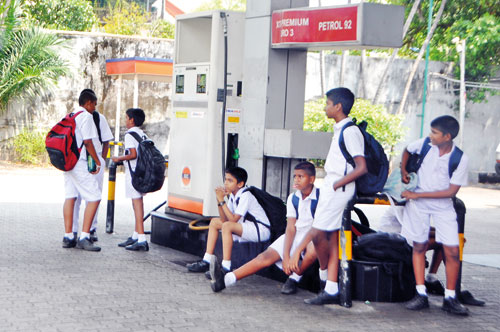
Students seek shade at a petrol shade away from the scorching sun while waiting for a bus. Pic by Priyanka Samaraweera
Depending on the situation, schools can contact the zonal director, provincial secretary, or provincial director for assistance. While provincial schools deal with their respective provincial administrators, the ministry is directly responsible for addressing issues at national schools.
An official from the Ministry of Education, involved in creating the guidelines, told the Sunday Times that they are not suitable for certain schools and need to be handled by principals.
Provincial schools can seek support from zonal education offices and provincial departments. National schools may contact the ministry directly, though the provincial director still maintains responsibility for them.
All schools fall under a zonal director, and in some provinces, divisional directors and their staff also share responsibility.
The Ministry of Education has issued guidelines to protect students from heat waves, which do not apply to certain schools as they lack many facilities.
While the unions are not opposed to the guidelines themselves, they claim that certain requirements are impractical for many schools. They argue that during a crisis, it is unrealistic to expect immediate solutions for long-standing, unacknowledged issues such as a lack of clean water, poor infrastructure, and various other systemic problems.
Sri Lanka National Principals’ Association president Sugishwara Wimalaratne said principals are expected to manage guidelines based on their specific school facilities and the local environment and that is what they do. “It is practically impossible to apply these guidelines 100%. In some cases, guidelines are issued more for the authorities’ own protection than as a realistic solution for schools.”
Schools have been told to provide adequate, clean drinking water and encourage students to hydrate themselves.
Ceylon Teachers Union General Secretary, Joseph Stalin said: ”Kottawa Dharmapala School, which has over 4,000 students, said that it was without water for three days. Despite the situation, no water tankers were sent by the authorities.”
Electric fans are expected to be used, and students who are in multi-storey buildings or buildings with tin or metal roofs should be moved to cooler, temporary locations during periods of extreme heat. “Many small schools lack basic facilities like fans or enough space to move students. These guidelines have no use and are published only for public display,’’ Mr Stalin said.
| Extreme heat threatens the health and safety of children The Government has warned parents and educators that extreme weather is reaching dangerous levels across the country. Conditions are a threat to the health and safety of children. Medical experts warn that young bodies are at severe risk of heatstroke, dehydration, and respiratory distress. Authorities have ordered a halt to all outdoor activities. This includes any event or activities related to sports, New Year festivities, and any public event involving prolonged sun exposure or physical exertion for minors. Parents are being asked to closely watch their children for signs of exhaustion or fever, and keep them hydrated within the safety of their home. Also, prioritise children’s lives over tradition or trophies. Lady Ridgeway Hospital Consultant Paediatrician Dr. Deepal Perera said excessive sweat leads to loss of water and sodium which leads to dehydration. Children need to be protected from dehydration; if not, they will face problems head to toe, including headache, difficulty concentrating, poor memory, tiredness, exhaustion, skin rashes, poor appetite, nausea and many other factors. Dr Perera warned parents and educators that prolonged exposure to the sun or working outdoors without replacing salt and water can lead to heat stroke. “Heat stroke is severe because it affects the heart and brain, which can lead to fainting, seizures, and death.” It is essential to consume water and solutes to recover what is lost through sweat. To regain lost water and sodium, certain types of fluids need to be consumed. Dr Perera advises parents to give king coconut water, coconut water, kanji, and soup to protect students from the heat risks. | |
The best way to say that you found the home of your dreams is by finding it on Hitad.lk. We have listings for apartments for sale or rent in Sri Lanka, no matter what locale you're looking for! Whether you live in Colombo, Galle, Kandy, Matara, Jaffna and more - we've got them all!