


Tale of two models on Jawatta Road
View(s):Halfway along Jawatta Road, you arrive at a junction that tells an interesting story. On one side of the road stands “Lanka Salusala,” – a government-owned business. Directly opposite, you find a private enterprise – the sales outlet of CIC Holdings.
You do not need complex economic theories or detailed research to understand the difference. All it takes is a glance to the left and then to the right. If you make sense out of what you see, it was like reading a good economic book. The contrast between the two businesses speaks for itself, showing which model thrives and which struggles.
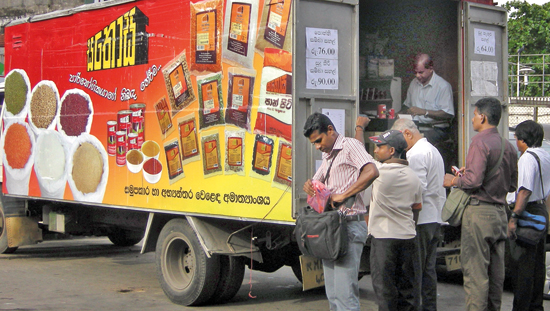
A Lanka Sathosa lorry with people queuing to buy products. Lanka Sathosa is also a SOE that is struggling with losses and past debt.
Contrasting models
The location is interesting because the outlook of the two business outlets either sides of the road simply demonstrate who can run a business better – the government or the private sector. Whenever I travel along this road, I am fascinated by the sharp contrast between the two models.
On a large plot of land with buildings in the heart of Colombo that carry immense commercial value, Lanka Salusala today looks abandoned – not for the first time, because it has been abandoned many times in the past. The place appears to be dilapidated. The facility is old and run-down, with little activity and a neglected appearance. The rusty and broken gate which can barely protect the premises is guarded by a security officer.
Although there seems to be no business activity happening within the premises, I am sure it still has a cost to the taxpayer. I believe that its maintenance cost and perhaps the employee salaries too if they were not absorbed by any other government agency, must be draining from the government coffers.
Across the road
Right across the road, the CIC outlet is located in a compact building on a tiny piece of land, compared to the big land of Salusala. It looks bright, colourful and modern, with neat displays of high-quality and high-priced agro-products: fruits, vegetables, processed agro products, dairy products, poultry products and exotic rice varieties.
 Customers appear to be coming in and going out throughout the day. The CIC supply chain between the company’s sales outlet and its farms as well as the farmers in the country’s remote areas seems to be running efficiently and constantly. It also has ready-to-eat meals, snacks and fruit salads as well as fruit juice varieties and lassie varieties, deriving the benefits of scale and scope of economies.
One side (of the road) shows the slow, tired face of a government-run shop, while the other side shows the energy and efficiency of a private business. The two business premises, facing each other, tell their own story about who manages business better and who contributes to the economy better.
Flourishing in protectionism
Lanka Salusala was established in 1967 as a state-owned enterprise (SOE) to lead the local handloom industry and manage the wholesale and retail distribution of textiles. It was given a significant mandate during Sri Lanka’s protectionist era from the late 1950s to 1977, when markets were tightly controlled, and competition was virtually absent.
In such a policy environment, a government business could survive and even appear to flourish. When supply was scarce and choices were limited, customers had no option but to line up at Salusala. Profitability was not a reflection of efficiency or innovation, but simply the outcome of monopoly conditions.
The quality of the business, its standards of efficiency, and its incentives for innovation were entirely different questions. In reality, the enterprise thrived only because people had no alternatives.
During times of shortage, when word spread that textiles had arrived at Salusala, women working in government offices would take ‘short leave’ to rush there. If they delayed, they risked missing out altogether, as supplies would quickly run out.
Printed sarees
At that time there were no printed sarees for ladies. What was available in the Salusala was plain sarees produced in our government-owned textile factories. Often, the quantity that can be purchased by a person is also regulated by the government.
After buying a saree, women had another task ahead of them – to print designs at home. For this, they would use a sweet potato, cut in half and carved with a design in relief. Colours dissolved in kerosene oil were applied to the carved surface, which was then pressed onto the saree spread out on the floor. In this way, a plain saree was turned into a printed one.
But the process had its problems. Not all prints looked attractive, since textile printing requires professional skill and proper technology. Another common issue was the strong kerosene smell, which lingered in trains, buses, and even office spaces.
After trade liberalisation in 1977, Lanka Salusala struggled to survive in a competitive market. Import controls were relaxed, government monopoly in import trade and distribution was abolished, private enterprise was encouraged, and trade barriers were reduced.
In this new environment, consumers had access to a wider range of choices, with better quality and lower prices. Why would they return to Salusala when fashionable, competitively priced, and higher-quality products were available elsewhere?
Although Salusala was closed down several times, successive governments attempted to revive it, driven by nostalgic ideas of restoring its old glory. Each revival involved pumping taxpayers’ money into the enterprise, only to end in losses. The repeated failures confirmed a universal truth: governments generally do not succeed in running businesses.
Singapore-style
When we talk about the failure of governments in doing business, there are few counter-arguments which I have come across frequently. The first is that there are countries which run the SOEs as efficient as private business.
A well-documented case study are the SOEs managed by the government of Singapore. If Sri Lanka can also have a Singapore-styled government, I am sure Sri Lanka can also manage its SOEs – of course, after privatising or closing down many of the white elephants out of 400 plus SOEs.
Singapore has over 60 statutory bodies under its ministries and about 20 government-linked key SOEs, managed by a management company, called Temasek Holdings. Although there are discussions about replicating a “Temasek-type” model to Sri Lankan SOEs, Sri Lanka does not have a Singapore-style political and governance structure.
Another argument draws parallels from South Korea’s SOEs which became global business giants. It is also true as the government set up some of the SOEs, but they did not become global giants in the hands of the government itself. The government privatised them, listed on the Stock Exchange, and the employees were made the shareholders.
It is, however, wrong to attribute economic progress of South Korea or any other country merely to the practice of nurturing their SOEs or extending government’s helping hand to a handful of private companies. Economic progress of a country depends on the overall policy environment that attracts investment flows – investment from both local and foreign investors that is the most fundamental driving force of success.
Conquering markets
Another common argument against liberalisation is that it destroyed domestic industries by exposing them to foreign competition. The claim is that, without liberalisation, Sri Lanka’s pre-1977 industries and SOEs would have grown and conquered export markets.
But if those industries truly had the capacity to succeed internationally, they would have shown signs of dynamism even before liberalisation. Instead, they remained inefficient, undercapitalised, underutilised, and technologically backward. Liberalisation did not destroy strong enterprises; it simply revealed the structural weaknesses of businesses that had been sheltered from competition for decades.
The evidence lies in what happened after 1977. Export growth in many sectors came not from the old protected industries, but from new, privately-owned enterprises that thrived under liberalised conditions. These businesses proved far more capable of competing globally, demonstrating that openness and competition, rather than protectionism, were the real drivers of success.
(The writer is Emeritus Professor at the University of Colombo and Executive Director of the Centre for Poverty Analysis (CEPA) and can be reached at sirimal@econ.cmb.ac.lk and follow on Twitter @SirimalAshoka).
Hitad.lk has you covered with quality used or brand new cars for sale that are budget friendly yet reliable! Now is the time to sell your old ride for something more attractive to today's modern automotive market demands. Browse through our selection of affordable options now on Hitad.lk before deciding on what will work best for you!