

News
Where have all the sparrows gone?
View(s):By Malaka Rodrigo
World House Sparrow Day draws attention to a tiny bird whose absence speaks volumes about deeper ecological shifts unfolding right at our doorstep
There was a time when mornings began with the lively chatter of sparrows perched on window sills and roof tiles. Their presence was so familiar it faded into the background of daily life. Today, that sound is disappearing from many towns and cities in Sri Lanka, drawing attention to a bird once taken for granted.
Jayasuriya Wijedasa, a nature enthusiast from Kandy who closely observes house sparrows, has witnessed this change firsthand. “Last year, on Sparrow Day, I photographed many sparrows at the Kandy Municipal Market, the entrance to the municipal car park, and the E. L. Senanayake Park. But this year, there is a reduction,” he told theSunday Times.

-

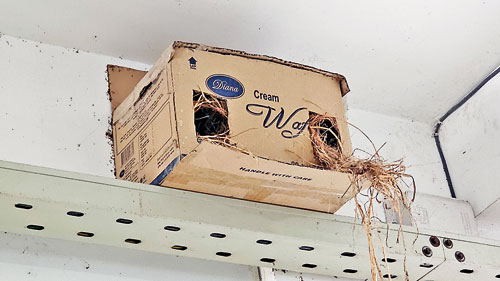
- A nest at the Matara Market
-

- The House Sparrow

-

- A pair among the vegetables for sale at the market. Pix by Dulithi Nethumsa

He recalls how, decades ago, village homes often had small clay pots with openings, placed specifically for sparrows to nest in. Their presence was even considered a sign of good luck and prosperity. “It is very sad to see such an alarming decline of this bird close to our heart now,” he said.
The decline of the house sparrow is not limited to Kandy; or even Sri Lanka. As a species with a wide global distribution, its reduction has puzzled ornithologists worldwide. To highlight how even common species can silently decline, March 20 has been observed as World House Sparrow Day since 2010.
Marking the occasion this year, the Field Ornithology Group of Sri Lanka (FOGSL), together with the Young Zoologists’ Association (YZA), held an awareness programme at the University of Colombo. The event featured lectures by Prof. Nihal Dayawansa and environmentalist Jagath Gunawardana, who stressed the urgency of addressing the issue.
Vanishing from familiar spaces
The house sparrow (Passer domesticus), once abundant across both urban and rural landscapes, has shown noticeable declines in many parts of Sri Lanka, reflecting global trends. While not yet considered endangered locally, its reduced numbers in cities are increasingly evident, said Prof. Dayawansa, President of FOGSL.
Several factors are driving this decline. Modern architecture has removed the small cavities sparrows once used for nesting, replacing tiled roofs and ventilated eaves with glass, steel, and concrete structures that offer little shelter.
Food scarcity could be another major concern according to the experts. Sparrows depend heavily on insects, particularly to feed their chicks. The widespread use of pesticides and the reduction of green spaces have diminished insect populations, making it harder for sparrows to find sufficient food during breeding seasons.
Although electromagnetic radiation from communication towers is sometimes cited in public discussions, scientists emphasise that habitat loss and food availability remain the primary causes for the decline of the House Sparrows.
Jagath Gunawardana, a senior environmental lawyer and veteran naturalist, recalls noticing this trend decades ago. “While living in Ampara, I first observed a reduction in house sparrows visiting our home. By around 1980, they stopped visiting our house and disappeared from our garden,” he said, adding that similar patterns are now seen across the country.
He also noted that due to their once high abundance, house sparrows were not even included in Sri Lanka’s protected species list until 2009. Today, only a handful of bird species remain unprotected, mainly due to their impact on agriculture. The earlier exclusion of sparrows from protection highlights how common they once were.
Prof. Dayawansa emphasised that sparrows are important indicators of environmental health. “Their disappearance signals deeper ecological imbalances. It also reminds us that even common species can become threatened if we fail to monitor them,” he said.
Survivors in unexpected places
Despite their decline, sparrows have not vanished entirely. They continue to thrive in smaller towns and rural areas, where traditional houses, home gardens, and mixed vegetation provide suitable nesting sites and food.
Markets, grain stores, and livestock areas also support stable populations, offering easy access to spilled grain and insects. Even within cities, pockets of survival remain—particularly in older buildings, urban wetlands, and well-vegetated home gardens. Railway stations and busy marketplaces often serve as last refuges.
These microhabitats demonstrate that even small environmental changes can support their survival.
The house sparrow has evolved alongside humans for thousands of years, making it a classic example of a “commensal” species – one that benefits from human settlements without harming them. Its decline therefore reflects broader changes in how we build, farm, and live. Gunawardana noted, that “When sparrows disappear, it tells us something is out of balance in our immediate environment.”
Small actions, meaningful impact
Encouragingly, sparrow conservation does not require large-scale interventions. Simple steps—such as providing nesting boxes, maintaining home gardens with native plants, reducing pesticide use, and allowing spaces that support insect life—can help their populations recover.
At the FOGSL-organised House Sparrow Day, it was also demonstrated how to make a pot suitable for the affable avian.
The best way to say that you found the home of your dreams is by finding it on Hitad.lk. We have listings for apartments for sale or rent in Sri Lanka, no matter what locale you're looking for! Whether you live in Colombo, Galle, Kandy, Matara, Jaffna and more - we've got them all!