

News
Dozens of child drug couriers arrested raise red flags
View(s):By Ishu Bandara
Children as young as five years old are being pulled into the narcotics trade, and authorities warn that traffickers are targeting children aged 5 to 14 years to move dangerous drugs and also as drug users, raising serious concerns about youngsters.
Speaking to the Sunday Times, Police Narcotics Bureau (PNB) director, Senior SupeDozens of child drug couriers arrested raise red flags rintendent of Police (SSP) H.M.C.P. Herath, said: “The most disturbing aspect of the current crisis is the involvement of minors. We have identified 32 children within the 5-14-age group, from Grade 1 to Grade 9, who have been caught in the drug net. In high-density slum areas, traffickers are reportedly using children not only as consumers but also as transporters. By giving a small packet to a child in exchange for a small payment, traffickers avoid suspicion while also drawing the next generation into this lifestyle and addiction.”
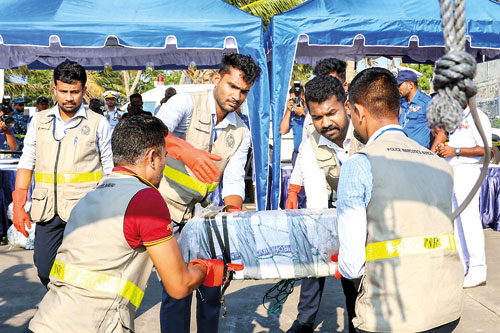
The Navy seized a cocaine haul exceeding 255kg in the seas off Dikowita fisheries harbour on March 16
He said that these children often have no other source of income and are easily manipulated by experienced criminals.
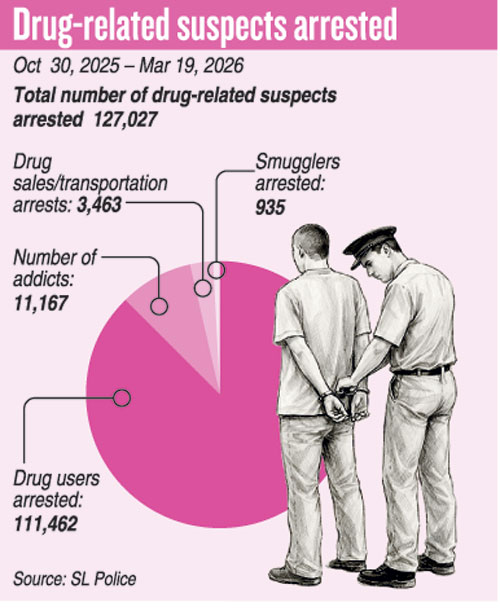
The Sunday Times learnt that the scale of drug seizures in recent months is unprecedented, and cumulative figures from October 30, 2025, to March 19, 2026, show that authorities arrested 127,027 suspects. Among them, 111,462 were drug users, 11,167 were addicts, 3,463 were involved in selling or transporting drugs, and 935 were identified as traffickers.
According to the data, nearly 88% of arrests involve users, suggesting that drug consumption, rather than high-level trafficking, remains the dominant issue on the ground.
The Sunday Times understands that experts in this field are divided on whether these volumes indicate that Sri Lanka is a transit hub or a country with massive internal demand. One official noted: “If these drugs were not intended for local consumption, they would not be coming into the country in such volumes. We are the final destination.”
However, others argue that the high value, reaching trillions when calculated globally, suggests a strong transit element.
“The high-end market for cocaine, costing nearly Rs 45 million per kilo, is used by the upper class in clubs, while lower-income groups are being devastated by ice and heroin,” an official explained.
The Sunday Times asked PNB Director Herath about the reasons for the increase in drug seizures and how the process is being carried out. He explained that the increase in successful sea operations is due to changes in strategies and advances in technology.
“The high-sea missions are now like five out of 10, highlighting a big shift in the frequency and effectiveness of maritime operations. This increase is clearly reflected in the seizure statistics. For the whole of 2025, the navy seized 13 Sri Lankan trawlers. By March 19, 2026, they had already seized eight trawlers, meaning that in less than three months, they had completed over 60% of the total seizures recorded in the previous full year,” Mr Herath told the Sunday Times.
He said, “We are focusing on the whole load; seizing a shipment in the deep sea is far more effective than waiting for it to reach the coast. Once a vessel nears the shore, traffickers often use fragmentation tactics, splitting a large shipment among multiple smaller dinghies. By carrying out raids in the high seas, the navy can capture the entire multi-billion-rupee load at once before it is divided.’’
As reported to the Sunday Times, a main reason for the increase in successful raids is that the navy and the Police Narcotic Bureau (PNB) now use the same software for monitoring. This allows for sharing of real-time intelligence.
Authorities track the Vessel Monitoring System (VMS), which is mandatory for about 5,000 fishing boats. They can identify suspicious behaviour, such as a boat idling in a known trafficking zone or travelling from high-risk regions like Iran, Pakistan, or Afghanistan, and launch a targeted raid immediately.
The PNB director said the frequency of these shipments has increased because Sri Lanka is increasingly being used as a final destination rather than just a transit hub. The high volume of seizures is a direct response to the massive quantities of “ice’’ and heroin being sent to meet local demand.
He revealed that the use of telephones and data analysis allows authorities to track the live locations of suspects and map out their communication patterns. Even as traffickers move to more secure systems like Iridium or Starlink, authorities are constantly adapting their surveillance methods.
“The technology used by traffickers is also evolving. They have largely abandoned traceable Thuraya satellite phones, which authorities can now analyse using specialised software, in favour of Iridium systems. More recently, some have begun using Starlink, which authorities admit is currently almost impossible to track. However, we are also using certain strategies to monitor those,” Mr Herath told the Sunday Times.
However, Sri Lanka’s navy continues to seize large-scale narcotics shipments at sea.
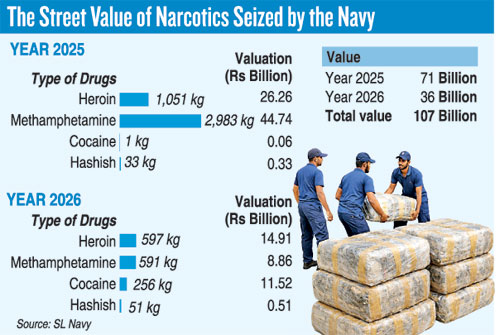
When the Sunday Times asked about their operations, Navy Media Spokesperson Buddhika Sampath said that the navy had seized over 4,068 kilograms of narcotics worth about Rs 71.39 billion, with methamphetamine, commonly known as ‘ice’, accounting for the largest share.
According to Commander Buddhika, in just the first three months of 2026, seizures have already reached 1,494.5 kilograms worth Rs 35.80 billion, including 596.5 kg of heroin valued at Rs 14.91 billion, 256.2 kg of cocaine worth Rs 11.52 billion, and 590.6 kg of methamphetamine worth Rs 8.86 billion.
He said that the combined total for 2025 and early 2026 shows that authorities have intercepted more than 5.5 metric tonnes of drugs, worth Rs 107.20 billion.
During these operations, 21 Sri Lankan fishing trawlers were also seized, highlighting the presence of organised maritime trafficking networks.
However, as drug seizures continue to increase by billions, the Sunday Times was informed that both the police and the navy have a reward system for those who provide information on drug trafficking. Tips can come from within the departments or from the public.
Police officials explained that the Police Reward Fund, described as holding billions of rupees sourced largely from court-imposed fines, manages the reward system for drug intelligence in Sri Lanka.
According to the officials, the system is designed to incentivise high-risk operations.
Rewards are typically paid in two stages to ensure legal accountability.
“We pay 50% of the reward shortly after a seizure to encourage the team. The remaining 50% is only paid if the suspect is found guilty in court,” the officials said. The specific amount is calculated based on the quantity and street value of the drugs, the operational difficulty, and the level of dedication shown by officers and informants.
Regarding recent big payouts, sources highlighted a police constable who recently received a reward of Rs 5 million. This substantial sum was awarded because the officer’s intelligence was the direct catalyst for a big seizure. Officials noted this as an example of how the fund is used to reward actionable information.
He further explained that “if the navy provides information and we make a seizure, then we pay the navy officers from the Police Fund.” To ensure fairness, the police request a certified list of people from the navy command, which includes everyone aboard vessels during a raid.
Navy officials emphasise that their main motivation is national security.
However, they rely on the Police Reward Fund to provide the financial incentives for officers operating in a high-risk environment.
But the Sunday Times learnt that informants and lower-level officers often have to wait more than a year to receive rewards. These delays are sometimes caused by senior officers holding back the process or by administrative issues, which can reduce the trust of those who provide important information.
Authorities said they have identified that in high-density areas, traffickers use children to move drugs, as they are less likely to be suspected. By educating parents and schoolchildren, officials aim to prevent traffickers from initially drawing children into drug use and distribution.
Another key pillar focuses on effective rehabilitation and reintegration, addressing the growing demand for drugs.
Authorities stress that relying only on legal action is not enough. Instead, rehabilitation programmes are needed to help users return to society and reduce the local demand that fuels the multi-billion rupee drug trade.
However, the ultimate priority as a nation is to dismantle the drug trafficking networks.
The focus, they emphasised, must remain on protecting the younger generation while combating the scourge of narcotics.
The best way to say that you found the home of your dreams is by finding it on Hitad.lk. We have listings for apartments for sale or rent in Sri Lanka, no matter what locale you're looking for! Whether you live in Colombo, Galle, Kandy, Matara, Jaffna and more - we've got them all!