


Beyond Degrees: Why Qualification Frameworks Are Crucial for Students and Parents
View(s):Education is a journey, and like any journey, it requires a clear roadmap to guide us toward our destination. In the context of education, this roadmap takes the form of a formal educational framework, which exists in every country to provide structure, standards, and progression pathways. In Sri Lanka, this framework is known as the Sri Lanka Qualifications Framework (SLQF). However, many students remain unaware of this crucial path. Recent studies reveal that undergraduates and learners have very limited awareness of education quality frameworks, highlighting the urgent need to improve understanding of how qualification and quality systems function in higher education. Shoukat and other scholars in 2024 note that clear quality standards and frameworks are essential for helping students make informed choices and enhancing overall educational outcomes. Well-defined frameworks also promote transparency, comparability, and international recognition of qualifications, ensuring that students gain the full benefits of the programmes they choose. By raising awareness among students about these systems before they enrol, we can help safeguard their academic progression and professional future. This article aims to contribute to building public awareness and understanding of educational frameworks, helping students navigate their academic journeys more effectively.

R.H Asari Perera- Lecturer Department of Marketing Management Faculty of Management Studies The Open University Sri Lanka
What is the SLQF?
In recent years, the global landscape of higher education has undergone a profound transformation. The mobility of students, academics, and professionals across national and regional borders has increased significantly, creating new demands on national education systems to ensure transparency, comparability, and quality assurance. In this context, the Sri Lanka Qualifications Framework (SLQF) has emerged as a critical pillar in the development of Sri Lanka’s higher education sector.
According to the University Grants Commission (UGC) of Sri Lanka, the SLQF aims to create an integral national framework for learning achievements by recognising and accrediting qualifications offered by different institutions engaged in higher education and vocational training. Key objectives include enhancing quality, facilitating mobility and recognition of prior learning, assisting employers, and promoting lifelong learning.
Twelve Levels of Learning: From Entry to Doctoral Studies
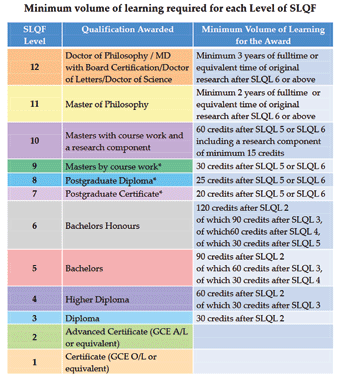
The Sri Lanka Qualifications Framework (SLQF) consists of twelve clearly defined levels, each supported by comprehensive descriptors that outline the expected knowledge and skills, the level of responsibility and autonomy, and the required academic and professional competence. For every qualification level, the framework specifies the minimum number of credits required, standardized qualification titles, appropriate designators, qualifiers and abbreviations, minimum entry requirements, and possible progression pathways. By establishing these clear and uniform standards, the SLQF eliminates ambiguity in qualification naming and ensures consistency and comparability across higher education and training institutions.
Mapping of SLQF and NVQ
The comparable NVQ and SLQF levels have been recognised on the basis ofsignificant similarities in the learning outcomes stated under respective leveldescriptors in the two frameworks by a panel of experts. Degree level qualification(NVQ 7) is benchmarked to internationally accepted standard for a Bachelor degree(SLQF Level 5). Nonetheless, the proportion of cognitive outcomes and psychomotoroutcomes may differ in the two qualifications, especially in qualifications beloW SLQF 2 (NVQ 4). Further, the attributes of two qualification holders, below thedegree level, at comparable SLQF and NVQ levels may differ. (SLQF, 2016, Pg 11)
International Qualification Framework Mapping
Similarto our academic education framework, different countries have developed their own qualification frameworks to standardise learning outcomes, ensure quality assurance, and facilitate national and international recognition of qualifications. At the international level, the International Qualifications Framework (IQF/IQAI) provides a broad reference point, while the European Qualifications Framework (EQF) serves as a common translation tool across Europe. In the United Kingdom, England and Wales use the Regulated Qualifications Framework (RQF), whereas Scotland applies the Scottish Credit and Qualifications Framework (SCQF). Australia has implemented the Australian Qualifications Framework (AQF) to integrate school, vocational, and higher education qualifications. In Asia, Malaysia follows the Malaysian Qualifications Framework (MQF), India operates under the National Vocational Education Qualifications Framework (NVEQF), and Hong Kong uses the Hong Kong Qualifications Framework (HKQF). Although the naming conventions, level structures, and emphasis vary across these frameworks, they are generally aligned through level descriptors based on learning outcomes, competencies, and autonomy, enabling comparison, mobility, and mutual recognition of qualifications across countries.
The Importance of Understanding Qualification Frameworks Before Pursuing Higher Education
Many students choose to study at foreign universities and higher education institutions without fully understanding how qualification frameworks and quality assurance standards operate. As a result, when they return to Sri Lanka or seek opportunities in other countries, they often face difficulties in continuing their studies or obtaining formal recognition for their qualifications. Such challenges can restrict access to higher degrees, limit professional recognition, and negatively affect employment prospects.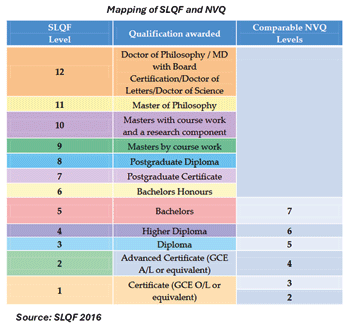
Therefore, before applying for any higher education programme whether in Sri Lanka or abroad it is essential to verify the qualification framework and quality assurance system under which the programme is offered and to understand how it aligns with the Sri Lanka Qualifications Framework (SLQF). Students have both the right and the responsibility to be well informed about the recognition status, academic level, and progression pathways of a qualification before enrolling in a programme.
Importantly, this awareness should not be limited to students alone. Parents also play a crucial role in guiding educational decisions and supporting their children’s aspirations. By understanding qualification frameworks and approved educational pathways, parents can help direct their children toward programmes that are credible, recognised, and aligned with long-term academic and career goals. Informed guidance from both students and parents ensures that educational investments lead to meaningful outcomes.
Making informed decisions at the outset helps ensure that the qualification obtained is academically sound, nationally and internationally recognized, and adds genuine value to one’s educational and professional journey.
HitAd.lk is the best and biggest mobile phone market in Sri Lanka, and we guarantee you will find what you need here from our extensive listing of mobile phones for sale in Sri Lanka. Whether it’s a budget-priced smartphone for communication, or higher end features with advanced connectivity, there are many different options from which to choose from on our site!