


The ‘very strange’ book that became a classic
Helen Macdonald is the author of the phenomenal 2014 bestseller H is for Hawk, a very British memoir set against the English countryside, about the loss of a father and how the author coped with it by training a goshawk.
Helen is also a naturalist, poet and former historian of science.
Here are excerpts from our interview with Helen midway through the Ceylon Literary and Arts Festival…
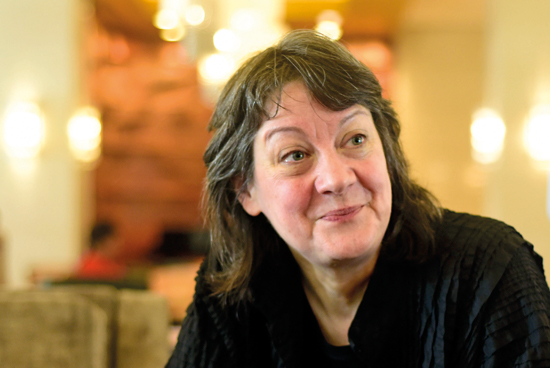
Helen Macdonald. Pic by M.A. Pushpa Kumara
- What first awakened you to nature when a child?
I have always been so obsessed with nature – particularly birds. I think partly because I have a slightly ‘spicy’ brain- I think I have ADHD (laughs)… Also there was a family tragedy – I had a twin brother, he died just after he was born. I didn’t know this for many years. I think, now, that when I was very small I would go out to nature and I would watch animals and I would try and find animals- and I think I was always looking for something I had lost.
- Were you prepared for the great acclaim for H is for Hawk?
No of course not (laughter). It was so funny- when I was writing that book I kept thinking “this is a very strange book”. It’s about a miserable person- me- a dead author – T. H. White- and a bird- a Goshawk; “no one’s going to read it- it’s too strange”. When it started to become very successful I was astonished. Everyone who has suffered a loss in life, and everyone who has been through a dark time, finds something in that book, and I didn’t expect it to find an audience.
It’s a very special book for many people and I’m very honoured that it has become a classic.
- What do you think made it such a classic?
It’s very funny – a few times people have told me ‘it’s not about grief and training a hawk- it’s about having a baby’. And I am like – what? And they are like, when you have a baby, you bring this precious thing back to the house. It doesn’t speak, you don’t know how to look after it, it’s your first baby. And you are sort of trapped inside with this baby and you love it but you don’t know if you are doing the right thing.
And that’s just like in the book where I am training a hawk… So I thought “Oh, the book might be about that too”.
But also goshawks are very, very ‘cool’. People read the book, they meet Mabel the goshawk, they see how arrestingly strange and wild they are and they fall in love with hawks.
- What was it like writing a book that was about bereavement but also the wonders of nature?
Very interestingly, it took me about seven years trying to write the book, before it began to flow. I think I needed to wait a long time after my father’s death to write the book. I needed to see myself – the character of the hawk and the character of me. I found the bits about nature very easy to write about the book, the bits that were hard were the bits that dealt with my father’s death…
Writing is a very strange activity- sometimes you feel like you are the worst writer in the world and you never want to ever write again; and sometimes you feel like you’re Shakespeare (laughter) – not really… but sometimes you feel you are a good writer. I can never be in the middle- I am always one or the other.
That’s why writers believe in muses- sometimes you have inspiration but sometimes you have not- and you don’t know where that comes from.
- So what’s your remedy for that?
I drink a lot of coffee (laughter); coffee is my secret.
The surprising thing for me is that when you are feeling inspired and you write a lot, and you feel you’ve done good work- compared to the days when you are not inspired and every word is the hardest you have written (it’s like you’re drawing blood from a stone) but if you go back and read all that sounds the same. So never trust your own assessment of your writing.
Yeah- it’s a lonely job, but also I get to meet my readers at festivals like this from all over the world which is wonderful.
- Your prose is so dense and rich. Do you take constant notes?
I don’t really take notes. (H is for Hawk) in particular was very special because it dealt with a time when I was very much in grief after losing my father. My memories from that are like crystal- they are very, very clear. I have no problems recalling those things. But now, I do have a notebook. I think every writer has one. I use my phone often to take notes. Sometimes you’ll be sitting somewhere and a whole world of a story will fall into your head and you have to take a moment to remember, or you are sitting in a café and someone says something very funny and you have to remember that.
We are like magpies for prose. We are always stealing from the world.
- What was it like writing your book after H is for Hawk- Vesper Flights? Was there pressure?
Huge pressure, huge pressure. What is it that the musicians say- the ‘difficult second album syndrome’ you know? I knew I couldn’t write a second book like H is for Hawk straight afterwards. So what I decided with my publishers was to collect short pieces together – some that I had written before; some I had written especially for that book. And I was very worried about it- I didn’t know if it would work.
But then I put all these different pieces together into the book and began to read it, straightaway I saw they were talking to each other. I became very happy about that.
I love that book now. It came out during the pandemic which was a very dark time for all of us, and I think everyone’s concentration spans were really short during the pandemic and because they were short pieces people really loved to read them at the time.
- What are you working on right now?
At the moment I am writing a big book on a tiny island in the Pacific called Midway Atoll; you may know it as there was a naval battle there in World War II. It used to be an American naval air station. It’s home to millions of birds, albatrosses mainly, and I visited it.
You walk around the island and it’s like an incredible dream. It’s full of ruined naval buildings and every three feet on the ground there’s an albatross sitting on eggs. It’s the most extraordinary place.
- What are other aspects of your life apart from writing and nature?
I have three parrots at home. I live in a village in England called Hawkedon – believe it or not- and everyone’s like did you move to this village because of its name? And I’m like no, I didn’t (laughter). So I take my parrots for walks around the village. It’s very funny- I have become the village eccentric (a classic writer’s role!) but I have a quiet life. All the excitement in my life comes from events like this…
I also wrote a science fiction book with a friend during the pandemic. It was a fun thing to do.
Searching for an ideal partner? Find your soul mate on Hitad.lk, Sri Lanka's favourite marriage proposals page. With Hitad.lk matrimonial advertisements you have access to thousands of ads from potential suitors who are looking for someone just like you.