


Sri Lanka’s forgotten blue pantry
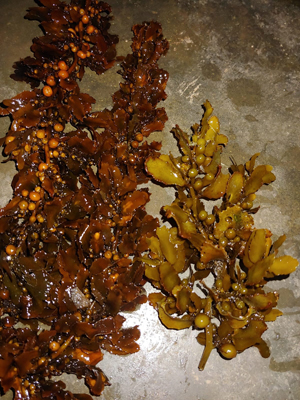
Diversity on the coast: Brown seaweed
Step into almost any pharmacy or wellness shop in Sri Lanka and you will see the same familiar names: ashwagandha, gotukola, moringa, black seed, cinnamon, ginger, garlic, and other botanicals that sit comfortably within Ayurveda and everyday home practice. Many are marketed for vitality, digestion, improving memory, healthy blood sugar or “immunity,” and consumers recognize them instantly.
Now look for seaweed.
For an island nation, the absence is striking. Sri Lanka is surrounded by a warm tropical ocean and coastal habitats that support a wide range of seaweed species. Yet seaweed-based nutraceuticals and functional ingredients remain mostly invisible to the public. This raises a simple question. How can a country surrounded by an ocean still under-use one of its most practical natural resources?
Seaweeds - Gracilaria, often called “Ceylon moss,” has been collected and used for decades, especially in coastal communities. It has been prepared as porridge and used in drinks and jelly. But it has rarely moved beyond seasonal demand into a steady, trusted product line in major markets.
Sri Lanka’s seaweed diversity is also not small. Across rocky shores, reef edges, lagoons, and sheltered bays, local records describe hundreds of species. Yet commercial use has focused on only a narrow subset, constrained by limited resource mapping, fragmented collection and marketing systems, weak processing infrastructure, and the absence of sustained industrial demand that could transform seaweed into consistent value-added ingredients.
In short, Sri Lanka has seaweed and demand for wellness products, but the two have not been connected by a mature value chain.
Sri Lanka’s marine environment has features that can favour seaweed growth.
Warm seas and long daylight periods can allow extended growth windows compared with strongly seasonal temperate coasts.
Monsoon-driven currents and wave action keep many nearshore areas mixed and oxygenated and can influence nutrient dynamics along different coasts at different times of year.
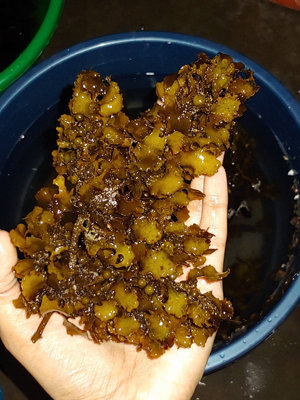
Freshly collected Sargassum (brown seaweed). Pix by Hashanthi Fernando
Habitat diversity, like reefs, rocky headlands, lagoons, and sheltered bays, creates multiple niches for brown, red, and green seaweed.
Fast regrowth in many tropical species can support repeated harvests when planting material and handling are organized.
Put simply, the missing part is not biology. It is organization, processing, and product development.
Turning seaweed into high-value ingredients Modern research describes seaweeds as rich sources of vitamins, proteins and amino acids, minerals and trace elements, pigments, polyphenols, sterols, omega-3 fatty acids, and complex carbohydrates. Many of these components are being studied for roles in antioxidant activity, gut-related benefits, inflammation-linked biology, and metabolic health pathways. The core point is simple. Seaweed is not one ingredient but a diverse source of useful compounds when harvested, handled, tested, and processed properly.
The compounds that matter-and why they matter
Hydrocolloids: agar, alginate, carrageenan These are the best-known seaweed-derived ingredients in the global industry. They act as thickeners, stabilizers, and gelling agents, often present in food without consumers noticing. Carrageenan, extracted from certain red seaweeds, is a workhorse in many processed foods and pharmaceutical formulations.
It also has an interesting scientific aside: in research, a form of carrageenan is commonly used to induce short-term local inflammation in standard animal models (such as rat paw edema). Scientists use it because it produces a predictable inflammatory response, making it useful for testing anti-inflammatory effects of drugs or extracts.
Sulfated polysaccharides: fucoidan and ulvan
Beyond hydrocolloids, these compounds have drawn attention.
Fucoidan (mainly from brown seaweeds) is being studied for effects linked to immune signalling, inflammation-related pathways, gut health, and some metabolic endpoints.
Ulvan (from green seaweeds such as Ulva) is also being studied for gut-related and immune-linked biological effects
These are not single, uniform chemicals. Their structure can vary by species, location and season. Meaning activity can change too. Any serious nutraceutical effort must prioritize standardization and quality control, not just extraction.
Polyphenols and pigments: phlorotannin and fucoxanthin
Brown seaweed can contain,
Phlorotannins, a group of polyphenols studied for antioxidant-related applications, including food preservation and wellness products.
Fucoxanthin, a carotenoid pigment studied in the context of metabolic and inflammation-related pathways.
These are promising targets for functional ingredients, but they must be backed by composition testing, responsible claims, and realistic consumer formats.
Minerals (including iodine)
Seaweed can be mineral-rich, including iodine. Nutritionally, that can be valuable. But mineral levels can be high and variable, and safety depends on species and harvest location. If we target seaweed-based supplements, routine testing and clear standards are not optional.
Seaweed farming has expanded in parts of the country, and research points to suitable coastal conditions in places such as Mannar for farming commercially important species like Kappaphycus alvarezii, widely used for carrageenan production.
So the bottleneck is not “can we grow it?”
The bottleneck is what happens after harvest.
If seaweed is dried unevenly, contaminated with sand and excess salt, mixed with other species, or stored poorly, it becomes difficult to turn into reliable ingredients. If farmers are not linked to steady buyers, farming remains seasonal. If processors cannot guarantee consistent quality, retailers avoid the category. The result is predictable: seaweed stays invisible on shelves.
Why Nutraceuticals still default to land plants
Familiarity drives demand: Sri Lankan consumers already trust Ayurveda-linked botanicals. The names are known, the stories are familiar, and the products fit existing habits.
Handling is stricter for seaweed: Quality depends on species identity, season, location, drying method, and hygiene. Without standard procedures, inconsistency becomes the norm.
Industry investment follows stable supply: Without reliable volume and quality, processors hesitate to invest in equipment, testing, packaging, and branding. Without processing, farming cannot scale. It becomes a loop.
Safety expectations are rising: Modern markets expect compositional consistency and safety assurance. For seaweed-based supplements, traceability and routine testing must be built in from the beginning.
What Sri Lanka could do next
If Sri Lanka wants seaweed to become a real part of the wellness and food economy, the steps are clear.
- Start with a few priority species and build depth rather than trying to commercialize everything at once.
- Fix post-harvest systems: clean washing, controlled drying, moisture targets, safe storage, and simple grading at the community level.
- Develop products that match local habits: seasonings and foods with small inclusion levels, drink mixes, jellies, powders for fortification and then move into capsules and extracts once supply is stable.
- Create reliable buying links so farmers and processors can plan and invest.
Sri Lanka does not need to choose between Ayurveda and seaweed. The sensible approach is to expand the wellness economy with a marine chapter built on species selection, clean processing, testing, and products that suit local tastes and build trust.
The question is not whether seaweed is useful. The question is why we have not treated it like the diverse, valuable resource it is. If Sri Lanka is serious about turning coastal resources into jobs, exports, and healthier food options, seaweed should be part of the plan.
(The writer is a Postdoctoral Research Fellow in Cellular and Molecular Immunology at the Institute of Biochemistry, Molecular Biology and Biotechnology (IBMBB), University of Colombo)
Searching for an ideal partner? Find your soul mate on Hitad.lk, Sri Lanka's favourite marriage proposals page. With Hitad.lk matrimonial advertisements you have access to thousands of ads from potential suitors who are looking for someone just like you.