

News
Hundreds of weevil species likely endemic, researchers find
Once a familiar household pest, the damage caused to grain by the rice weevil, called ‘gulla’ in Sinhala, has largely reduced, yet scientists have recorded 264 related species in Sri Lanka.
For generations of Sri Lankans, the word ‘gulla’ evokes instant memories of rice bins, earthen pots, and tiny beetle-like creatures crawling in stored grain. They were once an unavoidable part of daily life, but today, many younger Sri Lankans have never seen them.
Yet these insects, commonly known as weevils, are a large family, where 264 species are found in Sri Lanka alone, says researcher Dilshara Wijesinghe, a doctoral student at Sunchon National University, South Korea. Her study reviewing the family, published recently and co-authored with her supervisor, who is also a world-reputed weevil taxonomist, Prof. Ki Jeong Hong, also documents two species in the family that are new to Sri Lanka. Through the review of existing literature, the researchers could produce a checklist of this family of insects, revealing that the ‘gulla’ is far more than a simple kitchen nuisance.
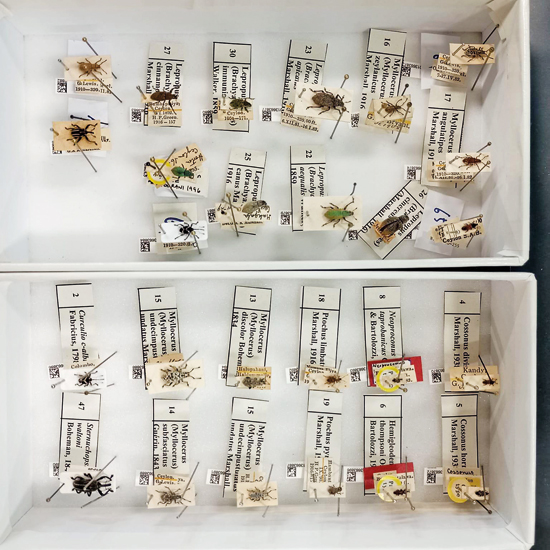
Sri Lankan gullas that journeyed to England: Specimens collected by British naturalists during the colonial era housed in the British Museum
Weevils belong to the beetle family Curculionidae, one of the largest animal families known, with more than 60,000 species described worldwide. New species continue to be discovered, including in Sri Lanka, and according to Ms Wijesinghe, about 175 species could be endemic or potentially endemic to Sri Lanka. “However, we need to do further research to establish their uniqueness,” Ms Wijesinghe told the Sunday Times.
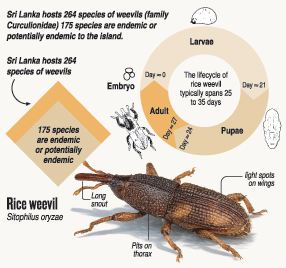 The most recognisable feature of the weevils is an elongated snout, or rostrum, which carries its mouthparts, according to scientific literature. This snout plays a crucial role in reproduction, allowing female weevils to bore into grains, seeds, or plant tissue to lay their eggs.
The most infamous of these was the rice weevil (Sitophilus oryzae), once a constant and unwelcome presence in Sri Lankan households. Closely related species such as the maize weevil and granary weevil caused similar damage. Their impact was especially severe because their life cycle unfolded largely out of sight. Eggs were laid inside individual rice grains, where the larvae developed hidden from view. By the time adult insects emerge, the grain is already hollowed out.
Several factors made weevil infestations particularly common in the past. Rice was traditionally stored in gunny bags, clay pots, or wooden bins that offered little protection from insects. Much of the rice consumed was hand-pounded or minimally processed, retaining bran layers that were attractive to pests. Chemical fumigation or controlled storage was rare at the household level, and Sri Lanka’s tropical climate allowed weevils to reproduce rapidly, producing several generations in a single season.
The near disappearance of rice weevils from rice is therefore no mystery. It reflects profound changes in food processing, storage, and lifestyles. Today, rice is machine-milled, polished, and thoroughly cleaned, removing hidden larvae and egg-laying sites. Commercial stocks are routinely fumigated or stored under controlled conditions, while at home rice is kept in sealed containers and purchased more frequently rather than stored long-term. Together, these changes have effectively broken the weevil life cycle, pushing them to the margins of everyday life.

Dilshara Wijesinghe at her lab in South Korean university reviewing weevils
Yet the story of the ‘gulla’ does not end with rice. While grain-feeding weevils shaped public memory, most weevil species are not pests at all. Sri Lanka is home to hundreds of species associated with forest trees, vines, shrubs, palms, grasses, and even aquatic plants. Many are highly specialised, relying on a single plant species to survive. Others play subtle roles in pollination, seed regulation, and nutrient cycling.
The humble ‘gulla’ thus tells a much larger story—one that links changing lifestyles, food security, agricultural modernisation, and the hidden biodiversity around us. For older generations, rice weevils were a daily annoyance. For scientists, they are a window into evolutionary success and ecological complexity. And for younger Sri Lankans, they may soon exist only in the recollections of grandparents, a reminder that even the smallest creatures once shaped how we lived, stored food, and survived.
The best way to say that you found the home of your dreams is by finding it on Hitad.lk. We have listings for apartments for sale or rent in Sri Lanka, no matter what locale you're looking for! Whether you live in Colombo, Galle, Kandy, Matara, Jaffna and more - we've got them all!