

News
How novel techniques in bypass surgery eliminate serious complications
Not just the good work but also the way forward came under the spotlight at the inauguration of the International Annual Academic Congress 2026 of the Association of Cardiothoracic and Thoracic Surgeons of Sri Lanka (ACTSSL) on Friday, January 16 at Battaramulla.
An icon in this field, though no more, was very much on the lips of all – the late Dr. Ravi Pillai who had been the ‘influencer’ of many who are now stalwarts wielding the scalpel in this field in Sri Lanka. Dr. Pillai had been a Consultant Cardiothoracic Surgeon at the Oxford Heart Centre in the United Kingdom, with strong links to Sri Lanka, the land of his birth.
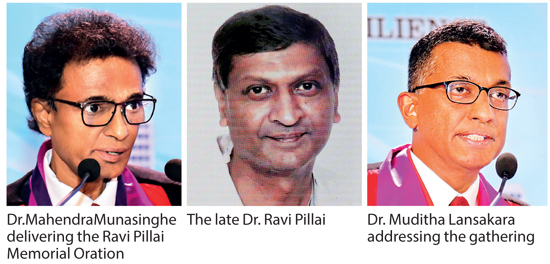
‘Is sternal dehiscence a deterrence to bilateral Internal Mammary Artery grafting? – the best treatment for Ischaemic Heart Disease (IHD)’ was the topic of the Ravi Pillai Memorial Oration this year, delivered by the fourth of the eminent heart surgeon’s trainees, Dr. Mahendra Munasinghe.
The earlier orations in 2023, 2024 and 2025 were by Consultant Cardiothoracic Surgeons Dr. Chandima Amarasena; Dr. Panna Gooneratne; and Dr. Rajeeva Pieris respectively.
Consultant Cardiothoracic Surgeon Dr. Munasinghe who is attached to the National Hospital of Sri Lanka (NHSL) said that coronary artery disease is the commonest cause of death in the world including in this country. This serious condition is IHD – formation of atheromatous plaques in the coronary arteries, narrowing their lumen (the inner open channel of these blood vessels). It causes symptoms and heart attacks or death of the heart muscle resulting in the affected person’s death.
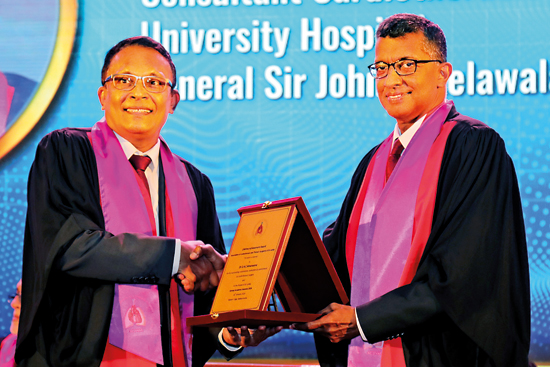
Dr. Chandima Amarasena being honoured with the Lifetime Award by Dr. Muditha Lansakara. Pix by M.A. Pushpa Kumara
“IHD is caused by ‘modifiable’ risk factors like diabetes, high blood pressure, bad lipids in blood and smoking. There are also two important ‘non-modifiable’ risk factors – the genes we get from our parents and advancing age,” he said.
Explaining that patients who have coronary artery disease are managed through interventions and conservatively, he said that the main objectives of the interventions are to relieve symptoms and make these patients live longer. These interventions are stenting and bypass surgery. Coronary Artery Bypass Grafting (CABG) is recommended for patients with multiple blocks in multiple vessels and patients with diabetes, according to European and American guidelines.
Dr. Munasinghe said: “The standard CABG that the majority of patients undergoes consists of one artery and two or three vein grafts. But hundreds of randomised clinical trials have clearly shown that using two arteries called the Internal Mammary Arteries as bypass grafts is far more superior and increases the life expectancy of the CABG patients significantly.
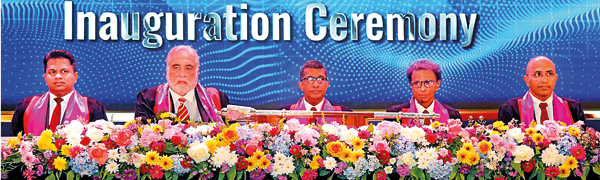
The head-table (from the left): ACTSSL Secretary Dr. Nalaka Dissanayake; SCTS President Prof. Aman S. Coonar; ACTSSL President Dr. Muditha Lansakara; Orator Dr. Mahendra Munasinghe; and ACTSSL Treasurer Dr. Dhammika Rasanayake
“However, it is associated with a serious complication – deep sternal wound infection and sternal dehiscence with an international rate of 0.7 to 4.7%. These are a deterrence to using both arteries as bypass grafts.”
(The sternum is the breastbone or long flat bone in the shape of a sword in the centre of the front of the chest. Sternal dehiscence means the repaired sternum after CABG, separating into parts.)
Therefore, Dr. Munasinghe and his team set about conducting a study at the NHSL on 358 patients. The objective was: ‘To assess the efficacy of using techniques based on basic surgical principles to prevent deep sternal wound infection and sternal dehiscence.’
The age distribution of the patients was:
- Below 30 years – 0.55%
- 30-40 years – 9.21%
- 40-50 years – 29%
- 50-60 years – 58.66%
- Over 60 years – 2.51%
The findings of Dr. Munasinghe and his team were – The serious complications of deep sternal wound infection and sternal dehiscence can be ‘totally eliminated’ with novel and focused techniques based on basic surgical principles.
“Your extra 20 minutes will give your patient an extra 20 years,” was the heartfelt plea of Dr. Munasinghe to heart surgeons.
Earlier, ACTSSL President Dr. Muditha Lansakara said one of their biggest challenges is the ever-increasing waiting lists of patients for cardiac surgery with more patients needing such surgery at a younger age. The ACTSSL is trying to resolve this by increasing operating capacity.
For this, the ACTSSL is actively engaged with the proposed National Heart Centre and the establishment of new Cardiothoracic Units at the Kotelawala Defence University (KDU) and the Kurunegala Teaching Hospital, he said.
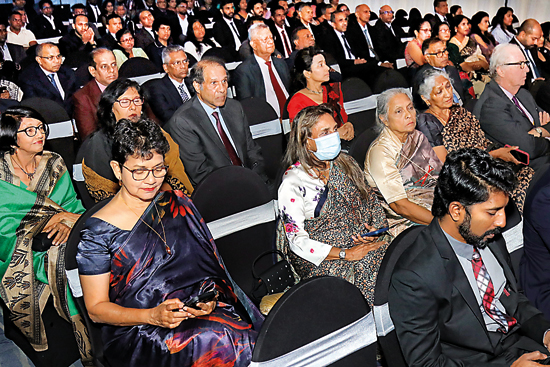
The late Dr. Ravi Pillai’s wife, Shanti Jayewardene, relatives and friends in the audience
Focusing on this year’s congress theme on ‘Advances, Innovations and Resilience’, he said that advances and innovations were not uncommon in their field. As such, he would concentrate on resilience.
“Sri Lankans have faced a lot of challenges during the last five to six years – the pandemic followed by the economic crisis and also natural disasters in the form of floods and landslides. Without resilience, we cannot imagine the survival of people,” he said, reiterating that as a profession not only did they survive but they also continued to provide what was expected – to operate and give relief to patients.
He was proud that none of the cardiothoracic units and thoracic units in Sri Lanka stopped providing full care.
Looking back, Dr. Lansakara said they had a constant dialogue with officials of the Health Ministry, the Medical Supplies Division (MSD) and the State Pharmaceuticals Corporation (SPC) and are in the process of streamlining the procurement of consumables and other essential items. Earlier, on occasion, the cost of items essential for a CABG for one patient went up to nearly Rs. 100,000. In the last month, the cost has come down to Rs. 20,000, a saving of 80% per patient.
Those present at the inauguration included Chief Guest and President of the Society for Cardiothoracic Surgery (SCTS) in Great Britain and Ireland, Prof. Aman S. Coonar, and the late Dr. Ravi Pillai’s wife, Shanti Jayewardene, relatives and friends.
The ACTSSL bestowed the ‘Lifetime Award for the Development of Cardiothoracic Surgery in Sri Lanka’ to Dr. Chandima Amarasena.
| Boon of an MOU | |
| It was a historic evening for the ACTSSL – signing a Memorandum of Understanding (MOU) with the Society for Cardiothoracic Surgery (SCTS) in Great Britain and Ireland. “While enhancing the ties between the ACTSSL and the SCTS, it will improve the level of our post-graduate trainees, thereby helping to improve the quality of care of
|
The best way to say that you found the home of your dreams is by finding it on Hitad.lk. We have listings for apartments for sale or rent in Sri Lanka, no matter what locale you're looking for! Whether you live in Colombo, Galle, Kandy, Matara, Jaffna and more - we've got them all!