

News
Grama Niladaris fear bad precedent from Rs 500,000 damage payout
Although the Defence Ministry issued a second circular to address the controversy over the payment of Rs 500,000 as compensation to owners of partially damaged houses without proper assessment following Cyclone Ditwah, the Grama Niladhari Union has continued to oppose the decision.
Sri Lanka Grama Niladhari National Union general secretary Neville Wijerathnatold the Sunday Times: “The government should not mix disaster relief funds with poverty alleviation programmes; disasters and poverty are two separate issues and should not be treated in the same way.”
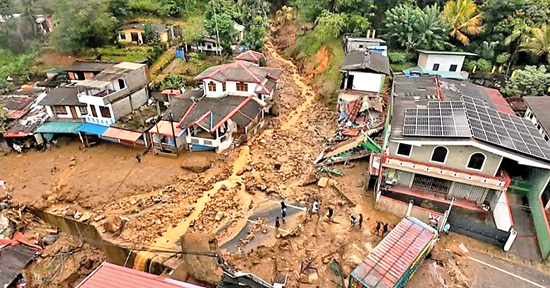
Payments for damaged houses: Rs. 300,000 initially and Rs. 200,000 after repair progress is verified
He added that such an approach reflects a lack of administrative logic.
Firstly, citing a mismatch between the government’s initial compensation circular, which offered Rs 500,000 for houses partially damaged due to the cyclone after assessment, and the promises made to the public that the payment would be a flat rate, the Sri Lanka Provincial Secretaries Association and the Sri Lanka Accountants’ Service Association jointly wrote to the Defence Ministry secretary, stating that they could not proceed with the circular as it lacked clear criteria. In response, the Defence Ministry issued a second circular.
The second circular states that those whose homes are partially damaged will receive Rs. 500,000 without a formal technical assessment, even if the actual damage is less. Payments are made in two stages: Rs. 300,000 initially and Rs. 200,000 after repair progress is verified. The funds must be used for specific improvements, including repairing or rebuilding house sections, kitchens, or toilets, improving sanitation and health facilities, building retaining walls, and making the house more disaster-resilient.
Mr Wijerathna highlighted the burning of houses during the Aragalaya, focusing on compensation and damage assessments for MPs and ministers.
He said the assessments back then were controversial, with some payments made without proper valuation, and warned that paying a flat rate of Rs 500,000 for partially damaged houses now, without proper assessment, could set a bad precedent.
He said the union’s executive group is meeting to finalise its stance, as they have not yet received formal instructions.
However, Public Administration and Provincial Councils Ministry Secretary Aloka Bandara told the Sunday Times, “The vast majority of those affected by cyclone Ditwah are low-income families living in vulnerable areas, and the policy is designed to improve their living standards.”
He said he met with representatives from the Provincial Secretaries Association and the Sri Lanka Accountants’ Service Association to assure them that the amended circular (NDRSC/02/04/10) provides legal protection for releasing funds without traditional technical assessments.
Provincial Secretaries Association president Rathnayake Senthil, however, said he believes that a technical valuation would have been fairer and more professional.
“We ultimately agreed to implement the payments only after the circular was amended to provide legal protection from the ministry and Cabinet. But the current policy is a ‘second version’ of past problems. In the future, people might expect similar payments for every minor flood, and a future government could question the legality of how the funds were distributed,” he said.
Another key party involved in influencing the second circular was the Sri Lanka Accountants’ Service Association.
Its Secretary and National Organiser, Sampath Bandara, said that although there were initial professional concerns about technical assessments, officials are now proceeding with payments because a formal guideline and circular have been issued.
He said the Rs. 500,000 compensation for partially damaged houses is released in instalments to ensure accountability. An initial payment of Rs. 300,000 is given, and the final Rs. 200,000 is released only after verifying the progress of the work.
To receive the funds, beneficiaries must submit a proposal or plan detailing how they will use the money to improve their home.
Mr Bandara emphasised that the objective is not just to hand out cash but to help people create more disaster-resilient structures, such as stronger roofs or raised areas to protect goods from floods.
He highlighted that monitoring is an essential part of the policy. If an individual does not complete the work according to their proposal, they will not receive the second instalment. He said this monitoring is now easier for officials because there are five specific criteria to check.
Mr Bandara said those already identified in the initial disaster records are eligible, specifically those who applied for and received the Rs. 25,000 for cleaning or for goods. He said it is difficult to include new applicants who did not apply for the initial assistance.
The best way to say that you found the home of your dreams is by finding it on Hitad.lk. We have listings for apartments for sale or rent in Sri Lanka, no matter what locale you're looking for! Whether you live in Colombo, Galle, Kandy, Matara, Jaffna and more - we've got them all!