


Middle East Crisis and Economic Management
View(s):
The year 2022 was marked by many crises in Sri Lanka’s history, as it witnessed the most severe economic and political collapse since independence. We have witnessed this in the form of power cuts, fuel queues, and gas shortages. From 2023 on, the recovery period begins, and we have to take support from the IMF as well. Cyclone Ditwah struck Sri Lanka again in November last year, significantly disrupting the normal lives of its citizens. The infrastructure damage is much more serious than the tsunami. According to World Bank reports and preliminary estimates, the losses amounted to approximately US$ 4.1 billion, nearly 4 per cent of the country’s Gross Domestic Product. Before taking a break from that, the emerging crisis in the Middle East has once again raised concerns about potential economic repercussions. Now we are experiencing the same fuel queues, gas shortages, and other disturbances as predicted globally.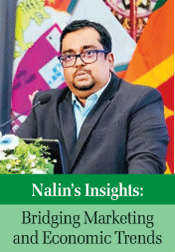
Historically, Sri Lanka has been vulnerable due to many changes. In particular, those already affected by disasters such as Cyclone Ditwah risk falling “from the frying pan into the fire,” facing multiple hardships simultaneously. Currently, we see fuel prices rising, four-day workweeks, a higher cost of living, increased pressure on household incomes, and a reduction in the overall standard of living for ordinary citizens.
Sri Lanka needs to have proper reading on this scenario. In the past, we have seen only short-term solutions given. As a country, Sri Lanka must focus not only on short-term responses but also on developing long-term economic and social mechanisms to mitigate the crisis.
First, immediate relief measures are necessary, particularly for vulnerable communities that are already struggling. Special assistance programmes should be designed for those most affected, ensuring that the burden of the crisis does not fall disproportionately on the poorest segments of society. As a nation, we should have a different model for economic management. Sri Lanka needs a multi-stakeholder economic advisory model. We need to adopt some acceptable practices from other countries. We can propose a Multi-stakeholder Economic Advisory Model, as practiced in Scotland. The Multi-stakeholder Economic Advisory Model is a collaborative governance approach that drives economic transformation by integrating diverse perspectives from the public, private, and third sectors. It shifts from traditional top-down decision-making to a co-creation and partnership model. The primary body responsible for overseeing the National Strategy for Economic Transformation (NSET) is co-chaired by the Deputy First Minister in Scotland and an external business leader, thereby balancing government leadership and private-sector expertise. It includes senior ministers and directors from the government, along with around nine to eleven external members representing industry, academia, and labour. These members consist of experienced business leaders, academic experts, and trade union representatives, forming a diverse, multi-stakeholder platform to guide and support national economic transformation. As a country, we can adjust certain things to our expectations, and Sri Lanka should consider a different approach to develop a long-term plan for economic progress.
We also need to consider the public’s financial literacy. Many citizens, even some professionals in Sri Lanka, still lack an adequate understanding of financial management, which often leads them into debt traps during periods of economic difficulty. Innocent poor people will be the most vulnerable in this aspect. As usual during the festival season, such as the new year, we can witness an increasing number of people turning to pawn centres. This phenomenon requires deeper research and policy attention.
In Sri Lanka, we have continuously witnessed a broader structural weakness: the tendency to address only the symptoms of crises rather than their root causes.
We find a valuable example of this situation in Buddhist thought, thus:
“Asevanacha balanan
Panditanancha sevana…………..”
When we examine this saying from a conventional point of view, it is interpreted as ‘associate with the wise and do not associate with the unwise or the balaya’. The definitions of ‘Pandita’ and ‘Balaya’ are unclear here, leading to significant confusion. The philosophical meaning of ‘bala’ is our thoughts, which lead to the demerit, while ‘pandita’ denotes the wholesome thoughts—merit—that arise in our minds. This is all about exploring our own minds. But the conventional interpretation leads to much confusion and conflict.
So we need to always read the real problem in a practical and philosophical way. We need to review best practices from other countries and adapt them to our own. Sri Lanka should undergo a paradigm shift in its economy and have experts not only in economics but also in strategic management.
Professor Nalin Abeysekera
(The writer is a Professor in Management Studies at the Open University of
Sri Lanka, and you can reach Professor Abeysekera
at nabey@ou.ac.lk )
HitAd.lk is the best and biggest mobile phone market in Sri Lanka, and we guarantee you will find what you need here from our extensive listing of mobile phones for sale in Sri Lanka. Whether it’s a budget-priced smartphone for communication, or higher end features with advanced connectivity, there are many different options from which to choose from on our site!