


‘Cricket does not reward impatience’
The recent defeats to Zimbabwe, England and New Zealand show that we did not lose because they were better opponents, but because we are no longer doing the basics right. The uncomfortable truth is that our skill level has declined. A country once respected for producing some of the finest players against spin bowling is now among the weakest teams against spin in T20 cricket. Scoring around 6.5 runs per over against spin on sub-continental surfaces is not merely disappointing; it is alarming. This represents a complete reversal of our traditional strength of playing on slow pitches with wristy batting.
The footwork is missing. Batsmen are caught in half-positions, neither fully forward nor properly back. Instead of reading the delivery, many premeditate sweeps and reverse sweeps as survival methods. Those strokes are not wrong in themselves, but they have become shortcuts rather than calculated options.
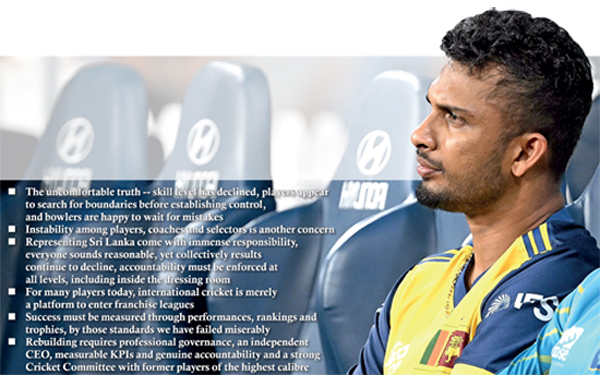
During my playing days, young batsmen were taught to control spin through movement. You either got to the pitch of the ball or went deep into the crease to change the length. That created scoring opportunities through placement and timing. Today, players appear to search for boundaries before establishing control, and bowlers are happy to wait for mistakes.
Game awareness and intelligence are either slowly disappearing or have already disappeared. Dot balls create pressure, pressure forces risks, and risks bring dismissals. One boundary does not compensate for five wasted deliveries. These are fundamentals that should never change, regardless of format. Our batting was historically built on intelligence rather than power-based cricket, for which we do not possess the same physical strength as the West Indians or Australians. Yet today we are attempting to imitate power-based cricket without the required physical attributes.
We occasionally produce one outstanding result and immediately convince ourselves that progress has been made. When we beat Australia, everyone turned a blind eye to the fundamental issues. Many believed the phoenix had risen. Then comes a collapse that exposes deeper weaknesses. This pattern has repeated for years.
Another concern is instability among players, coaches and selectors. Constantly changing selection panels, coaches and captains inevitably impacts team performance. The team entered this World Cup unsure of roles and expectations. Confidence cannot grow amid uncertainty. Cricket, like any long-term project, requires continuity. Sri Lanka needs a clear blueprint that survives political and administrative changes.
I sometimes wonder whether the cricketers of today take as much pride in wearing the national jersey as we did. For us, representing Sri Lanka came with immense responsibility — a responsibility to over 20 million people of this beautiful island.
Under Arjuna Ranatunga, discipline was non-negotiable. Friendships stopped once we crossed the boundary line. You earned your place every single day, regardless of reputation. Today, I sometimes sense a level of comfort among players, regardless of their performances. When poor performances do not carry consequences, standards inevitably fall. Accountability must be enforced at all levels, including inside the dressing room.
I often hear selectors say they have chosen the best available players. Coaches say they worked with the squad they were given. Captains blame conditions. Administrators speak about long-term planning. Everyone sounds reasonable, yet collectively results continue to decline. What does this mean? Is the system itself failing?
I am certain that once the tournament ends, heads will start rolling. This is what we have always done. We react to defeats by changing coaches or altering leadership without addressing structural weaknesses, or by replacing players without truly understanding the real issues. Meanwhile, administration remains largely stable while cricketing outcomes worsen. Sri Lanka Cricket is not a financial institution. Profit margins and balance sheets do not win matches. Success must ultimately be measured through performances, rankings and trophies and by those standards we have failed miserably.
We must also openly discuss the impact of franchise cricket. It has transformed the global game and offers financial opportunities that players cannot ignore. I do not blame cricketers for seeking financial security; a playing career is short and uncertain.
But we must be honest about the consequences. For many players today, international cricket has become merely a platform to enter franchise leagues. Money has replaced the pride of wearing the national jersey. The Sri Lanka cap was once the destination; now it risks becoming a stepping stone.
I think when financial success arrives before technical maturity, priorities shift. Players focus more on survival in franchise environments rather than long-term skill development. Discipline weakens, preparation changes, and technical flaws remain uncorrected because short-format success can temporarily conceal them.
So how can Sri Lanka strike a balance? Unlike India, we cannot impose strict restrictions on players because our financial ecosystem is different. Nor can we ban participation in foreign leagues without damaging our own competition, the Lanka Premier League. However, pretending franchise cricket has no influence would be dishonest. National cricket must remain the pinnacle. If representing Sri Lanka becomes secondary to franchise opportunities, our decline will accelerate.
Another worrying trend is the growing obsession with unorthodox techniques. Sri Lanka benefited from a rare talent like Lasith Malinga, but he succeeded because of extraordinary ability. Such unconventional methods should not become a development model. Today, too many young players are encouraged to be different before becoming technically sound.
Players like Mahela Jayawardene and Kumar Sangakkara always had the ability to return to basics when form deserted them. Strong fundamentals gave them longevity. Players built purely on unconventional methods often struggle when confidence drops and face increased injury risks due to biomechanical stress. At junior level, coaches now face parental pressure demanding instant results and rapid recognition. Development has become rushed, and foundations are sacrificed for short-term success. Cricket does not reward impatience.
I strongly believe cricketing decisions must be made by people who understand the game at the highest level. Elected officials can oversee governance and finances, but the technical direction of the sport should be guided by those who have played at elite level. For this reason, we need a strong Cricket Committee comprising former players of the highest calibre if we are serious about rebuilding.
However, there is a reluctance among many former players to become involved. This is not due to a lack of interest, but because they do not wish to compromise their integrity. I am proud of what cricket has given me, and many former greats feel the same. They do not wish to become part of systems where professional opinions have no place. I also see a lack unity among former players themselves. Privately, they share similar concerns, yet publicly divisions appear, and that separation only slows progress.
Finally, rebuilding requires professional governance, an independent CEO, measurable KPIs and genuine accountability at every level. Grassroots cricket must be strengthened through schools, coaching education must improve, and domestic cricket must become competitive enough to prepare players for international pressure.
Above all, we must restore pride in representing Sri Lanka. Our supporters remain loyal despite repeated disappointments. Stadiums still fill, and hope still exists. That loyalty deserves honesty.
If we rebuild the foundation, success will return. If we continue chasing shortcuts, whether technical, administrative or financial, we will keep moving in circles while the rest of the cricketing world moves ahead. The choice, quite simply, is ours.