

Sunday Times 2
Climate-resilient housing: From rebuilding to belonging
View(s):By Sheri Pitigala, Dipak Dasgupta and Nihal Pitigala
Sri Lanka’s climate crisis is no longer a distant or abstract concern; it is a present economic and social reality. Cyclone Ditwah offered a stark reminder of what lies ahead if current approaches remain unchanged. Frequent and increasingly severe flooding, including worsening monsoons, continues to inundate large parts of the country, damaging or destroying homes and exposing families to escalating hardship.
At the same time, rising temperatures and urban heat are intensifying heat stress, particularly in dense settlements marked by poor ventilation, low-quality construction, and limited green space.

The authors of this article (from left) :Sheri Pitigala, Dipak Dasgupta and Nihal Pitigala
Each major disaster triggers a familiar and costly cycle: emergency relief, partial reconstruction, and relocation schemes that move families away from livelihoods and community support. Recurrent flooding and rising heat undermine household welfare, strain public finances through repeated disaster response and rebuilding, and lock vulnerable communities into cycles of loss, debt, and displacement. While past reconstruction efforts have delivered physical housing—roofs, walls, and basic services—they have often done so at the expense of economic security and social cohesion. Relocation sites are frequently far from jobs, markets, and support networks, leading many to make rational choices and eventually return to informal, high-risk settlements, recreating the very vulnerabilities relocation was meant to address.
This is not a failure of households but of policy design and underdeveloped housing markets that do not serve low-income families under changing climate conditions. The solution is not to rebuild faster after each disaster but to reduce the need to rebuild at all—by reimagining housing as a community-centred, market-enabled development challenge rather than a purely post-disaster welfare intervention.
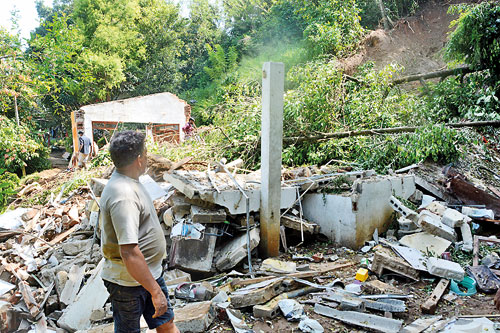
A house damaged by Cyclone Ditwah
A better path: Building a pro-poor market for climate-resilient housing
The alternative is both practical and compelling: to develop a functional, pro-poor housing market for low-cost, climate-resilient homes, anchored in strong community participation and supported by fit-for-purpose public policy. Markets matter because they are the only mechanism capable of delivering affordable, climate-smart housing at scale and over time—rather than through isolated projects dependent on episodic funding. A well-functioning housing ecosystem brings together households, private builders, material suppliers, financiers, insurers, local governments, and community organisations into a coherent delivery model. Housing becomes not just a shelter but a platform for resilience, livelihoods, and local
economic development.
What does this approach involve in practice?
First, a transition toward nature-based and climate-resilient construction materials and techniques: Conventional materials such as cement often appear cost-competitive due to economies of scale, automation, and access to capital. Yet these prices systematically ignore critical social costs, including carbon emissions imposed on future generations, higher disaster vulnerability, and health impacts from heat and poor indoor conditions. When these external costs are taken into account, markets fail by underproducing housing solutions that are socially optimal. By contrast, locally sourced and nature-based materials generate positive spillovers that market prices rarely capture. These include improved thermal performance that reduces indoor heat stress and energy consumption and enhanced resilience that protects household assets from floods and storms.
Second, households must be treated as informed consumers rather than passive beneficiaries: When communities are engaged early—in site selection, housing design, and material choices—outcomes are far more likely to reflect real needs: proximity to jobs and transport, flood-safe but accessible locations, ventilation for heat, and space for home-based enterprises. A well-functioning housing market connects these households to private builders and suppliers who respond to demand for affordable, resilient designs by investing in locally appropriate technologies, skills, and business models. This demand-driven dynamic is essential for scaling solutions beyond pilot projects and embedding resilience into everyday housing decisions.
Third, experience shows that housing solutions cannot be imposed from above: Communities possess detailed knowledge of local flood behaviour, heat exposure, drainage patterns, and livelihood geography that no standardised blueprint can fully capture. Market-based approaches that actively involve communities—through cooperatives, savings groups, and local organisations—allow housing solutions to evolve incrementally and adapt to diverse contexts, from floodplains to hill-country settlements. This participatory model also generates powerful livelihood spillovers. Safer housing shortens post-disaster recovery times, reduces lost workdays, and protects small enterprises. Health benefits from cooler, better-ventilated homes improve productivity and reduce medical costs, reinforcing household resilience. Local production of materials and construction services creates employment where it is most needed.
Finally, the role of government must be catalytic: Through climate-informed building standards, zoning reforms, provision of safe and serviced land close to livelihoods, and targeted incentives, the state can unlock private and community initiative rather than deliver housing directly. The housing market does not fully value the wider benefits of climate-resilient construction, so too little of it is built. When homes are safer, cooler, and more durable, the benefits extend well beyond individual households to communities, the economy, and the public budget.
This creates a strong welfare case for public intervention. Climate-resilient housing generates substantial positive externalities—lower disaster recovery costs, improved health, higher productivity, and reduced emissions—that are not fully reflected in private investment decisions. Targeted government facilitation can help internalise these benefits by aligning private incentives with social returns. By enabling markets for low-cost, locally sourced, climate-resilient housing, this approach corrects structural biases toward carbon-intensive, standardised construction while protecting vulnerable households, supporting local employment, and reducing fiscal exposure to disasters.
This direction is fully consistent with Sri Lanka’s NDC 3.0 (Nationally Determined Contributions (NDCs) under the Paris Agreement), which emphasises systemic adaptation, private-sector participation, and the mobilisation of climate finance. When aligned with disaster risk management strategies, it transforms housing from a recurring fiscal liability into a cornerstone of national resilience.
The case for a new path forward is clear
The evidence is clear: every dollar invested in prevention saves multiple dollars in future recovery costs. For Sri Lanka, where average annual disaster losses already approach half a percent of GDP—and extreme events like Ditwah can erase years of fiscal consolidation—the choice is clear. Continued reliance on reactive reconstruction will lead to escalating costs and deepening vulnerability. Instead, investing in community-driven, market-enabled solutions for climate-resilient housing protects livelihoods, reduces fiscal risk, and restores dignity and agency to affected households.
The next climate disaster is not a question of if, but when. Sri Lanka can either pay again for the same losses—or invest now in a sustainable, community-driven housing ecosystem that prevents them.
(The writers are InreachEconomic Fellows and Distinguished Fellows at TERI. The authors can be reached at sheri.a.pitigala@gmail.com)