


Tracing Sri Lanka’s early medical greats
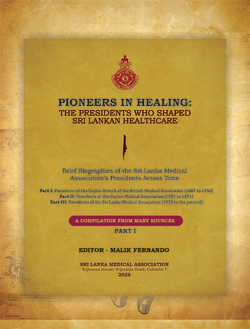
View(s):The story of Sri Lanka’s medical history has largely been limited to the administrative reports of the colonial period, the chronicling of the country’s medical scene in the Ceylon Medical Journal, and the monumental work A History of Medicine in Sri Lanka from the Earliest Times to 1948 by the late Dr. C. G. Uragoda, along with a few other contemporary accounts and monographs. This latest book supplements Sri Lanka’s medical history in several important ways.
First, it stamps the importance of the Sri Lanka Medical Association (SLMA) and demonstrates how its leadership and members have served the cause of the health sector of Sri Lanka for over 135 years. Secondly, it sheds light on some lesser-known medical luminaries who contributed to advancing hospital services, the scientific study and prevention of disease, and who played demanding roles in both peace and wartime for the benefit of the general population. Thirdly, it sheds light on facets of these Presidents who not confined to the field of medicine alone, went on to contribute to politics, the humanities, music, visual arts, drama, conservation, and literature.
Dr. Malik Fernando, himself a past President of the SLMA (1992), has limited his period of research for this volume to the years 1887 to 1950, a time corresponding with the height of British rule in Sri Lanka as well as the years immediately after independence. Two other volumes, succeeding this monograph, are to be published, chronicling an important part of the medical history of Sri Lanka.
The early pages of this book trace the evolution of Sri Lanka’s medical services during the British period, highlighting the central role played by leaders of the Ceylon Branch of the British Medical Association (re-named the Ceylon Medical Association in 1951 and Sri Lanka Medical Association after 1972 ).
Following British control in 1815, healthcare was initially dominated by military needs, with hospitals and medical services managed by the army. The establishment of the Civil Medical Department in 1858 marked a decisive shift to civilian administration and systematic expansion of hospitals across the island. Western medicine gradually replaced earlier systems, aided by vaccination campaigns, missionary activity, and voluntary organisations.
Between 1839 and 1870, Ceylonese with merit were sent to the Bengal Medical College in Calcutta to pursue medicine. Medical education evolved from informal training to structured institutions, notably the Mission Medical School at Manipay and the Colombo Medical School, founded in 1870, which later became the Faculty of Medicine, University of Ceylon. Prominent physician-administrators such as P. D. Anthonisz, W. R. Kynsey, Perry and James Loos shaped both medical policy and professional organisation.
The formation of the Ceylon Branch of the British Medical Association in 1887 provided a lasting forum for professional exchange, marking the consolidation of modern medicine in Sri Lanka. It is within this institutional and intellectual framework that the Presidents profiled in this volume must be understood.
From 1887 to 1950, no fewer than 50 men and one woman served as President of the Ceylon Medical Association. Dr. P. D. Anthonisz, was the first President of the SLMA (1887–1890). Born in Sri Lanka to a Dutch Burgher family, he was one of the first locals to be sent to the Bengal Medical College. The famous Clock Tower in the Fort was erected in memory of his services to the people of the south when he served as Colonial Surgeon – Southern Province between 1858 and 1890.
The brilliant Dr. W.R. Kynsey succeeded him and served no fewer than three terms as President (1890/91, 1893–95, 1896–98). Arriving in Ceylon as a military surgeon, he went on to become the Principal Civil Medical Officer and the Inspector-General of Hospitals. His primary research on the Parangi disease (yaws), supplemented with coloured illustrations by J. L. K. van Dort, laid the scientific foundation for finding solutions to that disease.
The third President was Dr. James Loos (1891/92), another Burgher physician who made a mark in Anuradhapura and the Northern Province, especially during the malaria outbreak in the 1860s. He was one of the chief proponents of the Ceylon Medical College and its first Principal in 1870.
Dr. William van Dort, J. L. K.’s brother served as President during 1900–1903. A French and German scholar, he played a major role in isolating and treating patients during outbreaks of tuberculosis, as well as serving as the Burgher representative on the Legislative Council. Dr. Thomas Forrest Garvin (1903–1904) played a major role at the Diyathalawa Boer War Prisoners’ Camp as Chief Medical Officer.
The first Tamil President was Dr. W. G. Rockwood (1904/05), for eight years the Tamil representative on the Legislative Council. He was succeeded by the first Sinhalese President, Sir Marcus Fernando (1905/06, 1914/15), the first Sri Lankan to receive an MD from the UK (University of London) and a Fellowship of the Royal College of Physicians. He was the first Consultant Physician at the Colombo General Hospital. He later went into politics and business, serving as Chairman of the State Mortgage Bank and was one of the founders of the Bank of Ceylon.
Dr. Albert John Chalmers (1907/08), a Briton, co-authored the Manual of Tropical Medicine, with Dr. Aldo Castellani, in 1910. Dr. Murugesar Sinnetamby (1908/09, 1916/17), the first Ceylonese to receive a Fellowship of the Royal College of Surgeons (Edinburgh) in 1890 transformed the De Soysa Lying-in-Home into a modern hospital and the premier training institute in midwifery.
Dr. Aldo Castellani (1910/11), an Italian medical luminary, was the most colourful of all the Presidents of this period. Little known is that he cured a young boy named S. W. R. D. Bandaranaike of diphtheria in Veyangoda. In his memoirs, Castellani wrote: “So I left Ceylon in January of the year 1915, but a part of my soul remained there. The memory of the Enchanted Island stirs in my heart an emotion which can only be expressed as love. I was a lover of that wondrous country then, I still am, and I shall be to the end of my days.”
Dr. S. C. Paul (1912/13) was the first Sri Lankan to receive a Fellowship of the Royal College of Surgeons (London). His MD thesis contained some of the earliest findings on diabetes. He was the first Surgeon at the Colombo General Hospital. Dr. E. V. Ratnam (1917/18) established the Ratnam Hospital, the oldest surviving private hospital in Sri Lanka.
Dr. Lucian de Zilwa (1919/20) who followed in the footsteps of his mentor, Dr. Marcus Fernando, apart from being the leading gynaecologist of his time, was a skilled novelist, orator, and patron of the arts. Dr. Andreas Nell (1924/25) was an equally gifted polymath. The first Surgeon at the Victoria Memorial Eye Hospital he was a well-known Orientalist and antiquarian. Dr. Frank Arnold Gunasekera (later Sir) (1931/32) was a decorated military surgeon who later served as a politician, first in the Colombo Municipality and then in the Senate.
Prof. W. A. E. Karunaratne (1932/33) was one of the leading medical scientists of his day. He was the first Dean of Medicine when the University of Ceylon commenced in 1942. Dr. H. O. Gunewardene (1933/34) was instrumental in setting up Sri Lanka’s first Department of Radiology and X-ray facility. Dr. Nicholas Attygalle later Sir (1937/38) was responsible for making obstetrics and gynaecology popular in
Sri Lanka. He went on to become President of the Senate as well as the second Vice-Chancellor of the University of Ceylon. Dr. J. H. F. Jayasuriya (1938/39) is well remembered for his services in preventing the spread of tuberculosis.
Dr. May Ratnayake (1943/44), the first and only female President during the period under review was at one time in charge of the Lady Havelock and Lady Ridgeway Hospitals and authored many papers on gynaecology. She was also well known for her work in paediatric surgery. Dr. R. L. Spittel (1944/45) was one of the finest surgeons of his time who travelled widely through the country. He conducted valuable studies on the Veddahs and wrote many books on them and on the wildlife of Sri Lanka.
Dr. E. M. Wijerama, (1947/48), was the first President of the Ceylon College of Physicians. In 1964 he gifted his abode Wijerama House to the SLMA and Ceylon Medical Library. The final President of this period was Prof. C. C. de Silva (1949/50), the first Professor of Paediatrics of the University of Ceylon who was instrumental in starting paediatric studies of Sri Lanka when he was based at the Lady Ridgeway Hospital.
Inevitably, a work of this scope must also confront the limits imposed by archival silences. This work is limited to just short descriptions of these 51 Presidents. Some of the their basic information has not been traced due to the lack of record keeping. This is the gap the next scholar would have to cover.
Taking up this project in his retirement, Dr. Malik has produced a volume that will be referred to increasingly in the years to come.
| Book Review | |
 |
Searching for an ideal partner? Find your soul mate on Hitad.lk, Sri Lanka's favourite marriage proposals page. With Hitad.lk matrimonial advertisements you have access to thousands of ads from potential suitors who are looking for someone just like you.