


From the earliest granite bench to reign of wood
View(s):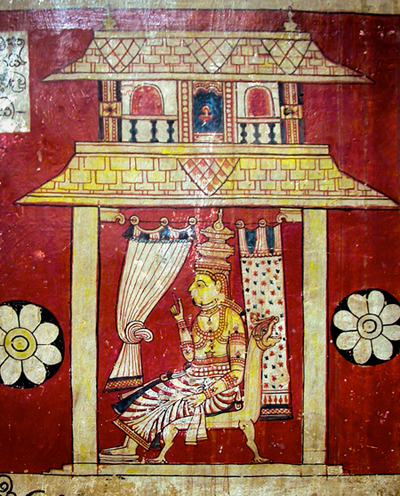
The image on the book cover
Look closely and you see the detail: On the cover of this recently released book is a dignitary seated on a lion-headed chair with animal feet legs. The illustration is from a wall painting from the Suriagoda Raja Maha Vihare of the Kandyan period, a fine representation of the kind of elaborate furniture design in existence then.
The Story of Furniture in Sri Lanka – the latest publication in the National Trust of Sri Lanka’s significant output of coffee table books on history, culture and heritage has a wide sweep in tracing the evolution of furniture in the country from as early as 3BCE and looking at how various socio-cultural influences on indigenous and traditional norms contributed to producing a hybridity of styles.
A decorative arts historian, author Ayesha Abdur-Rahman, is well known as the founder of the non-profit organisation, Lanka Decorative Arts and has organised international conferences on the decorative arts of the country. Her dissertation for her PhD on ‘Sri Lankan Furniture up to the Colonial Period’ which she gained from the Post Graduate Institute of Archaeology (PGIAR), University of Kelaniya and that formed the basis of this book, focused on the development of furniture in Sri Lanka. Her extensive research took her to ancient little explored archaeological sites and Buddhist temples.
There are nuggets of fascinating information that spark the reader’s interest from the start, for instance, how the earliest object of furniture to be excavated was a granite bench or quern (bankku) at the Yattala dagoba site near Hambantota. That stone surfaces were used for sitting and reclining is borne out in the first chapter where the author details the use of granite and stone. The many illuminating examples of the stone beds and brick seats found in monastic sites from Anuradhapura, Mihintale, Sigiriya and Polonnaruwa, all reveal the ancients’ understanding of ergonomics and anthropometrics (the study of the movement of the body). Stone beds were chiselled into the rock surfaces, sometimes three or four parallel to each other, the first phase of this development dating back to the time of Arahat Mahinda and the advent of Buddhism.
The progression to reclining seats is seen in the next stage evident in the early Anuradhapura period followed by the gal asana found in Sigiriya which are well documented. The illustrations of the audience hall in Mihintale and the seat in Kaludiya Pokuna as well as the brick and masonry seat of Pidurangala, clearly depict how they were used.
In Chapter Two, the author takes us to the representations of furniture found in the wall paintings of Polonnaruwa and here we enter the Tivamka Pilimage where the surviving fragments still seen give glimpses of the furniture of the palace and court of the 12th century. Documented by the country’s first archaeological commissioner H.C.P. Bell and later by one of his successors C.E. Godakumbura, the author notes the urgent need for documentation and restoration before they fade away.
‘Wooden Furniture of Kandy’ is Chapter 3, where the shift to wood as a material is best evidenced in Embekke (carved pillars) and certain ambalamas. “Was the Kandyan period furniture a product of the continuing furniture tradition of Sri Lanka, and did the Indian and European furniture design and manner of use influence it”, is a key question the author poses in looking at the period from 1469 to 1815 when the European colonizers first made inroads into the country and the impact of the western styles on local design styles.
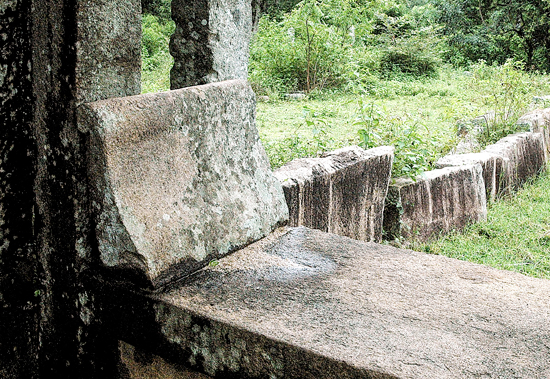
Two-slab bed or reclining granite seat at Western Monasteries
Wall paintings seen in temples such as Suriagoda, Madawala Raja Maha Vihare, Nagolle and Degaldoruwa, depict not just armchairs but other styles of furniture – sofas, rectangular vankku and individual food stands, tall tables and ceremonial throne-like seats. The Degaldoruwa paintings reveal the South Indian and European influences prevalent at the time.
Chapter Four of the book moves to the furniture collection now seen at the Velivita Sri Saranankara Museum at Malwatte, which presents ample scope for further study. As a key force in the revival of Buddhism at a time when it was swamped by colonizing powers, the furniture used by the Thera and that gifted to him occupy ‘a small humble space’ yet are representative of the vibrant revival of the arts and crafts at that time, and the cultural influences of the South Indian craftsmen.
The following chapter looks at the luxury colonial furniture made of precious tropical hardwoods such as ebony and calamanders, collections of which now repose at the National Museum in Colombo and the Dutch Museum in Pettah. Well known, of course, is the Dutch influence seen in the throne gifted to the last King of Kandy – high backed and richly decorated – South Indian and Sri Lankan craftsmanship, the author notes.
It may come as a surprise that the Burgomaster chair, very characteristic of the Dutch VOC period has its origin in South Asia. Jan Veenendaal (from his book ‘Domestic Interiors in the Cape in Batavia) is quoted: “The provisional assumption must be that the burgomaster chair was developed around 1700 in Ceylon by Singhalese or Tamil furniture makers. The clearly European character of the legs and stretchers suggest it originated in Dutch settlements in Colombo and Jaffna”. Other quotes refer to its use as a king’s chair or shaving chair that came to be popular in England.
A brief description of the tropical hardwoods used in furniture making during colonial times such as calamander, jak, ebony, Kolon, kumbuk, mara, palu and satinwood wraps up this informative book that is overall well complemented by very specific illustrations.
| BOOK FACTS | |
|
Searching for an ideal partner? Find your soul mate on Hitad.lk, Sri Lanka's favourite marriage proposals page. With Hitad.lk matrimonial advertisements you have access to thousands of ads from potential suitors who are looking for someone just like you.