


A country without a National Art Gallery is a country without an artistic memory
Sri Lanka’s National Art Gallery, located in Colombo, is not merely a physical structure. It is a repository of the nation’s artistic memory, a space that reflects cultural identity, historical continuity, and creative freedom. Its prolonged closure and incomplete renovation raise serious concerns about how we, as a nation, value our cultural heritage.
The National Art Gallery was established in 1932, during the British period in Ceylon, through the collective efforts of prominent artists, intellectuals, and art lovers associated with the Ceylon Society of Arts. It was conceived as the first state-supported institution dedicated to the visual arts in Sri Lanka. In the early 1950s, responsibility for the gallery was transferred to the Department of Cultural Affairs, under which it functioned for decades as a vital public institution.
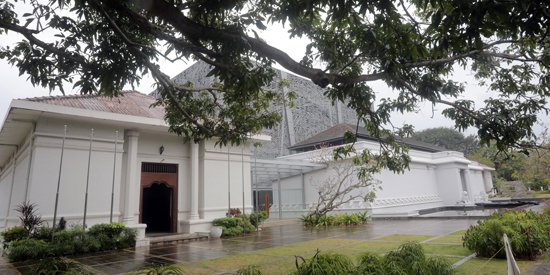
Doors long shut: The National Art Gallery in Colombo. Pic by Nilan Maligaspe
For many years, despite minor structural issues such as roof leakages and the need for conservation work, the gallery remained open and accessible. It hosted permanent collections, temporary exhibitions, and served as an essential educational resource for art students, teachers, researchers, and the wider public. However, instead of systematic maintenance and phased conservation, the gallery was eventually closed, the collection removed, and renovation responsibilities handed over without a transparent or time-bound process. More than a decade later, the project remains unfinished.
A national art gallery is a fundamental institution of any civilised society. Alongside libraries, museums, and universities, it safeguards collective memory and nurtures critical cultural dialogue. In many countries, national galleries function as open classrooms, research centres, and public forums where citizens engage with history, aesthetics, and contemporary ideas. The absence of such a space weakens art education and distances the public from its own cultural heritage.
International examples clearly demonstrate the broader role of national art galleries. Institutions such as the Tate Gallery in the United Kingdom, the Centre Pompidou in France, the National Gallery of Modern Art in India, and the Museum of Modern Art (MoMA) in the United States operate as dynamic cultural engines. They organise annual national exhibitions, curate international and travelling exhibitions, publish research and catalogues, and collaborate across borders. These institutions actively shape cultural discourse while serving millions of visitors each year.
Beyond cultural and educational value, art galleries play a significant economic role. The global art market is one of the world’s major cultural economies, generating billions of dollars annually. National galleries contribute to income generation through cultural tourism, international exhibitions, publications, merchandising, licensing, and professional services. They create employment for curators, conservators, educators, researchers, designers, and technicians. For many countries, art is recognised not only as heritage but also as soft power and cultural diplomacy.
Sri Lanka possesses a rich modern and contemporary artistic tradition that has gained international recognition, particularly within South Asian and postcolonial art discourse. Yet, without a functioning National Art Gallery, the country is unable to properly present, preserve, or promote this legacy.
The prolonged closure represents not only a cultural loss but also a missed national opportunity in education, tourism, and international cultural engagement.
The National Art Gallery is inseparable from the identity of Sri Lanka as a culturally mature nation. Its restoration and reopening should not be viewed as a secondary or symbolic gesture, but as a national responsibility and long-term investment.
It is therefore imperative that authorities give urgent attention to: the transparent and timely completion of renovation work, professional conservation and secure display of the national collection, the reactivation of the gallery with regular national exhibitions, the development of international collaborations and travelling exhibitions, and the inclusion of artists, art historians, curators, and conservators in decision-making processes.
The silence surrounding the National Art Gallery must end. A nation that neglects its cultural institutions risks erasing its own memory. Reopening the National Art Gallery is not merely about restoring a building — it is about restoring confidence in our commitment to culture, creativity, and civilisation.
(The writer is a former Dean and Senior Lecturer, Department of Painting, Faculty of Visual Arts, University of Visual and Performing Arts, former member and Chairman of the Visual Art panel, Department of Cultural Affairs)
Searching for an ideal partner? Find your soul mate on Hitad.lk, Sri Lanka's favourite marriage proposals page. With Hitad.lk matrimonial advertisements you have access to thousands of ads from potential suitors who are looking for someone just like you.