

Sunday Times 2
A new UN chief must either be subservient to US —or get vetoed
View(s):By Thalif Deen
UNITED NATIONS – As a financially stricken UN is looking for a new Secretary-General, who will take office beginning January 2027, the world body is suffering an unprecedented crisis in its 80-year-old existence.
The current Secretary-General, Antonio Guterres, is facing a daunting task battling for the very survival of the UN, with a hostile White House forcing the world body to sharply reduce its staff, slash funding and relocate several UN agencies, moving them out of New York.
The bottom line: the incoming Secretary-General will inherit a virtually devastated United Nations which has to remain subservient to the US.
Addressing the General Assembly last September, President Trump was vociferously anti-UN when he remarked, “What is the purpose of the United Nations? It’s not even coming close to living up to [its] potential.”
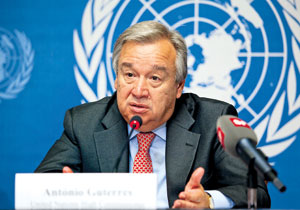
Antonio Guterres: Daunting task
Dismissing the UN as an outdated, ineffective organisation, he boasted, “I ended seven wars, dealt with the leaders of each and every one of these countries, and never a phone call from the United Nations offering to help in finalising the deal.”
Whoever is elected, the new UN chief will have to faithfully abide by the ground rules of the Trump administration, virtually abandoning what the UN stands for, including racial equality and gender empowerment.
“Diversity, equity and inclusion (DEI) policies that were adopted to address historical and structural injustices are being vilified as unjust,” says Volker Turk, UN High Commissioner for Human Rights.
In his 345-page book titled “Unvanquished: A US-UN Saga”, released in 1999, Boutros Boutros-Ghali of Egypt, a former Secretary-General, points out that although he was accused by Washington of being “too independent” of the US, he eventually did everything in his power to please the Americans.
But when he ran for a second term, the US, which preaches the Western concept of majority rule, exercised its veto even though Boutros-Ghali received 14 of the 15 votes in the Security Council, including the votes of the other four permanent members of the Council, namely the UK, France, Russia and China.
In such circumstances, tradition would demand the dissenting US abstain on the vote and respect the wishes of the overwhelming majority in the Security Council. But the US did not.
Unlike most of his predecessors and successors, Boutros-Ghali refused to blindly play ball with the US, though he occasionally caved into US pressure at a time when Washington had gained a notoriety for trying to manipulate the world body to protect its own national interests.
Jesselina Rana, UN Advisor at CIVICUS’ UN Hub in New York and a member of the steering committee for the 1-for-8 Billion campaign for gender empowerment, told IPS, “When key international norms are being openly flouted by certain member states and the veto is used to undermine the very principles the UN was built on, will structural reforms alone be enough to restore trust in the institution?”
Can the UN80 process genuinely rebuild trust in multilateralism, she asked, when the process itself has been opaque and has lacked meaningful civil society participation?
“An accountable and transparent Secretary-General selection process requires stronger and more explicit support from member states.”
A process that is open and inclusive of civil society and grounded in feminist leadership will strengthen the UN’s ability to navigate today’s difficult geopolitical conditions and help rebuild trust in multilateralism, she argued.
After 80 years of male leadership, the next Secretary-General should be a woman with a proven record on gender equality, human rights, peace, sustainable development, and multilateralism, declared Rana.
Felix Dodds, Adjunct Professor at the Water Institute, University of North Carolina, and Associate Fellow, Tellus Institute, Boston, who has written extensively on the UN, told IPS the UN is experiencing challenging times, living through what are probably the most difficult times since the Cold War.
It may not be a bad idea to move some UN bodies. UNDP did a lot of that under Helen Clarke – being closer to the people you are working to help. Maybe it is a cost-cutting issue, but it may also be something that should have been considered before.
“The new SG will need to be someone Trump allows, as he has a veto,” he pointed out.
“Of the candidates we looked at before, the only one that is realistic is Rebeca Grynspan from UNCTAD. She has shown herself to be a good bureaucrat and has led UNCTAD well, as she did for Costa Rica when she was the Deputy President, said Dodds, City of Bonn International Ambassador.
“We may be looking at a man again,” he said, at a time when there is an intensive campaign for the first female secretary-general.
“Clearly, the new secretary-general taking over in 2027 has a daunting task ahead. Whoever it is will have had to make concessions to the P5 on the size and reach of the UN. The present cuts may be just the first set to come down.”
“A UN with a clearer mandate on what it will do may be a result. Stakeholders need to, of course, defend the UN as a critical body for multilateral affairs, but they must at the same time be putting forward reforms that are simple and strengthen the area they are working on.”
There is no way we can get security council reform through—it doesn’t mean it shouldn’t be proposed, but what is realistic in the areas being reformed is that stakeholders and governments can work together on it.
Ultimately, the driving forces should be a more effective UN delivering on the ground. Do reform proposals do that? he asked.
“The organisation has always worked in a world of political pressures. I agree the body should be a place for dialogue and protection of the most vulnerable. UN80 offers an opportunity for dialogue on realistic proposals. “The question is, what are they in the different areas?” he said.