


‘Culture eats strategy for breakfast’ – Australian expert Prof. Dickson during NOCSL seminar
Australian sports governance expert Professor Geoffrey Dickson told Sri Lankan sports administrators that their country stands at a pivotal moment, calling the recently enacted National Sports Associations Regulations as “a tremendous step forward” while cautioning that laws alone cannot guarantee success.
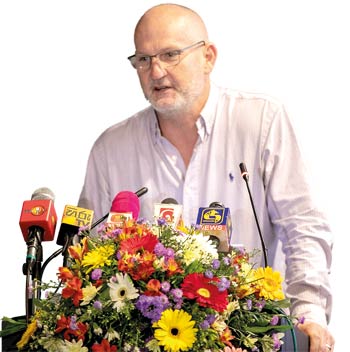
Prof. Geoffrey Dickson
“Culture eats strategy for breakfast,” Prof. Dickson told an audience of National Sports Federation presidents, secretaries and government officials at the National Olympic Committee of Sri Lanka headquarters last week.
“You can legislate governance, but you cannot legislate culture. People must internalise and live those values.”
The La Trobe University academic, who has advised the Australian Olympic Committee and Sport Australia for over two decades, delivered a keynote address at a seminar titled “Strengthening Good Governance in Sri Lankan Sports Organisations,” organised by the NOCSL Education Committee.
Prof. Dickson, who came to Sri Lanka for the first time with ‘high expectations’ shaped by his supervision of Sri Lankan PhD students, paid tribute to the island’s people before diving into his central thesis: that Sri Lanka’s governance reforms of 2025 represent significant progress, but implementation will depend on whether administrators embrace the spirit behind the regulations.
The professor praised several aspects of Sri Lanka’s new sports law, including term limits for directors, requirements for transparency and accountability, and provisions allowing professionals from outside sport to serve on boards. He noted that restricting board members to serving eight years in specific roles and 12 years overall represents best practice.
However, Prof. Dickson identified areas where Sri Lankan sport could learn from Australian models. He expressed concern about constitutional clauses requiring sports federation directors to have competed at national or international level, calling such restrictions unnecessarily narrow.
“Why does being a good athlete help you be the director of an organisation?” he questioned.
“Is it a little bit like SriLankan Airlines saying the only people we can have on our board of directors are former pilots.”
In Australia, he explained, National Sports Organisations actively seek ‘independent directors’ with business acumen, legal expertise or financial skills, regardless of their sporting background. Swimming Australia recently appointed an Olympic middle-distance runner and lawyer to its board specifically for his legal expertise and understanding of high-performance sport, not swimming.
“In Australian sport, we have found a way to value total outsiders because they are independent minds,” Prof. Dickson said.
“They have no baggage. They have no bias because they’re coming from outside the sport.”
The Australian academic advocated for smaller, more efficient boards, noting that most Australian National Sports Organisations maintain between five and nine directors, with none exceeding 12. Sri Lanka’s new limit of 17 directors, while an improvement, still presents challenges for achieving consensus and cohesion, he suggested. Prof. Dickson acknowledged, however, that Sri Lankan sports federations may require larger boards because they lack the paid staff that Australian organisations employ to implement decisions.
“In Australia, when we elect our directors, they think of the big picture and strategy. The paid staff implement it,” he explained.
The keynote also emphasised the importance of board renewal through staggered three-year terms rather than complete changes every two years, and the need for one unified strategic plan rather than competing visions within each sport.
In a practical recommendation, Prof. Dickson proposed establishing a ‘Sri Lankan Sports Governance Standards Benchmarking Initiative’ that would annually compare the performance of National Sports Federations. Such an exercise, involving the Ministry of Sports, the National Olympic Committee, federations and universities, would monitor improvements and identify areas requiring attention.
“In Australia, our three biggest weaknesses are succession planning for directors, evaluating board performance, and professional development of directors,” he revealed.
The seminar, chaired by NOCSL Treasurer Prithiviraj Perera, brought together representatives from across Sri Lankan sport alongside Vice President Niloo Jayatilake and University of Kelaniya Senior Lecturer Anoma Ratnayaka.
“I want you to believe that these regulations are a significant step forward for sports governance in Sri Lanka. The government reforms will only be effective if there is also a change in culture,” Prof. Dickson, who has published extensively on sport management and integrity, concluded.