

News
Rising fuel prices burn a hole in budgets
View(s):By Sajanya Sathanathan
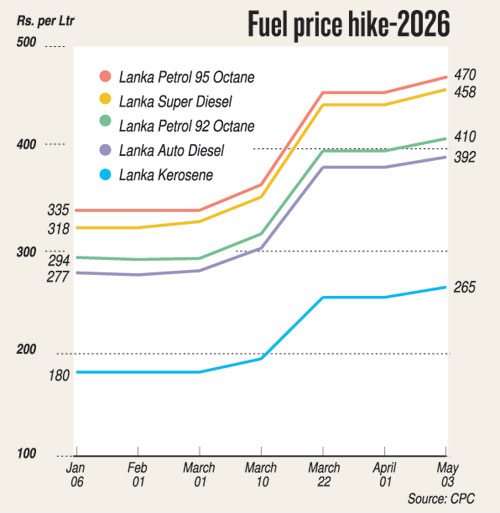
Fuel price increases for the third time in three months and higher cooking gas prices are being felt in the transport services sector by daily wage earners and households.
The fuel price increase has not only burdened consumers but even taxi operators, who are not sure about how to adjust their fares without losing customers.
Prices of a range of other goods and services, too, have been moving up gradually.
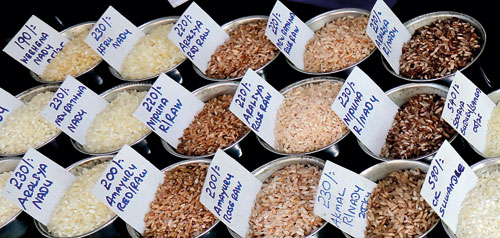
Prices of a range of goods and services have been moving up gradually. Pic by M.A. Pushpa Kumara
Gas prices, too, have been on the rise in recent months, affecting food providers, restaurants and eateries and eventually the consumers.
Samanthi Pathiranage Wijesinghe, 43, widowed mother of two, is finding it difficult to sustain her livelihood as a taxi driver. Three consecutive fuel price increases in three months feel too much.
Ms Wijesinghe told the Sunday Times that for a recent trip from Katunayaka to Kesbewa via the highway, she managed to get only Rs 2,900, which she said was an unreasonable income compared with the cost of fuel.
“What I earn is not enough even to feed us or to buy medicine. We survive with pol sambol and rice or bread, as I do not have any money left to buy nutritious food.’’
With the fuel price increases, those operating taxi services also have seen a demand decline.
All-Island Three-Wheeler Drivers’ Union President Lalith Dharmasekera said taxi hires have dropped significantly and fares cannot be increased further.
He said the real problem is not the recent Rs 12 fuel price increase but the 20-litre weekly fuel quota. “To continue working, drivers are forced to pay extra to gas station employees or the underground market to get more than the fuel quota, which is insufficient for professional drivers.’’
He claims that the National Transport Commission (NTC) has to regulate three-wheeler fares via a gazette and a price formula. However, authorities have failed to implement this regulation, leaving the industry in a state of uncertainty.

Mr Sundaram, 66, has earned his living cutting grass, but lately, survival has become a battle. With employers refusing to raise stagnant wages and no access to financial support, he looks for odd jobs that leave him exhausted and underpaid.
He has to make sacrifices to support his family, such as drinking plain tea at home and saving the milk powder for his son, an educated man who, despite his experience, remains unemployed. To save a few coins, Mr Sundaram now walks, cutting his journey down to two buses instead of three. At home he avoids using the fan despite the heat.
A 50-year-old janitor who survives on a fixed salary is looking for jobs with daily wages so she can manage the daily expenses.
“One cup of plain tea is an energy boost, as we cannot afford food or tea. Sometimes we share food for one meal. We are treated with the lowest level of respect, similar to beggars, and provided with Rs 1,800 for a 12-hour shift but paid for 11 hours, as one hour is deducted for a meal break.”
These female workers, who are aged 70 to 80 years old, come from difficult home situations where family members may have substance abuse issues and travel long distances from areas like Ganemulla, Walpola, and Ragama. They board a train at 4:00am to arrive at work by 6am. “To survive the current crisis, some workers have taken to selling household furniture and their gas cylinders and are forced to take loans.”
While some people are forced to sell their gas cylinders just to survive, others struggle to find refills because they rely on those cylinders for their jobs and to provide for school children.
A man who has been operating a food catering service for schoolchildren since 2024 said he continues only because he has no other job. “The government is increasing the prices second by second without any consideration, which is suffocating people like us who have to survive with financial losses and personal debt.’’
He is frustrated. “I wish to quit the service and find another job, but I do not have the luxury, as I need to manage getting basic provisions, while children’s parents rely on school meals due to their poverty.’’

Parents have asked that fares not be raised, but service providers are not keen to delay increases.
All Island School Children’s Transport Association head Harischandra Pathmasiri said that, beyond fuel, the costs of tyres, engine oil, and batteries have risen. Additionally, new insurance regulations require full payments monthly rather than in instalments, which is nearly impossible to meet without profit, and fare revisions have been discussed.
Beyond school services, the rise in fuel and gas prices has hit office transport and the container shipping industry particularly hard.
Office transport service provider V. Dimuthu has been in the transport industry for 20 years. Fuel prices have increased three times, leading to a monthly loss of about Rs 500,000. He is a month in arrears on his vehicle lease.
He transports about 160 passengers from Kurunegala to Colombo in luxury buses.
Mr Dimuthu said fares cannot be raised because office workers will not be able to afford them. He said he has had to seek financial help from his parents to cover household expenses despite working full-time.
Container Transport Owners Association President Sanath Manjula said the crisis is not limited to fuel price; the costs of lubricants, spare tyres, and batteries have also increased.
Because container transport is typically governed by one-year contracts, it is difficult to adjust prices frequently in response to fuel price increases and drivers’ demand for more money, Mr Manjula said. “There is severe congestion at the port due to Customs verification delays. Drivers are forced to wait in queues for three to four days to load a container, which results in massive fuel wastage as trucks idle for long periods.’’
Apart from higher fuel prices, farmers claim they do not get a good price for the paddy harvest.
Iranaimadu Farmers’ Federation President Muthu Sivamohan, 68, who had been farming since he was 14 or 15 years old, said it costs over Rs 120 to produce a kilogram of paddy. Because the government has set the purchase price at Rs 120, farmers are left without profit or savings.
He suggested at least Rs 140 per kilogram of paddy.
Agri inputs are also a challenge, alongside labour wages that have increased from Rs. 3,000 to 3,500 per day.
| Food, transport, and utilities drive prices higher in April The Colombo Consumer Price Index (CCPI), which consists of a family of indices that measure price change experienced by urban consumers, increased by 5.8 points in April to 201.6 points from the previous month, which represents an increase in expenditure value of Rs 5,380.92 in the market basket. The market basket consists of 12 main groups, of which eight recorded significant changes in April. Food and non-alcoholic beverages, non-food items, housing, water, electricity, gas and other fuels, furnishings, household equipment and routine household maintenance, health, transport, education, restaurants and hotels and alcoholic beverages, tobacco and narcotics are among the main groups The month-to-month change saw an increase of 0.56% Increases in value changes were reported for coconut oil (0.10%), vegetables (0.10%), dhal (0.07%), dried fish (0.09%), eggs (0.04%), sugar (0.02%) and fresh fruit (0.09%), among other items. Increases were also reported for transport (1.47%), housing, water, electricity, gas and other fuels (0.49%) and education (0.07%). The full report is available on the Department of Census and Statistics website. | |
The best way to say that you found the home of your dreams is by finding it on Hitad.lk. We have listings for apartments for sale or rent in Sri Lanka, no matter what locale you're looking for! Whether you live in Colombo, Galle, Kandy, Matara, Jaffna and more - we've got them all!