


Will it, or can it achieve the desired transformation?
A committee that withstood earlier attempts with great authority crumbled under pressure that finally became impossible to manage. The message from the political hierarchy was clear and loud. Step down or be removed. By not cooperating, they would have invited the wrath of the Executive and they decided to bow down ‘gracefully’, respecting the will of the President Anura Kumara Dissanayake.
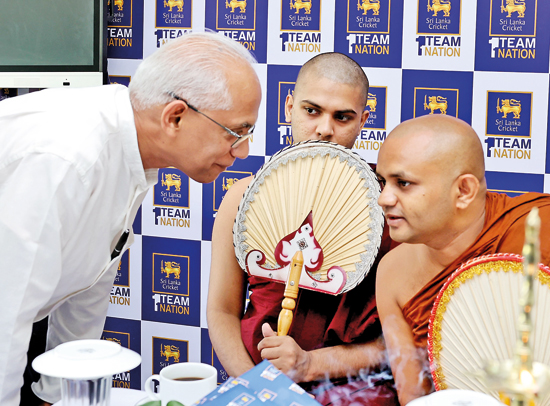
Expectations are sky high and all eyes will be on Eran Wickaramaratne and his team to deliver something more durable - Pic courtesy SLC
Shammi Silva was no stranger to political storms. He had navigated them before, often emerging intact when others had expected his fall. Attempts to dislodge him in 2023 were neutralised. He had the support of the International Cricket Council (ICC) and the money and lawyers to challenge in courts the appointment of an interim committee. The ICC acted as a buffer then. This time, however, that shield appeared flimsier.
Declining on-field results had a huge bearing, as did allegations of financial management and governance standards. Sri Lanka hasn’t been to a knockout stage of an ICC World Cup for over a decade now and the demand for Silva’s head was growing. The government had ignored this for a while. But a complete overhaul is now seen as the only way forward.
Silva’s rise began in February 2019. He was Thilanga Sumathipala’s man. But when opportunity came his way, he grabbed it with both hands and consolidated. What followed was an extended period of control. Four consecutive terms, and three uncontested. That tells the story.
But that stability was not mirrored on the field. The national team continues to slide, producing performances that fluctuated between promise and deterioration. Public frustration grew gradually, much like the accumulation of runs that once defined Kumar Sangakkara at the crease–steady, relentless, eventually overwhelming.
The ICC Men’s T20 World Cup 2022 became a moment of exposure. It did not create the problems, but it revealed the underlying patterns with clarity. A subsequent government inquiry added weight to concerns that had previously been dismissed. Allegations of financial misuse, reportedly involving substantial sums, raised uncomfortable questions about priorities and accountability.
Subsequent global tournaments reinforced the sense of slide. SLC appeared reactive rather than prepared, responding to setbacks without a coherent framework. The gap between potential and performance widened.
Public discontent increased. So did the campaigns calling for the board’s sacking. A government that had soft-peddled the cricket administration for many moons finally decided to act on the public calling.
The message was conveyed with clarity. Resignation was presented as the way forward, with removal the alternative. By that stage, there appeared to be an understanding with the ICC, enough to ensure that the transition would not trigger immediate sanctions over political interference.
The exit, when it came, was controlled. There were no protracted legal disputes, no resistance. An emergency meeting of the Executive Committee formalised what had already been decided. Some within the administration questioned the absence of a written directive. In the end, those concerns carried little weight.
Soon after the exit, the government took control using provisions in the Sports Law and appointed a nine-member committee to run cricket for an unspecified period of time.
The Sri Lanka Cricket Transformation Committee, as it is called, is chaired by Eran Wickramaratne, banker turned politician. The composition of the committee is notable. Sidath Wettimuny, Kumar Sangakkara, and Roshan Mahanama give it a credibility that is difficult to challenge. They are joined by professionals from outside the playing sphere, including Prakash Schaffter, Avanthi Colombage, Dinal Philips, and Upul Kumarapperuma.
Wickramaratne has identified two core priorities: governance and performance. Governance has long been the fault line and, thus, implementing a new constitution is a priority of the new administration.
“Our immediate priority is a total overhaul of the governance framework at SLC,” Wickramaratne said in a brief statement.
“The cornerstone of this effort will be the implementation of the new constitution, ensuring it serves as a robust, modern foundation for the sport.”
A blueprint had already been finalised by a committee headed by Justice K.T. Chitrasiri, which proposed a complete overhaul of the administrative structure three years ago. Implementing this is what the new administration intends to do.
The second pillar is performance. Sri Lanka’s struggles on the field are not rooted in a shortage of talent but is a result of systemic inconsistency.
“We will focus on establishing the structures, world-class facilities, and incentive models necessary to empower our national teams,” the statement said.
“Our goal is to enable our players to consistently deliver world-class performances and elevate Sri Lanka back to the top tier of international rankings.”
Wickramaratne’s intent is evident. But intent, alone, has rarely been enough. What has often been lacking is the resolve to push through resistance, particularly when reform threatens established interests. Sri Lanka Cricket does not require cosmetic change. It needs a cultural shift–from patronage to accountability, from improvisation to structure, from influence to merit.
These are not new ambitions. Similar commitments were made in the past, notably during reform efforts in 2015. The language has not changed significantly. The outcome must.
What happens next will define more than a transition. Constitutional reform, structural realignment and performance systems have all been attempted before. Each time, they began with conviction. Execution faltered, every time. Now, however, expectations are sky high and all eyes will be on Wickaramaratne and his team to deliver something more durable than cosmetic changes.