


One compost pit, one home garden, one village at a time
View(s):As Sri Lanka continues to face the twin challenges of extreme weather events, economic crises and rising food prices, a grassroots agricultural initiative in the Southern Province is offering farmers a practical pathway toward food security and sustainability.
A community-based composting programme organised by the Faculty of Agriculture, University of Ruhuna, in collaboration with IAAS SL Ruhuna and AGRIRES Lanka, recently brought together nearly 78 farmers from Madauyangoda village in the Hakmana area for hands-on training in organic fertilizer production.
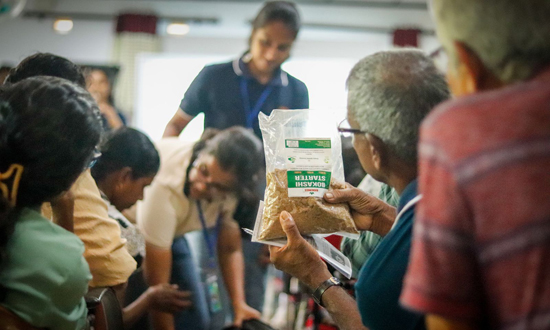
Hands on: Students explaining the process at the workshop
Held at the Madauyangoda Agrarian Service Centre the programme conducted under the theme “Thirasara Rahasak Sarusara Polawak” (A Sustainable Secret for a Prosperous Field) focused on empowering smallholder and household-level farmers with simple, low-cost composting techniques that enable them to produce their own organic fertilizer while reducing dependence on expensive chemical inputs.
The programme introduced farmers to two effective and environmentally friendly composting methods: Bokashi composting and vermicomposting. Both techniques were demonstrated in a practical, easy-to-understand manner.
In Bokashi composting, a rapid organic waste recycling method, relies on beneficial microorganisms and operates under anaerobic conditions, meaning it does not require oxygen. Farmers learned how kitchen waste, crop residues, and animal manure can be layered with Bokashi inoculant in airtight containers. Within a few weeks, this process converts waste into nutrient-rich organic fertilizer that enhances soil fertility and plant growth.
Trainers emphasized that Bokashi composting is particularly suitable for household and small-scale farming due to its minimal space requirements, low odour, and fast decomposition rate.
Equal importance was given to vermicomposting, which uses Tiger worms (Eisenia fetida) to transform organic waste into high-quality compost. Participants observed how the worms break down organic matter into a fine, dark compost rich in essential nutrients such as nitrogen, phosphorus, and potassium. Experts explained that vermicompost also improves soil structure, enhances water-holding capacity, and promotes beneficial microbial activity in the soil.
Vermicomposting is especially effective for vegetable cultivation, seedling production, and home gardens. Unlike chemical fertilizers, vermicompost releases nutrients slowly. Farmers were encouraged to establish small vermicompost units using simple, low-cost containers.
To ensure immediate adoption of the techniques taught, each participant received a Bokashi compost starter pack along with radish seeds.
With academic guidance from Professor I. R. Palihakkara of the Department of Crop Science and Professor S. Rajika Amarasinghe of the Department of Soil Science, Faculty of Agriculture, University of Ruhuna, and full institutional support from the university, the initiative was organized by IAAS SL Ruhuna in partnership with AGRIRES Lanka, with generous sponsorship provided by Ms. B. U. Hansi Dayanath, Founder of AGRIRES Lanka. Additional support from BioKings came by way of contributing training materials and composting resources.
Students from the Faculty of Agriculture worked closely with farmers offering hands-on guidance, gaining valuable field experience for students. Farmers who attended the programme appreciated its practical focus. Several participants expressed interest in sharing the techniques with neighbours and family members.
While modest in scale, the Madauyangoda composting programme illustrates how sustainable agriculture can begin at the household level one compost pit, one home garden, and one village at a time.
Searching for an ideal partner? Find your soul mate on Hitad.lk, Sri Lanka's favourite marriage proposals page. With Hitad.lk matrimonial advertisements you have access to thousands of ads from potential suitors who are looking for someone just like you.