


How the pull of energy shaped her path
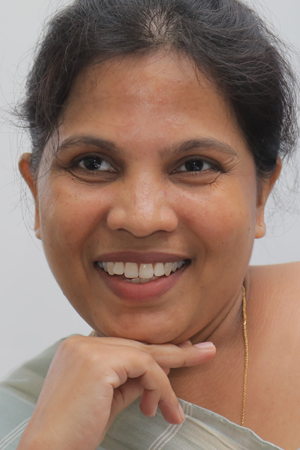
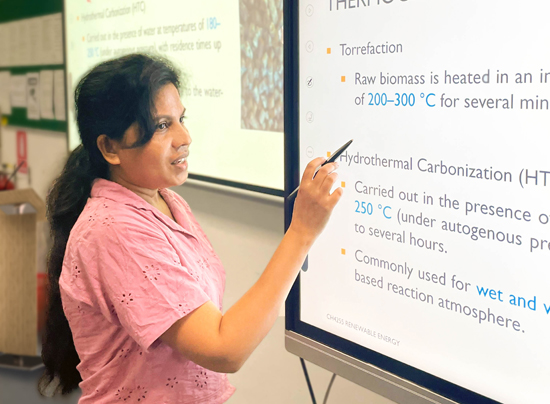
Prof Duleeka Gunarathna. Pic by M.A. Pushpa Kumara and below, engaged in one of her favourite pursuits -- teaching
That February day was auspicious for scientist Dr. Duleeka Sandamali Gunarathne.
It was the day on which she faced her final interview to gain her professorship at the Department of Chemical and Process Engineering of the prestigious University of Moratuwa.
It was also the day on which she won the much-vaunted 2026 OWSD-Elsevier Foundation Award for Early Career Women Scientists from the developing world. She is one of the top five “pioneering” scientists who have been recognized as “shaping” the future of sustainable energy from the Global South. (See box)
……And as 2026 draws to a close, chemical and process engineer, Prof. Gunarathne from Sri Lanka, will stand beside a civil engineer from Guatemala; an organic chemist from Syria; a physicist and materials scientist from Kenya; and a climate–energy scientist from Togo at a leading international conference, to receive her award. It will be the 21st Conference on Sustainable Development of Energy, Water and Environment Systems (SDEWES) to be held from August 30-September 3 in Gran Canaria, Spain.
“Energy and waste are two major challenges in developing countries. Sri Lanka has a large amount of under-utilized biomass resources, while biomass is also a primary energy source in Sri Lankan industries,” says Prof. Gunarathne, explaining that her work focuses on converting biomass such as energy crops and agricultural waste into improved solid and gaseous fuels, as well as advanced materials for energy storage and other applications.
To the uninitiated, she goes onto explain that biomass is renewable organic material that comes from plants and animals.
It is on Monday that we meet her at her second home that is the Moratuwa University to dwell not only on her research and its applications but also other contributions to the energy sector.
With enthusiasm, Prof. Gunarathne elaborates on how she enjoys teaching energy-related undergraduate and postgraduate courses. She has been the co-developer and founding coordinator of the MSc (Master’s) programme in Energy for Circular Economy at the Moratuwa University, jointly offered by four Sri Lankan state universities. It had been developed with the support of European Universities under the Erasmus+ Capacity Building Grant.
She is also sought as a technical expert for energy related assignments by both the government and industry. She contributes as a reviewer for international and national level research funding schemes and engages in editorial and reviewer roles for international peer-reviewed indexed journals in the energy sector.
When asked what set her on this illustrious journey – this passion for energy – Prof. Gunarathne brings under the spotlight her undergraduate internship at a dairy processing plant in Kurunegala. “I found myself more interested in utility areas than in core process operations sought after by others,” she says, referring to her fascination with boilers et al.
Even at university, the energy-pull realization had been obvious – better performance in energy-related subjects within the curriculum which led her to pursue a minor in Energy Engineering during her undergraduate studies, followed by an MSc and PhD (doctorate) in the same field.
Growing up in the village of Kadawalagedera about 20 kilometres from Kurunegala, Prof. Gunarathne recalls how her parents, especially her mother, was insistent that she and her younger sister and brother concentrate on their studies. It was their first priority. For young Duleeka, early education was at the village school of Dharmavijaya Maha Vidyalaya, Kadahapola. On doing well at the Grade 5 scholarship examination, it was to the Maliyadeva Girls’ College, Kurunegala, that she got admission, where she sat the Ordinary Level and the Advanced Level examinations.
Next it was entry to the Moratuwa University’s Faculty of Chemical and Process Engineering, passing out as an engineer with B.Sc (Honours) in 2007.
Laughingly acknowledging that she was a typical “studious” girl, she says that after graduation, a 10-month stint followed as a temporary instructor at the faculty, after which she joined the National Engineering Research and Development Centre in Ja-ela where she remained for four years, coming back to her base of Moratuwa thereafter.
Marriage followed in 2010, heading to Stockholm in Sweden in 2012 for her PhD and once again returning to the Moratuwa University in 2016.
She has been and still is an avid reader of adventure, mystery and detective novels, while travelling is also a major hobby.
Focusing on challenges that scientists in developing countries face, Prof. Gunarathne says they include limited financial resources and infrastructure and periods of financial constraints with no active research funding.
“I do not see being a woman as a major challenge, as there are many opportunities available now such as through organizations like OWSD. However, the representation of women in the energy sector remains low due to the nature of the field,” she says.
When asked what of the future, this scientist says she is bent on extending biomass research to push boundaries in the energy sector.
“Our research team is developing a state-of-the-art laboratory dedicated to advanced materials processing, which will enable further expansion of our work,” she says, giving as her vision the education and mentoring of more and more young people to become future leaders in the energy sector.
For, Prof. Gunarathne has tremendous appreciation for her own mentors who have shaped her journey since childhood and the OWSD and Elsevier Foundation for recognizing her work through this award.
| The award | |
| The 2026 OWSD-Elsevier Foundation Award recognizes five outstanding early career women researchers from the Global South and the chosen were researchers whose work is advancing affordable, reliable and sustainable energy, a field that is central to global development and climate priorities. “Winners are selected not only on the basis of their impactful research, but also on their strong commitment to capacity building and to their communities,” stated a media release from the organizers of this annual award. It elaborated that this year’s awardees have harnessed their expertise to advance UN Sustainable Development Goal (SDG) 7: ensuring access to affordable, reliable and sustainable energy for all. The 2026 winners’ research demonstrates the power of collaboration and innovation in tackling urgent energy challenges. From solar-powered refrigeration for rural health centres, to geospatial modelling for forecasting community energy demand, these scientists are driving meaningful change in their regions. Their achievements go beyond the laboratory and each has demonstrated remarkable dedication to mentorship, inclusion and supporting their communities, the release said. Dr. Gunarathne has been selected for her work on biomass thermochemical conversion technologies and her commitment to sustainable energy education. She has pioneered practical solutions for clean energy, mentored future professionals and contributed as a technical expert to national and international energy initiatives, it stated. The other four winners are: Cristina Dominguez (engineering sciences) of Guatemala; Ghafi Kondi Akara (physics) of Togo; Tabitha Awuor Amollo (physics) of Kenya; and Fadia Alhaj Hussien (chemical sciences) of Syria. The awards given in partnership by the Organization for Women in Science for the Developing World (OWSD), a programme unit of UNESCO, and the Elsevier Foundation had been announced ahead of International Women’s Day on March 8. Inaugurated in 2013, the awards have championed the achievements of 84 women scientists from 38 developing countries. |
Searching for an ideal partner? Find your soul mate on Hitad.lk, Sri Lanka's favourite marriage proposals page. With Hitad.lk matrimonial advertisements you have access to thousands of ads from potential suitors who are looking for someone just like you.