


Phasing out para-tariffs
View(s):The panel discussion theme, “Trade and Macroeconomic Challenges in South Asia”, was timely. I felt that it is especially relevant to Sri Lanka’s current situation. Having endured a series of shocks, a debt default, and an economic crisis since 2022, Sri Lanka has been on a recovery path over the past three years.
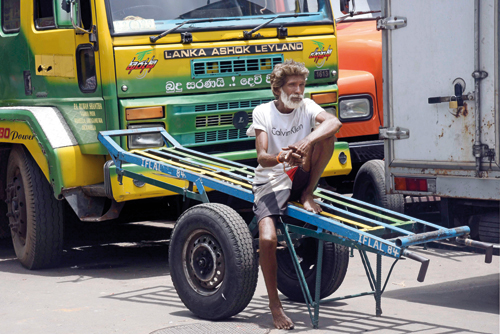
Even ‘Natamis’ like this worker in Pettah are affected by para-tariffs on their food bill.
Yet today, Sri Lanka is grappling with serious policy challenges in trade and macroeconomic stability. Few seem to grasp the gravity of the issue. Over the past three years, people have made significant sacrifices to restore stability, but this hard‑earned progress cannot be sustained without a breakthrough in trade performance.
Without stronger trade outcomes, not only is macroeconomic stability at risk, but so too are the prospects for income growth, job creation, poverty reduction, and debt repayment.
Openness, interchanged
At the outset of the panel discussion, moderator Dr. Zaidi Sattar drew a striking contrast between India and Sri Lanka. In the 1990s, India was only beginning its difficult journey toward trade liberalisation. At that time, Sri Lanka—having embarked on its liberalisation as early as 1977—was already seen as South Asia’s most open economy.
Today, however, the positions are reversed: India has advanced far in liberalising trade and integrating globally. Sri Lanka has backtracked and become one of the most restrictive economies in Asia.
A key milestone in Sri Lanka’s earlier openness came in 1993, when the country removed nearly all exchange controls on current account transactions. This reform enabled Sri Lanka to meet the IMF’s Article VIII obligations, which require free payments and transfers for international trade and services. Compliance marked the country’s formal acceptance of IMF rules on current account liberalisation and underscored its commitment to integration into the global economy.
End of the journey
 The 1990s marked the last time Sri Lanka was widely recognised for its open economy and trade liberalisation journey. Since the mid 2000s, however, the country began reversing course, and its trade performance steadily deteriorated. In contrast, India advanced its reforms and deepened global integration.
The results are stark: India recorded an impressive increase in its exports value 10-times reaching US$445 billion in 2025. Sri Lanka improved its exports only 2.5 times accounting for $13.5 billion in 2025.
In fact, we should be now getting ready to celebrate 50 years of trade liberalisation by next year. What is striking is our trade performance for the past 50 years – merchandise exports and service exports both remain about $20 billion and foreign investment about $1 billion.
There is a critical need for better trade performance, and for that matter winning investor confidence. However, rising tourism earnings and increasing remittance flows seem to have come back again in cushioning the underperforming external finance position of the country.
Para-tariff region
The keynote speech at the SANEM Conference was delivered by Franziska Ohnsorge, Chief Economist of the World Bank for South Asia. The speech was based on the latest issue of the World Bank’s South Asia Economic Update (April 2026) on the implications of trade reforms.
When it is about trade, South Asia as a region still remains the world’s most protected region in spite of there being variations across individual countries. Unlike other regions in the world, South Asian countries are integrated more with the rest of the world than with their own regional peers.
A unique characteristic of South Asia’s protectionist regime is the existence of para-tariffs – in fact, “South Asia is the world’s para-tariff region”. Most probably, the South Asian countries seem to have invented the para-tariffs.
They did so, on the one hand to secure government’s tax revenue which they thought declining with trade liberalisation. On the other hand, these countries wanted to keep their protectionist regimes insulated from competitive waves of their own trade liberalisation policies, as businessmen benefitted from protection had a strong lobby for protection.
Nullifying reforms
Para-tariffs are additional taxes and levies imposed on imports, beyond the standard customs duties. South Asia has become known as a region where these charges are unusually widespread and burdensome, nullifying trade liberalisation reforms and becoming protectionist barriers.
As per the Sri Lanka Customs National Imports Tariff Guide 2025, the government collects many taxes and fiscal levies: Customs Duty, Export Development Board Cess (CESS), Port and Airport Development Levy (PAL), Excise (Special Provisions) Duty, Value Added Tax (VAT), Special Commodity Levy (SCL) and Surcharge Social Security Contribution Levy (SSCL).
Out of this list, Customs Duty is the tariff. There are four types of para-tariffs – CESS, PAL, SCL, and SSCL. Excise (Special Provisions) Duty is a domestic excise tax, while VAT, a general consumption tax. In general Customs Duty, Excise Dity and VAT (or any other similar domestic consumption taxes are quite common types of taxes applied on imports in most of the countries, although their rates could be different.
Sri Lanka’s import taxes and levies are unusually numerous and, levied in complex ways making it uncertain and difficult to understand. Some taxes are applied on the top of other taxes so that even the “tax is taxed” on businesses. Special commodity taxes are often changed overnight giving some businessmen an undue gain over others and making doing business in Sri Lanka risky.
Poverty and para-tariffs
At last, para-tariffs are now scheduled to be phased out gradually as reported in early 2024, which was also recommended under the IMF-assisted economic recovery programme. Instead of taking this as a positive move towards trade liberalisation, investment promotion and better trade performance, some are worried about the negative implications of the move.
The April 2026 South Asia Economic Update provides evidence-based answers to these issues and confirms the expected performance after the removal of para-tariffs. Linking industrial policy with trade liberalisation, the report suggests that both are necessary to accelerate trade performance and integrate more deeply into global value chains, while creating job opportunities to educated people.
Poor households spend a larger share of income on basic needs – food, clothing, construction materials and simple manufactured items. These are exactly the sectors where para-tariffs were highest. Therefore, removing the para-tariffs lowers prices of basic needs, so the poor feel the relief more directly.
Input costs
Imported input costs will be lower for small manufacturers and farmers such as fertiliser, machinery, chemicals and textiles as well as for large firms exporting to international markets. As production cost declines, consumer good prices will fall too. Exported goods will also be more competitive in global markets.
Multinational firms tend to prioritise low‑cost and predictable input markets when choosing production locations, since these conditions reduce uncertainty and improve efficiency. This reform can make the country more attractive for foreign direct investment in assembly, processing, and logistics hubs—critical nodes in modern supply chains—positioning Sri Lanka as a competitive base for regional and global production networks.
Lower input costs give firms the incentive to expand production, which in turn generates demand for younger and more skilled workers. This dynamic supports a gradual shift away from low‑productivity, protected sectors toward higher‑productivity manufacturing and services that are naturally more integrated into global supply chains. Over time, such a transition strengthens workforce capacity and skills, laying the foundation for deeper and more sustainable integration into international production networks.
Misleading idea
The idea that para‑tariffs strengthen government revenue is misleading. The report shows that removal of para-tariffs will lower the government revenue from trade taxes but improves it much more from non-trade taxes. It is because the removal of para-tariffs allow revenue from income taxes, corporate taxes and other domestic taxes to rise as the economy begins to expand.
In conclusion, the South Asia Economic Update 2026 confirms that Sri Lanka’s para-tariff phase out reduces costs, boosts competitiveness, and signals openness to trade and investment. These changes make it easier for domestic firms to join regional and global value chains, attract FDI, and transition labour toward sectors with higher productivity and export potential.
The report rightly cautions that para‑tariff phase‑outs cannot be pursued in isolation. While removing para-tariffs lowers input costs and signals openness, the full benefits will only materialise if accompanied by complementary reforms. Labour market adjustments are essential to help workers transition from low‑productivity, protected sectors into higher‑productivity industries.
At the same time, investment liberalisation is needed to attract foreign capital and integrate Sri Lanka more deeply into global supply chains. In other words, para‑tariff removal is only one piece of the puzzle—without parallel reforms in labour and investment, the gains from trade liberalisation risk becoming partial and unsustainable.
(The writer is Emeritus Professor at the University of Colombo and Executive Director of the Centre for Poverty Analysis (CEPA) and can be reached at sirimal@econ.cmb.ac.lk and follow on Twitter @SirimalAshoka).
Hitad.lk has you covered with quality used or brand new cars for sale that are budget friendly yet reliable! Now is the time to sell your old ride for something more attractive to today's modern automotive market demands. Browse through our selection of affordable options now on Hitad.lk before deciding on what will work best for you!