


Rising on a firm foundation of faith over more than a hundred years
It is now the tallest church in the world.

Rich in symbolism: The ornately carved Nativity facade of the church. Pix by Christophe Ludwig
On February 20, 2026, as the upper arm of a cross was precisely placed on the Tower of Jesus Christ, Barcelona’s La Sagrada Familia reached a staggering height of 566 feet (172.5 metres). At the base of the cross made of glass and ceramic is engraved the line ‘You alone are the Holy One, you alone are the Lord, you alone are the Most High’, a reminder that impressive architecture aside, churches are all about faith and worship.
World Heritage Site and pride of the Spanish city it may be but Barcelona’s Church of the Sagrada Familia or Expiatory Temple of the Holy Family, though on every visitor’s agenda, is often perceived as the surreal creation of an eccentric architect where Catalan Modernism, Art Nouveau, neo-Gothic, Moorish and even touches of primitive African design all co-exist in some mystical harmony. It is all that. And yet so much more as we were to discover on a visit last year – coming away awed by its overarching spirituality and the amazing vision of its architect Antoni Gaudi.
On June 10 this year, Pope Leo XIV will visit the Sagrada Familia to mark Gaudi’s 100th death anniversary. It is not the first Papal visit to this Basilica so long a work in progress – Pope John Paul visited in 1982 and Pope Benedict XVI was there in 2010 to consecrate it as a Basilica.
Still shrouded in scaffolding and surrounded by cranes, construction of the Sagrada Familia, has been a miraculous, if arduous saga, stretching over a century.
It is Gaudi’s life’s work, a man so far ahead of his time that it is still hard to fathom how the Barcelona city authorities approved his plans for a church so far removed from the classic or Gothic mould that was the norm then. Gaudi was an outsider. Born on June 25, 1852, the youngest in family of five, he was a sickly child and spent most of his childhood in the family’s country house in Riudoms, before coming to Barcelona aged 17, to study at the School of Architecture. Gaining his degree when he was 26, there were still questions about his ability, the school’s director famously quoted as having said, “I do not know if we have awarded this degree to a madman or to a genius; only time will tell.”
Gaudi was also not the first choice for a church dedicated to the Holy Family that a devout Catholic bookseller and printer Josep María Bocabella y Verdaguer envisioned after a visit to Rome. Work on the building began on St. Joseph’s Feast, March 19, 1882, but within a year, its first architect Francisco de Paula del Villar y Lozano gave up the commission and it was the 31-year-old Gaudi who stepped in. Fittingly both Bocabella and Gaudi have their final resting place within the crypt of the Sagrada Família.

Inspired by nature: A wondrous play of light throughout the day
Gaudi initially worked on the Sagrada alongside some of his great designs which are today Barcelona landmarks like the Casa Batllo or Park Guell but it was the church that became his grand obsession. In the last 14 years of his life, he worked exclusively on the Sagrada, living a Spartan existence in his workshop on the premises. His death at the age of 73 was shocking. Crossing the street on his way to confession at his favourite church of Sant Felip Neri, he was hit by a tram and mistaken for a beggar, being shabbily dressed, was taken to the Santa Creu hospital for the poor in the Raval. It was only much later when he didn’t return that the chaplain of Sagrada went looking for him. Gaudi died three days later, on June 10, 1926. It is said the whole of Barcelona turned out for his funeral.
Thankfully Gaudi’s vision did not die with him. As in the great cathedrals all over the world, many have laboured to see the Sagrada rise. His plans were faithfully executed by his assistants but even then there were huge obstacles, not least the lack of funds. When his workshop was burnt in the Spanish Civil War, it took the diligent efforts of several architects to painstakingly piece together his intent from other notes and documents that survived.
Seeing the Sagrada merely from the outside, its soaring spires and ornate entrances decorated with heavily detailed sculptures, it is impressive if hard to decipher, so rich in symbolism is every figure, carved in stone. Built in the shape of the Latin cross, the church has five naves, three façades (the Nativity, the Passion and the Glory) and eighteen towers (12 for the Apostles, four for the Evangelists, one for the Virgin Mary, and one dedicated to Jesus Christ). The just-completed Jesus tower is intentionally a few feet less than the height of the Montjuïc mountain close to the city for Gaudi was adamant that man’s work should never surpass God’s creation.
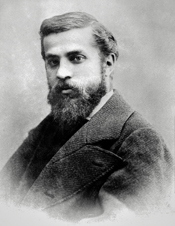
Antoni Gaudi
While from the outside, the Sagrada is imposingly, impossibly, elaborate, once inside, the feeling changes. An aura of sanctity, of light and tranquillity envelops you. The crowds milling around fade. You have only to look upwards and Gaudi’s vision that this should be a symphony with nature makes perfect sense – the columns reaching up like the spreading branches of trees embracing the sky, like a mystical forest. In his own words: “Do you want to know where I found my model? An upright tree: it bears its branches and these, in turn their twigs, and these in turn, their leaves. And every individual part has been growing harmoniously, magnificently, ever since God created it.”
The Sagrada Familia booklet describes his intent: “Gaudí’s idea that the interior of the Temple should be like a forest, encouraging spirituality, elevation of the soul and prayer, and suitable for holding communion”.
Then there are the breathtaking jewel-bright stained glass windows, again designed to inspire reflection. Gaudi’s genius plotted the sun’s rays through the day streaming through, lighting up the stained glass, so no moment is the same. The morning sun falls on the Nativity facade at the entrance – this is where life begins and the evening rays illuminate the Passion facade symbolising the end of life. Gaudi was only able to see the Nativity facade completed in his lifetime.

Jewel bright: Stained glass window inside La Sagrada Familia
Gaudi was also fascinated by mathematics and the sound geometric principles behind the church’s design continue to astound modern architects.Hyperboloid vaults, catenary arches, fractals all figure prominently.
In June 2025, Pope Francis issued a decree declaring that Gaudi would be ‘Venerable’ – placing him thus on the path to sainthood – this for the man who never sought honour and recognition but through his work has come to be known as ‘God’s architect’.
Awe mingles with sadness as we leave the Sagrada Familia. Awe at this truly inspiring creation and sadness that this man who dedicated much of his life to it did not live to see it completed. But it seems he was content to leave it in God’s hands. “There is no regret that I cannot finish this church. I will grow old but others will come after me. What must always be conserved is the spirit of the work, but its life has to depend on the generations it is handed down to and with whom it lives and is incarnated,” Gaudi wrote.
A hundred years after his death, Antoni Gaudi’s work is nearly done.
Searching for an ideal partner? Find your soul mate on Hitad.lk, Sri Lanka's favourite marriage proposals page. With Hitad.lk matrimonial advertisements you have access to thousands of ads from potential suitors who are looking for someone just like you.